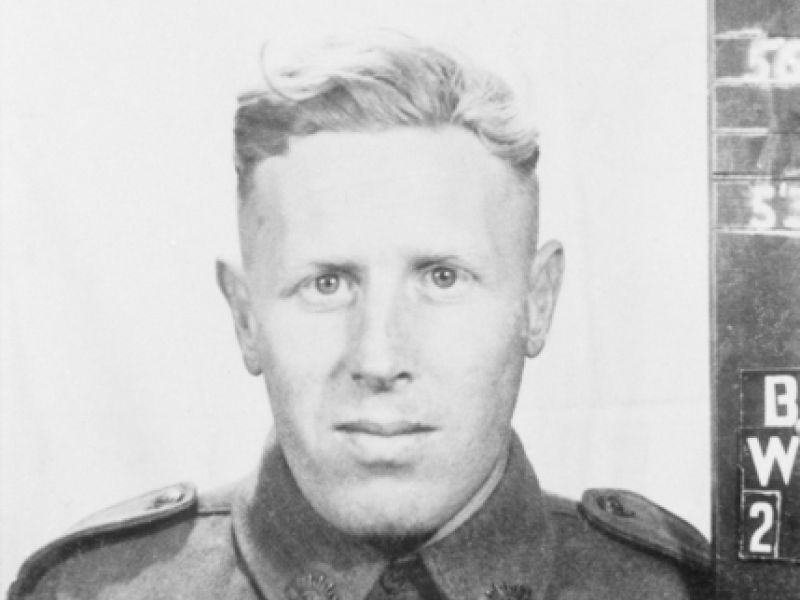
Gunner Daniel Patrick Ryan, 3rd Light Anti-Aircraft Regiment
 Australian War Memorial
Daniel Ryan was born in Bendigo, Victoria on 7 April 1918, to Daniel and Ivy Ryan. The couple had nine children between 1912 and 1925, six girls and three boys; Daniel was the middle child and eldest boy. When Daniel was fourteen his father died at the age of 42. Sometime after this, Ivy and some of the children, including Daniel, moved to the Melbourne suburb of Burnley. By 1939 he was still single and was employed as a rubber worker.
Ryan enlisted in the Australian Imperial Force on 21 June 1940. By August he had been posted to the 3rd Light Anti-Aircraft Regiment at Werribee. On 29 December, the unit embarked for overseas service aboard the ocean liner, now troopship, Mauretania. At Colombo they transhipped to HMT Devonshire. Sailing through the Suez Canal, the ship disembarked the men at Haifa in Palestine on 31 January 1941.
The 3rd Light Anti-Aircraft Regiment was initially stationed near Gaza, and on 5 February they were visited by Prime Minister Menzies. Sergeant Hugh Hill said that after being made to stand for two hours along the road the boys were wild. Next day one of the regiment’s three batteries, the 8th, was sent to Tobruk to aid in the besieged garrison’s defence.
Later in February, Daniel was caught absent without leave, his second offence. For being absent only 24 hours, he was fined a whole month’s pay and had to serve 28 days in custody at the detention barracks. He was released on 19 March.
In early April, as the Allied expeditionary force arrived in Greece, the remainder of the 3rd Light Anti-Aircraft Regiment set out for Amariya in Egypt. There the regimental headquarters would remain, along with the 9th Battery.
The 7th Battery, to which Daniel belonged, was originally intended to go to Greece, but it quickly became clear the campaign there was doomed and the Allied troops would be evacuated. The 7th would therefore go to the island of Crete. Under the command of Major Hipworth, they embarked from Alexandria aboard the Ulster Prince on 22 April.
Arriving two days later amid the chaos of troops evacuated from Greece, the battery was initially positioned near the main town of Chania. Some men helped out on the docks, while others put up tents for a British army hospital. At night they camped among the olive groves.
Expecting the Germans would soon try to capture Crete, some 48,000 Allied troops remained on the island to defend it. Anticipating an attack by air, the 7th Battery’s 16 Bofors anti-aircraft guns would be valuable.
At the end of April, headquarters and most of B and C Troops, were moved east to Heraklion to defend the aerodrome. On the 4th of May, A Troop was repositioned to defend Maleme airfield, just west of Chania. Gunner Daniel Ryan was with them.
Soon Luftwaffe attacks began. The bombing and strafing increased over the next few weeks until the morning of 20 May, when all hell broke loose. Beginning just before 7.00 am, each anti-aircraft gun was attacked by multiple dive bombers. Then came the gliders, and paratroops onboard them.
Landing to the west of the Tavronitis River, the enemy glider troops immediately sought cover in the dry river bed. Their mission was to seize control of the bridge, then capture the adjacent Maleme airfield to bring in many more troops. The attackers were from the elite German Airborne Assault Regiment. They had already suffered heavy casualties, but Major Braun and Oberleutnant von Plessen rallied a group of survivors for the assault.
A fierce battle took place as they stormed the positions held by New Zealand infantrymen. The Germans were only a few yards away, hurling grenades into the main trench near the Bofors gun. The Australian anti-aircraft gunners, including Daniel, joined their fellow Anzacs and fought it out, but they were soon overwhelmed. The position was taken and all but one were killed. Among the dead was Daniel Ryan.
With the airfield captured, Crete was lost, and once more the Allied survivors were evacuated by the end of May. The 7th Battery had suffered heavily. Only 71 men got away. Nearly 200 had become casualties: 50 dead, the rest in hiding on Crete, or taken prisoner.
Daniel’s body was not recovered from the battlefield, so he is commemorated on the Memorial at Phaleron War Cemetery in Athens. He was 23 years old. His name is also listed on the Roll of Honour on my left, among almost 40,000 Australians who died while serving in the Second World War.
- Australian War Memorial Roll of Honour https://www.awm.gov.au/collection/R1700399