Pilot Officer Colin Douglas Bell, No. 127 Squadron, Royal Air Force
 Australian War Memorial
Colin Bell was born in Sydney on 5 October 1918. He was the youngest of three children born to hairdresser David Alexander Bell and his wife Amy. Colin received his education at Clovelly Public School and later at Stanmore Commercial High School. After his schooling he worked as a storeman and then with a local printing supply company as a clerk. At the outbreak of the Second World War, Colin was living in the Sydney suburb of Lidcombe.
Colin Bell enlisted in the Royal Australian Air Force on 6 January 1941. He undertook his initial training at Bradfield Park and Narrandera before embarking for Canada in June. In Uplands, Ontario he continued his training to become a pilot. During this time, he was involved in filming for a movie titled Captains of the Clouds. On 25 September 1941, Bell qualified as a pilot and embarked for England just two weeks later. As part of the Empire Air Training Scheme, he was one of almost 27,500 RAAF pilots, navigators, wireless operators, air gunners, and flight engineers who, throughout the course of the war, joined Royal Air Force squadrons or Australian squadrons based in Britain.
Bell arrived in England in mid-October and was posted to No. 61 Operational Training Unit, where he learned to fly Supermarine Spitfire fighter aircraft. In January of 1942, Bell began serving with No. 263 Squadron from their base in Colerne. Now flying twin-engined Westland Whirlwind fighters, Bell undertook some of his first major missions with this squadron in raids over enemy-occupied France. Between November 1942 and April 1943, he served in the Persian Gulf and Egypt with No. 123, No. 134 and No. 80 Squadrons.
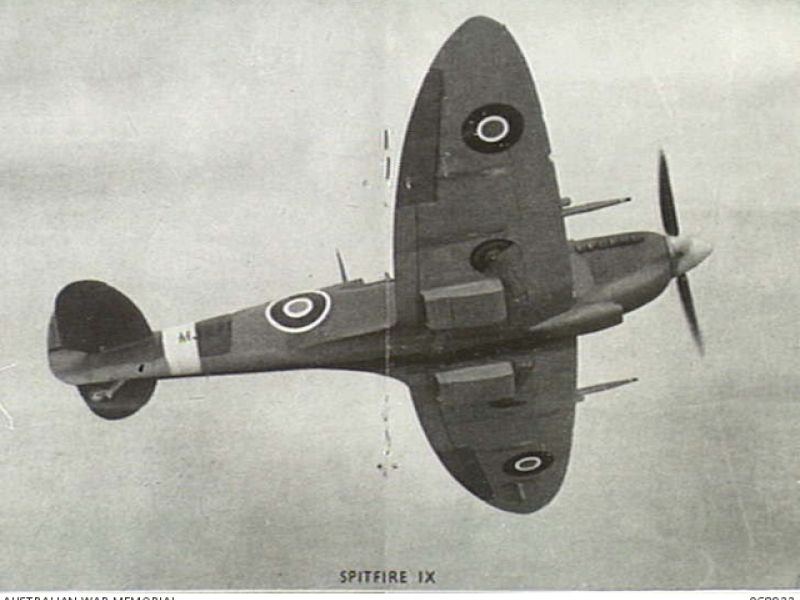
In September 1943 Bell joined No. 127 Squadron based in Palestine. Earning the predictable nickname “Dinger”, Bell continued flying with his new squadron in operations over the eastern Mediterranean until April 1944, when they returned to England in preparation for the invasion of Normandy. Based out of North Weald, No. 127 Squadron, now equipped with Spitfire IXs, supported the D-Day landings, flying sweeps over the beaches, escorting bombers and dive bombing specific targets. In August, the squadron moved to the continent, where they continued flying fighter-bomber missions from airfields in France, Holland and Belgium.
On 11 September 1944, Bell took off in his Spitfire for a raid on enemy shipping near Flushing, Holland. His formation encountered heavy flak from anti-aircraft positions as they pulled away from their target, and shortly afterwards a large splash was seen not far from the coast. At the conclusion of the mission, Pilot Officer Colin Bell had failed to return to base and was listed as missing. His squadron leader wrote to Bell’s family:
“Dinger had been with the squadron for a long period and in that time he has made himself indispensable and a fine fighter pilot. He has always been an asset to me in the Squadron in the Persian and Iraq Forces and later in the Western Desert. He returned to England with this squadron and has remained with us in France. I offer you the best wishes for his safety.”
Bell remained listed as missing, presumed dead for almost a month. It was not until the 10th of October that a body washed up off the coast of Belgium. On the back seam of each boot was the name C. Bell. After this, Bell was officially presumed to have lost his life as the result of air operations on 11 September 1944.
Today, Colin Bell lies at Oostende New Communal Cemetery beneath the inscription chosen by his family. It reads:
“His duty fearlessly and nobly done. Ever remembered.”
He was 25 years old.
- Australian War Memorial Roll of Honour https://www.awm.gov.au/collection/R1705521