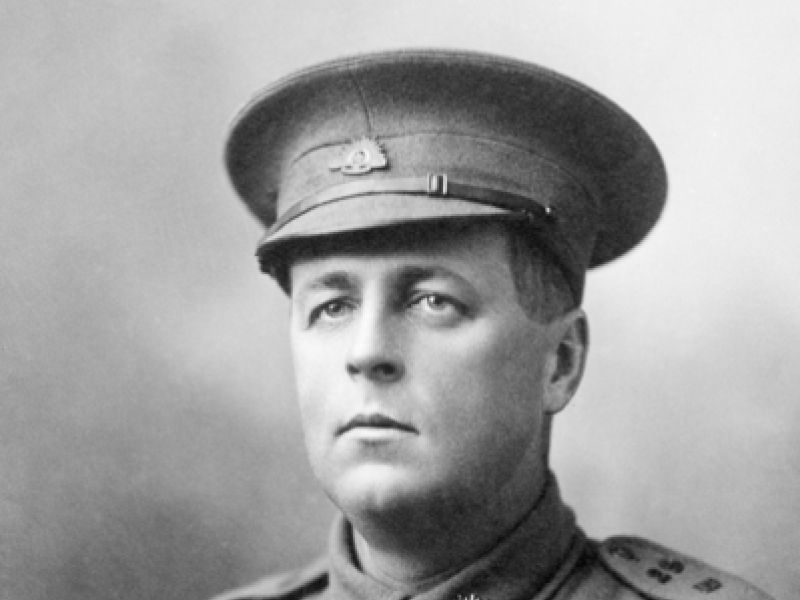
Corporal Roydon Hoadley Pinhey, 25th Australian Infantry Battalion
 Australian War Memorial
Roydon Pinhey was born on 21 April 1884 in Manly, New South Wales. Affectionately known as Roy, he was the youngest of three children born to William Pinhey, a bank inspector, and his wife Laura. Roy received his education at Sydney Grammar School, where he took special courses and took an interest in agriculture. In 1903, he won the Department of Agriculture’s prize for best butter and cheese-maker, shortly before graduating from school. Roy later worked as a sheep farmer at near Quirindi before moving to Rockhampton in Queensland where he was employed as a stock and station agent.
Roy Pinhey enlisted in the Australian Imperial Force on 2 June 1915, in Brisbane. He was assigned to the 2nd Reinforcements of the 25th Battalion with the rank of private. After a short period of training, he was promoted to the rank of corporal in August. Later that month, he embarked for active service, sailing on board the troopship Shropshire.
In December of 1915, Corporal Pinhey joined his unit on Gallipoli, where he earned the nickname “Pin”. Pinhey was evacuated with the rest of his unit just ten days later, when the allies decided to abandon the campaign.
Pinhey and his comrades returned to Egypt to continue training and in March, the 25th Battalion embarked for the Western Front. Arriving in the French city of Marseilles, they were immediately sent north to the French and Belgian border. There they undertook training behind the lines, as well as short stints on duty in the trenches.
In July, the 25th was sent south to the Somme Valley, to take part in the advance on German positions around the French village of Pozieres. They entered the front lines on 28 July 1916, in preparation to attack under the cover of darkness. They began their advance just after midnight, tasked with taking two lines of German trenches on Pozieres Ridge. In five waves the men of the 25th jumped the parapets, immediately coming under murderous machine-gun fire from enemy lines. As they pressed forward, Pinhey and his comrades were hit by the enemy’s artillery, as well as fire from mortars just as they reached their first objective. By the time they made it to the second trench, the 25th was so outnumbered that they were forced to dig in for cover. Private Herbert Harris described the battle:
“Imagine men dug in a few feet into the ground and shells falling just like rain. Trenches blown up and men digging for dear life to rebuild them, or rescuing their comrades who were buried, and in most cases the rescuers were also buried by shells… Entering the trenches, we were bombarded with tear and gas shells which made us wear our gas helmets… it is almost impossible to see and hard to breathe… I have heard officers and men say that the landing and the Lone Pine battle at Gallipoli were a picnic compared to this last fight.”
Shortly after, they received their orders to retreat to their own lines. By the following morning, the 25th Battalion had suffered some 340 casualties. Among the missing was Corporal Roy Pinhey.
He remained missing for well over a year, during which time, nothing was heard of him. At the end of July 1917, a court of enquiry determined that Pinhey had most likely been killed in action. His mate, Corporal Ballard, recounted the last time he saw Pinhey:
“He was killed between Pozieres and High Ridge on 29 July by shell-fire. I found the body when I returned in a shell hole. There was no time to bury the dead and he was buried afterwards by the Pioneers.”
Pinhey was never seen again, and no trace of his grave has ever been found. Today, he is commemorated on the Australian Memorial at Villers-Bretonneux among more than 10,000 others who have no known grave.
Corporal Roy Pinhey was 32 years old.
- Australian War Memorial Roll of Honour https://www.awm.gov.au/collection/R1655079