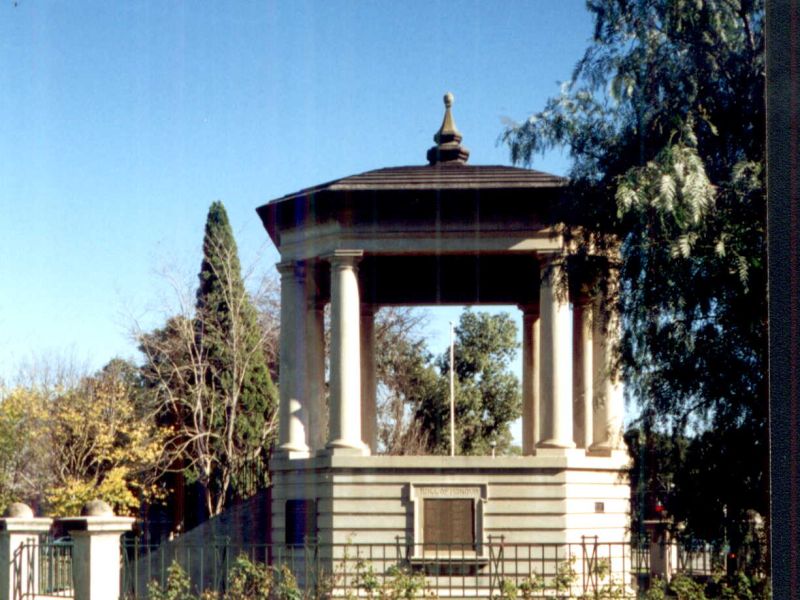
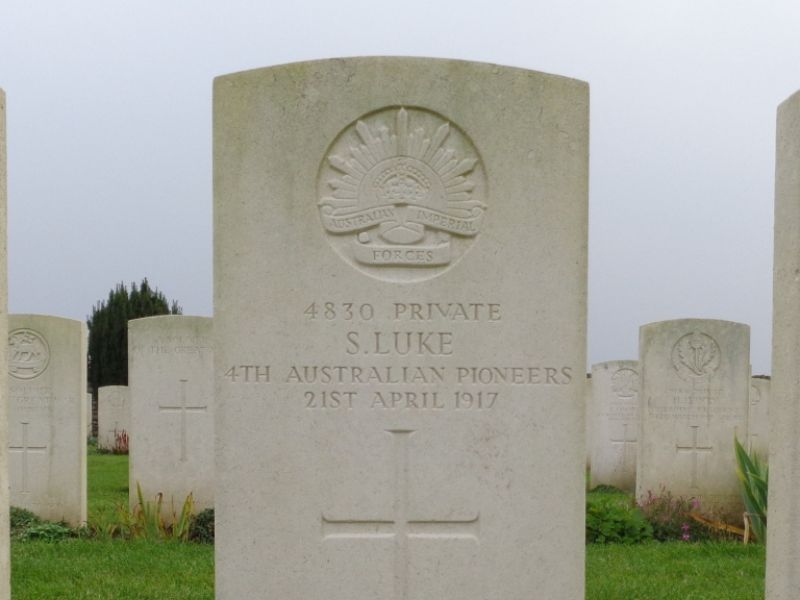
4830 Private Samuel Luke, 4th Pioneer Battalion, AIF
 Australian War Memorial
Known as Sam, he was born on 17 July 1876 in St Marys, New South Wales, to Robert and Elizabeth Luke. He was the fourth of their eight children.
Sam grew up on the family’s farm at Mamre but little else is known of his early life. His father Robert died in May 1887, leaving Elizabeth to raise their children, the youngest of whom, Emily, was one year old. Elizabeth married John Delaney in March 1896 and would have a further three children. By the time his mother remarried, Sam was working as a labourer in the St Marys district.
Tragedy struck the family on 10 January 1914 when Sam accompanied his mother, his sister Emily and two of her young children on a trip to St Mary’s to register her three-week-old daughter. On the return journey, as Sam drove the family sulky, Emily’s dress caught fire and she was soon engulfed in flames. One of the children was rescued by Elizabeth and the other by Sam, who then went to his sister’s aid. She suffered horrendous burns and died several hours later in hospital. It was later thought that a spark from the pipe Sam had been smoking had inadvertently caused the fire. Elizabeth died almost a year to the day after her daughter’s death.
By this time the First World War had begun. In October 1915 a group of men who were keen to enlist left Gilgandra and began a march to Sydney to enlist. The marchers stopped at towns along the way, where they held recruiting rallies, shouting “coo-ee” to draw men into joining the march. Known as the Cooees, their numbers began to swell. When the marchers reached Penrith, Sam joined them and enlisted for service at the next town, Ashfield, on 11 November 1915. When the march ended at Liverpool a day later, the marchers’ numbers were counted at 263 men. Those who had been in from the start had covered 510 kilometres in the space of a month.
Luke was allocated to the 15th reinforcements to the 13th Battalion. After several months’ training he embarked from Sydney with other reinforcements on 8 March aboard the transport ship Star of England bound for Egypt.
After arriving in Egypt on 11 April, Luke was sent to the 4th Training Battalion and at the end of the month he transferred to the recently-raised 4th Pioneer Battalion.
The 4th Pioneer Battalion arrived in France in early June and was sent to the Nursery Sector to gain experience of the Western Front. Though the men were trained as infantry, they were employed in more of an engineer role, constructing trenches and strongpoints, light railways and battlefield clearance tasks.
When the 4th Australian Division was sent to the Somme in late July, the men of the 4th Pioneer Battalion received their baptism of fire. Despite not being in the front line, they experienced heavy German shellfire while engaged in digging and repairing trenches and re-wiring defensive positions.
During their time on the Western Front the 4th Pioneers were never employed as infantry, but were right in the thick of the action as they worked to support the 4th Division. The unit saw service at Flers in late 1916 and for the following months were heavily engaged building a light railway line.
On the 21st of April, Luke and his unit were working on the Decauville Light Railway when they came under German artillery fire. He and another member of the work party were killed instantly by shrapnel when a shell detonated near them. Luke was 40 years old.
The two men were initially buried near where they fell at Vaulx-Vraucourt but were later reinterred at Vaulx Hill Cemetery.
- Roll of Honour, Australian War Memorial https://www.awm.gov.au/collection/R1638940