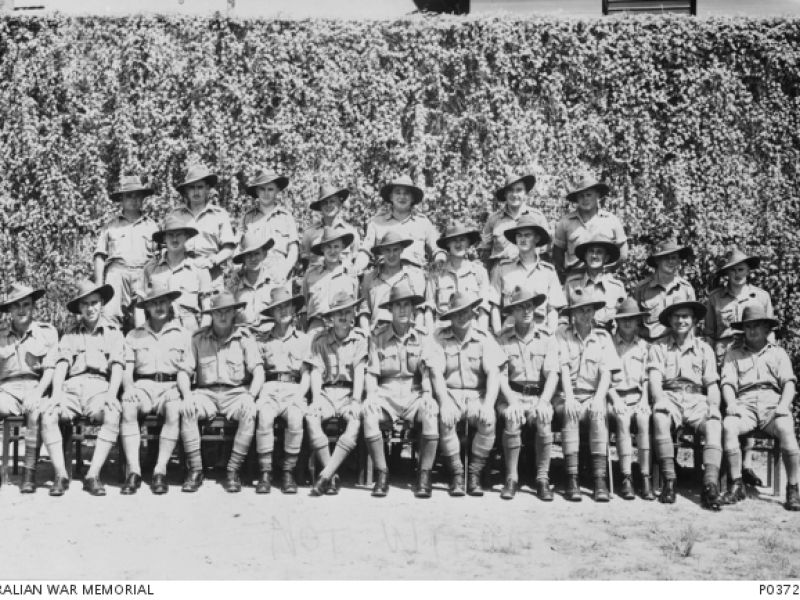
Private Donald James Carn, 2/19th Australian Infantry Battalion
 Australian War Memorial
Donald Carn was born on 17 December 1910 in Wagga Wagga, New South Wales. Known as “Don”, he was one of three sons born to farmers Jack and Kate Carn. Don grew up and received his early education in the small town of French Park. In 1920, his family returned to Wagga Wagga where he attended primary school and the local high school.
Don and his brother Reginald went on to work on the family farm, named “Kelvin”. Don was a keen sportsman and enjoyed playing rugby, tennis, and cricket. In 1937, He married Pearl Plum, a woman from the nearby town of Tootool. When the Second World War broke out two years later, Don and his wife were living on the family farm at French Park.
Don Carn enlisted in the Second Australian Imperial Force on 26 June 1940. He was assigned to the 2/19th Battalion with the rank of private and commenced a short period of training in Australia.
In late 1940, he was granted pre-embarkation leave and returned to French Park, where he was farewelled by his community. He was gifted a pen, a wallet, some handkerchiefs and a money belt from friends and colleagues who wished him well. He returned to Sydney and embarked for active service on 2 February 1941.
Private Carn arrived in Singapore later that month and moved north to Seremban in southern Malaya with the rest of his unit. There, the men continued their training with a focus on serving in tropical conditions. In May, Carn was detached for duty with the ordnance guard in the northern area of Singapore and did not re-join his unit until the end of June 1941.
Over the months that followed, Carn and the rest of the 2/19th spent time training before moving out to the airfield at Kluang in September. In early October, Carn and his comrades began moving east towards the town of Jemaluang, the site of a vital road junction. With the increasing likelihood of Japan’s entry into the war, the men of the 2/19th devoted their time to preparing and fortifying the Allied defensive position.
In December 1941, Pearl Harbour was attacked, and Japanese forces began their land invasion of Malaya. From the front, Private Carn wrote a letter home to his nephew, Peter, on 8 January:
“Peter I am still going strong and we have not had a scrap yet, but it’s getting very close to us now so it looks any day we will. We live in dugouts now, which are rather warm in this climate but it’s safe to sleep in them on account of air raids. We had a good Christmas dinner in the trenches, turkey, fruit salad and a bottle of beer but not so hot on New Year’s Day, we were down to tinned stuff – the old bully beef … well Peter there is not much I can tell you and I have not got a snap to send you, we are not allowed cameras now so will say cheerio for the present. Wishing you all a Happy New Year and hoping to see you all soon, with love from Uncle Don.”
Within days of writing this letter, Carn and his comrades were drawn into action. Japanese forces had swept quickly through Malaya, forcing Allied units to begin a fighting withdrawal back towards Singapore. The 2/19th covered this retreat, and helped to reinforce the 2/29th Battalion at Bakri. There they held the vital crossroads to allow a number of Allied units to escape and withdraw from the direction of Muar.
Throughout 19 January, Carn’s battalion encountered heavy fighting on all flanks as the units around them continued to suffer heavy casualties and aerial bombing. Not long into the attack, Private Carn was wounded in the thigh, but continued fighting after applying his own field dressings. Soon after, his best mate saw Carn wounded for a second time, though he apparently still continued fighting. He pressed through the attack at Bakri despite these two wounds, before being killed by an enemy sniper.
After the fighting around Bakri, the Japanese continued pushing forward as Allied forces continued their withdrawal. Their desperate retreat ended with surrender on the outskirts of Singapore on the night of 15 February 1942, leaving some 130,000 Allied troops to become prisoners of the Japanese.
Private Carn’s final resting place was not uncovered until some years later. He was reburied in 1949 and today lies in Singapore’s Kranji War Cemetery beneath the simple inscription chosen by his family: “The Lord giveth, the Lord taketh away, blessed be the name of the Lord.”
Don Carn was 31 years old.
- AWM Roll of Honour https://www.awm.gov.au/collection/R1692670
- AWM photo collection item https://www.awm.gov.au/collection/C984603