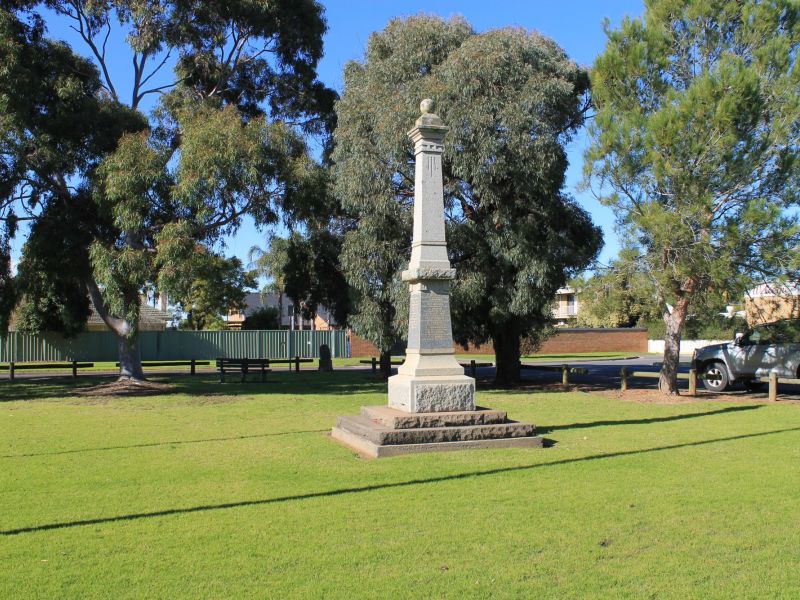
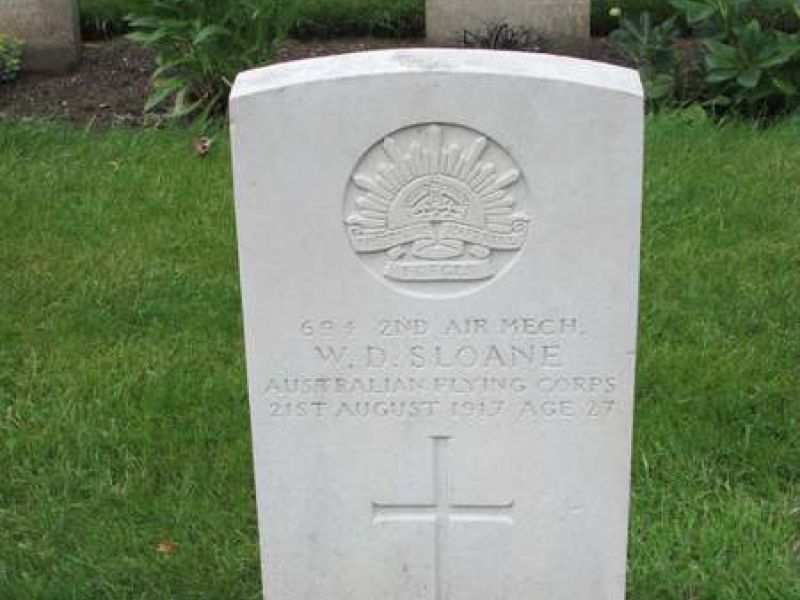
Air Mechanic Class II William Douglas Sloane, No.2 Squadron, Australian Flying Corps
 Australian War Memorial
William Sloane was born on 4 June 1890 in the town of Mulwala, on the banks of the Murray River in New South Wales. He was the youngest of three sons born to local grazier James Sloane and his wife Amy. William received his education as a boarder at Geelong College where he was a sergeant in the Senior Cadets and a keen sportsman. As a young adult, he received further education at the Vulcan Foundry and also at the Working Man’s College, both located in Geelong. When the First World War broke out in 1914, Sloane was working as a motor mechanic, and building an aeroplane at his home near Corowa.
Sloane enlisted in the Australian Imperial Force on 2 October 1916. With his interest in aeronautics, and his trade background as a motor mechanic, he was assigned to No. 2 Squadron of the Australian Flying Corps. He was sent to Point Cook, where a flying school had been established. There, he completed further training and was assigned the rank of Air Mechanic. He embarked for active service from Melbourne in late October on board the troopship Ulysses.
Sloane arrived in England at the end of December 1917. The following month, he was sent on a one month course to become a fitter. These mechanics were responsible for repairing and maintaining the engines of aircraft, working alongside riggers who were responsible for the aircraft’s frame.
On completion of the fitter’s course, he re-joined his squadron at their base near Waddington. In July 1917, he was sent on command to armament school at Perivale before returning to his unit in August.
Sloane was scheduled to go to France alongside his pilot, Lieutenant Frank Shapira. They took off on the morning of 21 August, with Sloane in the observer’s seat. Encountering some slight engine trouble, the pair landed at the nearby aerodrome at Biggin Hill, in Kent. There, mechanics serviced the engine while Sloane and Shapira broke for lunch. Returning to their plane to take off, everything appeared to be running well and the two men again set off for France.
But when they had reached a height of about 600 feet, the machine began to spin out in flat circles before crashing to the ground in a spinning nose-dive. The accident was recounted in a report given to the Red Cross: “Immediately an ambulance and a light tender proceeded to the site of the crash, and we lost no time in getting there but we were unable to do anything for them. The machine was blazing from end to end and it was impossible for us to approach. A man who was working in the field in which they fell tried to drag them out with a long-handled hay rake, but it was obvious that they were dead and he gave up the attempt.”
One of Sloane’s comrades later reflected on his death in a letter home: “The boys feel very sad about his death, and the news came through so suddenly – only about six hours after we boys had shaken hands with them and waved them off.”
Air Mechanic William Sloane was buried at London’s Brookwood Cemetery with full military honours on 25 August 1917. He was 27 years old.
- Roll of Honour, Australian War Memorial https://www.awm.gov.au/collection/R1661031