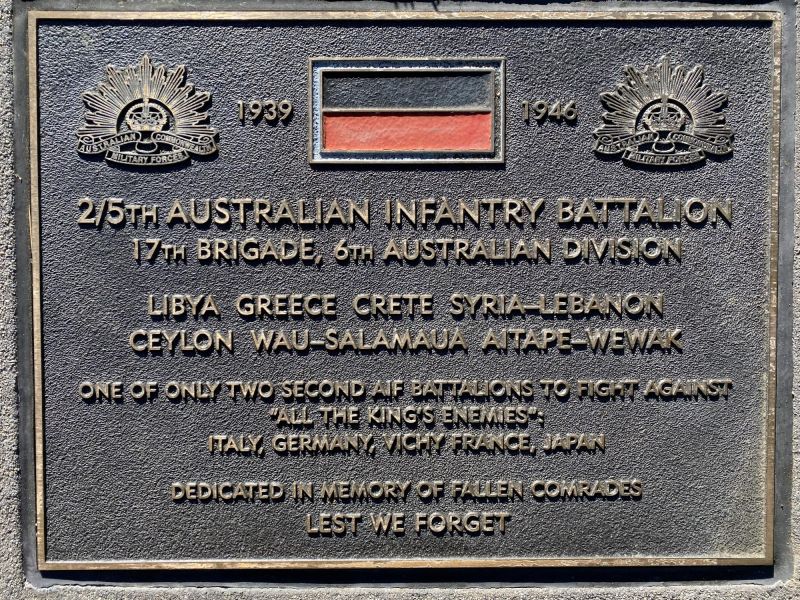
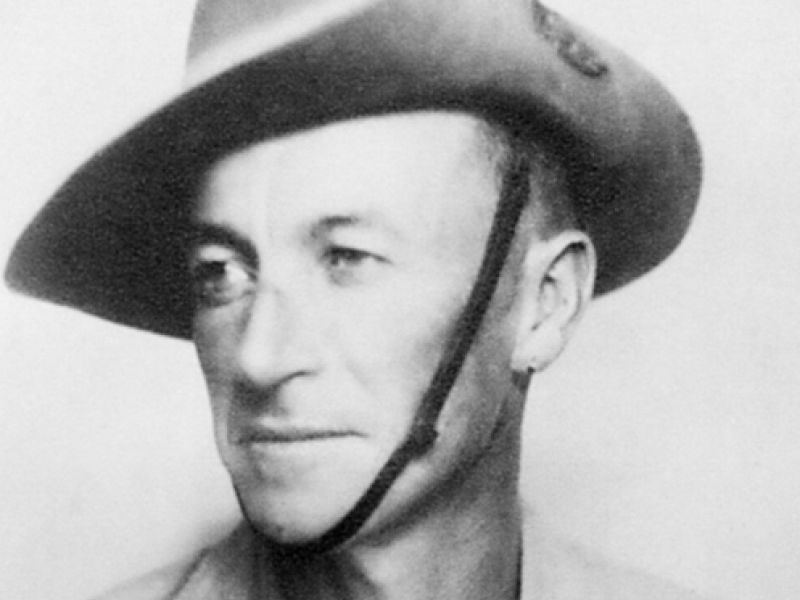
VX3284 Private George King Sutherland, 2/5th Battalion
 Australian War Memorial
George Sutherland was born at Riddell’s Creek, between Bendigo and Melbourne in Victoria, on 24 March 1906, the son of George and Anna Sutherland.
Little is known of his early life. By the advent of the Second World War, he was living with his wife, Vera, in the Melbourne suburb of Middle Park, working as a clerk.
George Sutherland enlisted in the Second Australian Imperial Force on 25 October 1939 at Melbourne Showgrounds. After being transferred to Puckapunyal he was posted to the newly formed 2/5th Battalion.
Having completed basic training, Sutherland and his battalion embarked at Melbourne for overseas service on 14 April 1940.
Arriving in Kantara – a city on the western side of the Suez Canal in Egypt – the battalion continued training in Palestine and Egypt.
Private Sutherland suffered from sandfly fever in July, but was back with his unit in August.
The men took part in their first campaign in January and February 1941, advancing against the Italians in eastern Libya, where they took part in successful attacks at Bardia and Tobruk. In early April, the battalion deployed to Greece with the rest of the 6th Division in order to resist the anticipated German invasion.
The Greek campaign lasted approximately a month, during which the Allies lost men as well as essential arms and equipment. With limited air cover, the Allies were chased out of Greece under fierce and sustained German bombardment. Caught in the middle of these events were the Australians.
On 12 April, Lieutenant-General Thomas Blamey, commander of the Australian Imperial Force in the Mediterranean, issued an order announcing the formation of a new Anzac Corps. Australian and New Zealand troops were fighting side by side against an invading German army that had been triumphant everywhere. With the very existence of his force in the balance, Blamey invoked the spirit of Gallipoli to inspire his troops. The deeds of the Anzacs in Greece did not to prove to be an inspiration to Australian war mythology in the same way as the defeat on Gallipoli in the First World War. The bulk of the Anzac Corps was evacuated by the end of April, though many got only as far as Crete.
After occupying defensive positions at Kalabaka on 14 April, the battalion became involved in one long withdrawal to the southern Greek port of Kalamata, from which it was evacuated about two weeks later. The battalion lost 21 men killed, 26 wounded and 47 taken prisoner of war. Among those killed was Private George Sutherland, who was 39 years old. He was killed in action on 19 April 1941, ten days after arriving in Greece.
Today, his remains lie in Phaleron War Cemetery in Greece, underneath the epitaph chosen by his grieving family: “Duty nobly done”.
- AWM Roll of Honour https://www.awm.gov.au/collection/R1698505