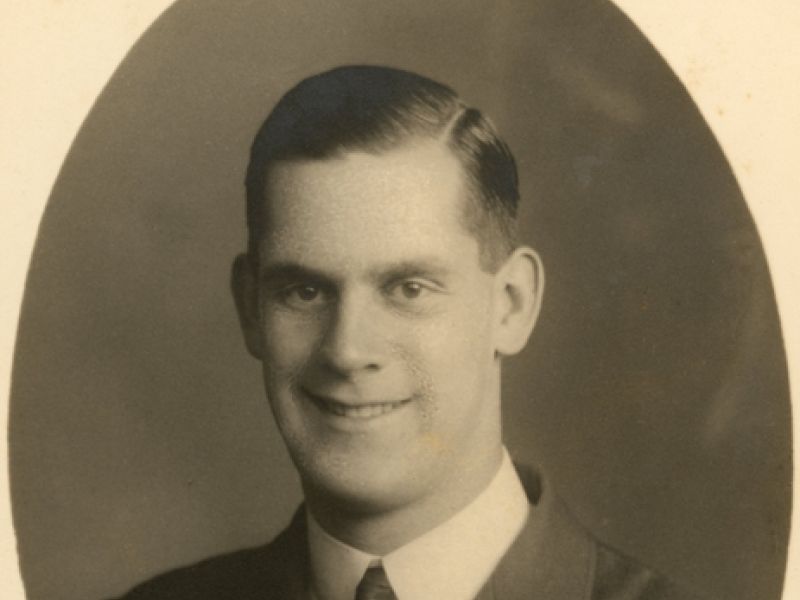
Pilot Officer Lloyd Wilson Bailey, No. 149 Squadron, Royal Air Force
 Australian War Memorial
Lloyd Bailey was born on 27 February 1920 in Kempsey, New South Wales. He was the younger of two children born to Cecil Bush Bailey, a journalist, and his wife Isabel. When Lloyd was three years old, his family relocated Grafton, New South Wales. He was educated at the local primary and high school, and at Scots College in Sydney, where he was an active member of the cadets. After graduating, Lloyd moved to Brisbane to pursue a career in journalism, working on the literary staff of The Telegraph; he was there when the Second World War broke out.
Bailey was invited to join the staff of the State Publicity Censor. He began working in this role while serving in the militia, before he enlisted in the Royal Australian Air Force. He was accepted in October 1940 and trained at a variety of locations across Australia before embarking for Canada in February 1941. In Vancouver, he learned to fly on training aircraft, including the Harvard and the Yale. As part of the Empire Air Training Scheme, he was one of almost 27,500 RAAF pilots, navigators, wireless operators, air gunners, and flight engineers who, throughout the course of the war, joined Royal Air Force squadrons or Australian squadrons based in Britain. He graduated as a pilot in June and embarked for England.
Bailey was posted to No. 27 Operational Training Unit at Lichfield, where he trained as night bomber crew and learned to fly the Vickers Wellington medium bomber. At the end of September he was posted to his first operational unit, No. 149 Squadron of the Royal Air Force. Based out of Mildenhall in Suffolk, the squadron was part of Bomber Command and was equipped with Short Stirling heavy bombers.
Bailey’s squadron was involved in a major bombing campaign against Germany and Nazi-occupied territory; this involved regular raids over major cities and military targets. Some of Bailey’s first missions were as pilot on raids against enemy factories near Paris and in the Ruhr Valley. In 1942, Bailey was involved in several more attacks on German targets. From England, he wrote home to his mother:
“One time we visited one of Germany’s most highly defended areas and were credited with a successfully placed stick of bombs. We crept out after bombing, weaving our way through a recognised ‘hot’ area without being discovered. The moon was up and we flew over fleecy clouds, almost covering the sea from view. The beauty of such sights defies description … I have learned to do without lots of things and to expect less than I get. I have found comradeship and faith which is beyond words; a quiet determination, unmasked emotions, trust and consideration of fellow men. My crew is happy with me and I am happy with them. They are all English and I am Australian but there is no difference.”
On 10 March 1942, Bailey was captain of an eight-man crew taking part in a night bombing raid on the German city of Essen, a major industrial centre. Their primary target was the Krupps factory which produced steel as well as armaments.
The attack initially went to plan, but at about 10 pm Bailey’s Stirling bomber was hit by anti-aircraft fire near the Dutch and German border. The aircraft was badly damage, and sustained several hits to the petrol tanks which burst into flames – causing the plane to plummet towards the ground. One of the crew, Sergeant Munro, was able to bale out, but was later taken prisoner. Bailey and the rest of the crew were still in the aircraft when it crashed just outside the town of Kleve. There were no survivors.
The remains of Bailey and his crew were later removed from the wreckage and buried by the enemy in a nearby village cemetery.
News of his death was met with shock and sadness at home. One newspaper in Grafton reported his death, noting:
“Lloyd Bailey, like so many thousands of his fellow countrymen who are in the fighting forces, had the Australian characteristics of adaptability, initiative, cool courage and a sincere desire to serve his native land in her time of danger. Like those thousands also, he showed the Australian’s remarkable facility for air sense and aircraft control, although, like them, he had never previously stepped into a plane.”
Today, Bailey lies at Reichswald Forest War Cemetery in Germany beneath the words chosen by his parents. They read:
“We cherish his dear memory.”
Pilot Officer Lloyd Bailey was just 22 years old.
- AWM Roll of Honour https://www.awm.gov.au/collection/R1705286