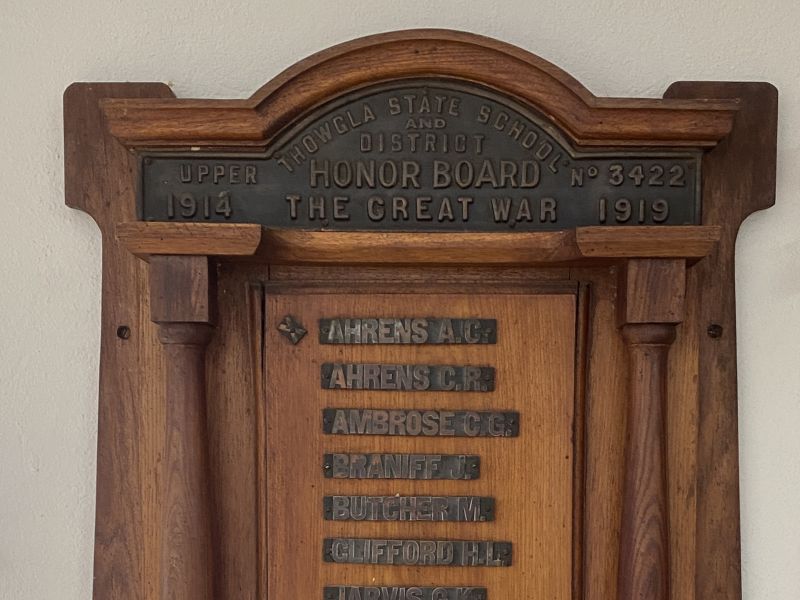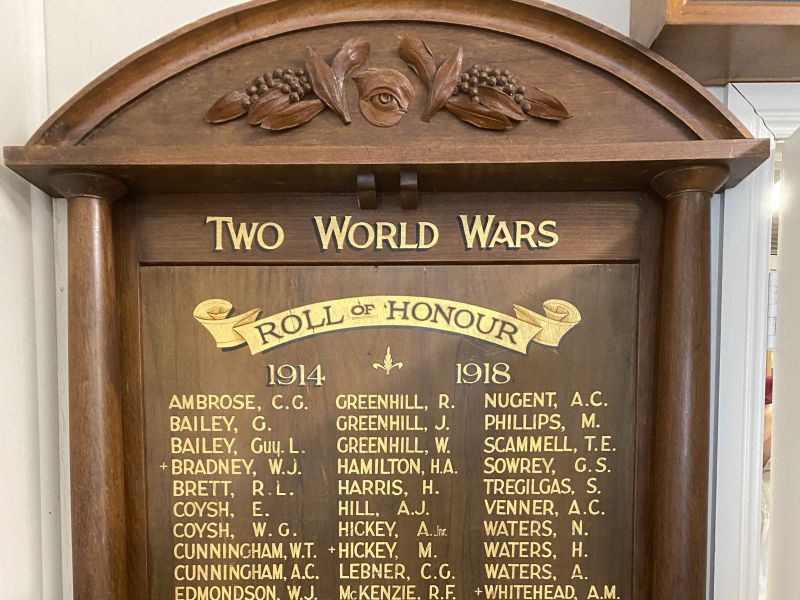
Christopher George Ambrose
 Stephen Learmonth
Christopher George Ambrose was born on October 2, 1888, in Wyddial, Hertfordshire, England, to Samuel Ambrose and Sarah Ann, nee Barker. He was the youngest of eight children. By the age of 13, he was working as an agricultural labourer. The 1911 England Census states that Christopher was employed as a gardener, in a Market Garden and shared a room with another gardener at ‘The Nursuries’, Lincoln Road, Grange de Lings, in Lincolnshire, England.
On September 10, 1913, Christopher boarded the SS Port Lincoln and departed England’s shores for Australia. He arrived at the Port of Melbourne on September 10, 1913. A year later, he was working as a farm hand at Upper Thowgla.
On September 24, 1914, he enlisted at Rosehill Camp, Sydney, NSW. At the time, he was a single, 25-year-old farmhand living in the Upper Murray. He was allocated Regimental Number 2203 and placed in C Company of the 3rd Battalion. Christopher gave his next of kin as father, Samuel Ambrose.
After initial training, he embarked on HMAT A32 Themistocles at Melbourne, Victoria, on December 22, 1914. After further training in Egypt, Christopher joined the 3rd Battalion as it was preparing to embark for the Dardanelles Campaign. The battalion arrived at Lemnos harbour on April 8. Further training was undertaken, focusing on disembarking into smaller boats.
The 3rd Battalion War diary for April 25 reads as follows:
“We left anchorage at 12:30 am & sailed for PENINSULA of GALLOPOLI arriving there shortly after 4 am. In the face of a heavy fire the Division landed, the enemy being strongly entrenched on a steep headland. The Bn commenced dis embarkation [sic] at 5.30 am and the Bn was ashore by 8.30 am. Shortly after landing the Bn with other Bns, took the second ridge occupied & entrenched by the evening. The taking of the trenches was difficult but eventually we succeeded. …”
Between the day of the landing and the last day of April, Christopher was wounded by a bullet to his scalp and shoulders. On the first day of May, he was admitted to a military hospital in Cairo. One month later, he was discharged from the hospital and admitted to the OC Convalescent Camp at Helouan, Egypt.
On July 5, 1915, he boarded the HS Ballarat bound for Australia. His war was over! He was discharged on November 25, 1915, as medically unfit and was awarded the 1914-15 Star, the British War Medal, and the Victory Medal for his service during the war.
Upon returning to Australia, he settled back in the Upper Murray and became a farmer. At some stage during the 1950s, he married Margaret Tweedie. Christopher would return to England twice during the 1950s. He passed away on September 20, 1971, at Thougla, Corryong, Victoria and was buried in Corryong Cemetery.