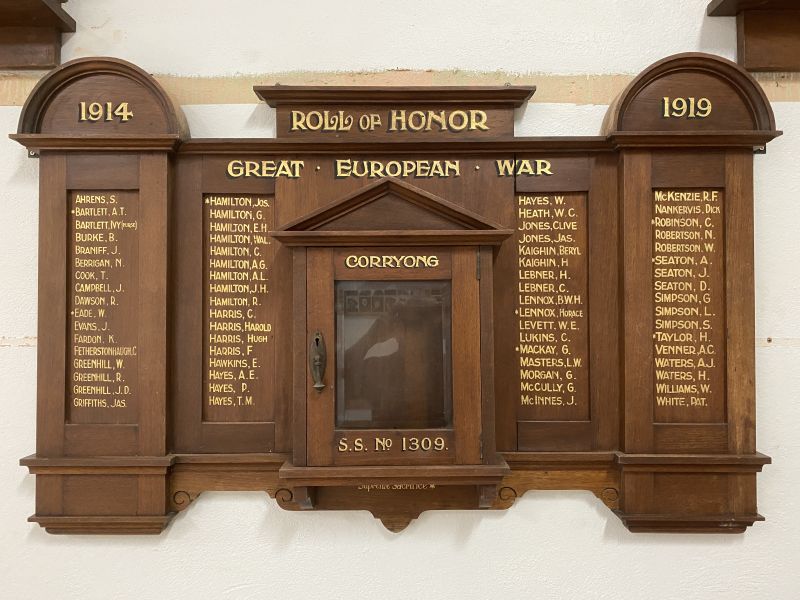
Dick Nankervis
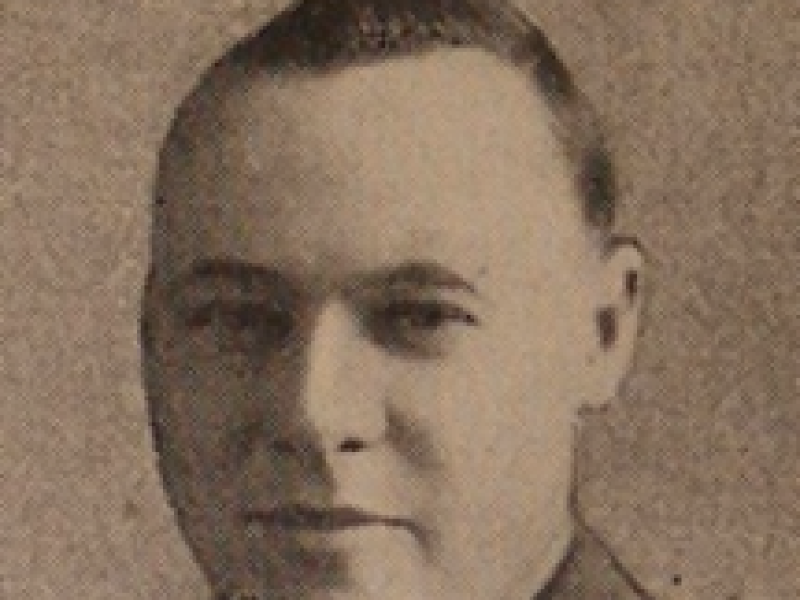
 Stephen Learmonth
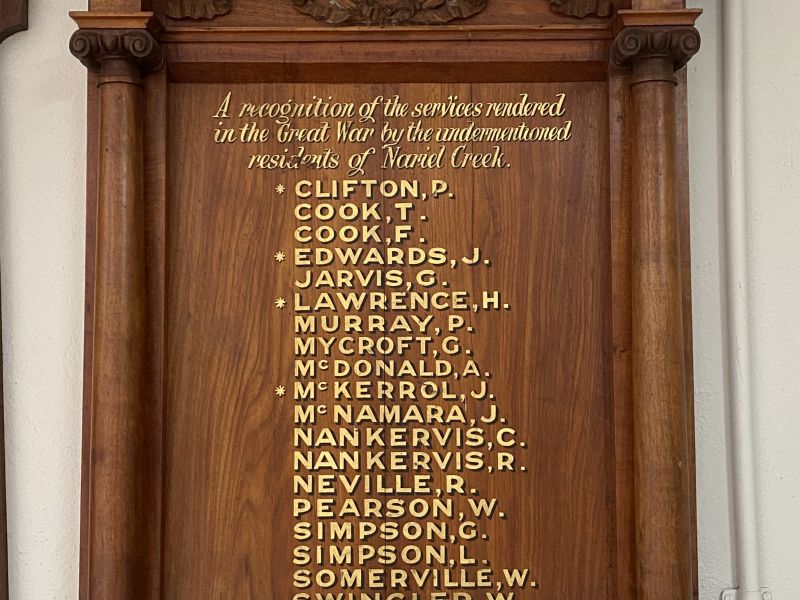
Dick Nankervis was born on August 26, 1894, in Corryong, Victoria, to Charles Nankervis and Emma Isabel, nee Simpson. In 1914, he became a probation teacher with the Victorian Department of Education. His final supervisor's report, prior to his enlisting, stated: “He works well but could keep better control of his grade by instilling more interest into his lessons.”
On August 2, 1915, he enlisted at Melbourne, Victoria. At the time, he was a single 21-year-old schoolteacher living at Nariel Creek, via Cudgewa, Victoria. He was allocated Regimental Number 100A and placed in the 29th Battalion, Machine-gun section. Dick gave his next of kin as father, Charles Nankervis. His Service Records contain a letter from Charles stating that he gave Dick permission “to join His Majesty’s Forces to fight for his country and the right.” Both parents signed.
After initial training, he embarked on HMAT A11 Ascanius at Melbourne, Victoria, on November 10, 1915. Four weeks later, he disembarked at Suez. In early March of 1916, he was transferred to the 8th Machine Company of the 8th Brigade, 5th Division. Dick arrived in France in late June of that year and was soon promoted to Corporal. Ten months later, he was promoted to Sergeant. While on furlough in England in late July 1917, he was admitted to No.2 Australian Auxiliary Hospital in Southall.
In October of 1917, he was awarded the Military Medal for his actions at Polygon Wood. His citation read:
“During operations in the vicinity of POLYGON WOOD from 26th/29th, this N.C.O. took charge of a Battery of eight (8) Machine Guns, after both his Officers had been wounded on 26th September, and controlled them during the operations. He set a splendid example to the men of the Battery which had many casualties, not - withstanding which the Battery fired successfully on every S.O.S. call.”
During the two-day period, there were at least 10 SOS calls from the advancing infantry, each resulting in a 30-minute fire period.
On October 7, he was selected to attend an Infantry Cadet Battalion course in England. Two months later, he joined the No. 5 Officers Cadet Battalion at Cambridge. For the next ten months, he was attending courses or in hospital suffering from synovitis of the knee and tonsillitis. In late October 1918, he joined the 5th Machine Gun Battalion in France. He remained in France until mid-May 1919, when he returned to England.
On July 23, 1919, he returned to Australia aboard the HT Main with the rank of Lieutenant. He was discharged on April 8, 1919, and was awarded the Military Medal, the 1914-15 Star, the British War Medal, and the Victory Medal for his service during the war.
The last statement in Dick’s record from the Education Department states that on December 13, 1919, he became a temporary assistant. The 1919 Electoral Roll for the Division of Indi states that Dick is living at Wooragee and has the occupation of ‘gentleman’. In 1920, Dick and his brother purchased a property in Wooragee and began farming.
Dick married Elma Leila Cook in 1926. He was a very civic-minded person, serving as a Councillor for many years in the North Riding of the Beechworth Shire and as Shire President on a number of occasions. During World War 2, he was the commander of the Beechworth unit of the Volunteer Defence Corps and president of the Beechworth branch of the R.S.S.A.I.L.A. In June 1954, he was appointed a district councillor for the 34th RSL District, which meant he would represent the district at State Council meetings.
He passed away on March 11, 1974, at Beechworth, Victoria, and was buried in Beechworth Cemetery.