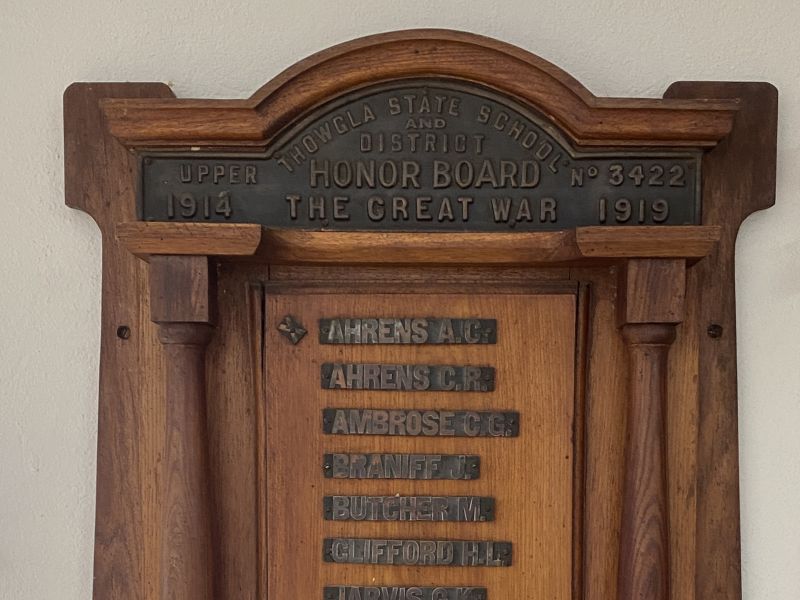
Horace Leslie Clifford
 Stephen Learmonth
Horace Leslie Clifford was born in 1896 in Chiltern, Victoria, to George Tomkins and Florence, nee Ahrens.
On July 17, 1915, he enlisted at Melbourne, Victoria. At the time, he was a single, 19-year-old butcher living at Campbell St, Ararat, Victoria. Being underage, Horace needed his parents' permission to enlist. A note in Horace’s Service Records written by his father, George, states, “I do hereby give my consent for my son, Horace Leslie Clifford, to go on active service with the Australian Expeditionary Forces.” He was allocated Regimental Number 2030 and placed in the 3rd Reinforcements of the 22nd Battalion. Horace gave his next of kin as his father, George Tomkins.
After initial training, he embarked on HMAT A68 Anchises at Melbourne, Victoria, on August 26, 1915. Horace was taken on strength by the 22nd Battalion on October 25, at ANZAC Cove. His initiation to war was quick, as over the next few days, the area occupied by the 22nd was shelled, and casualties were taken. The battalion served at Gallipoli until the evacuation in December 1915. It arrived back in Egypt on January 1 1916.
On July 23, the 22nd Battalion, as part of three Australian Divisions, took part in the opening stages of the Battle of Pozieres. The Australians would suffer approximately 23000 casualties during the 42 days of the battle. Two weeks into the fighting, Horace was wounded with a gunshot wound to the right leg and penis. He was taken to the 44th Casualty Clearing Station, then evacuated to England on the HS Marama, a converted New Zealand passenger liner.
After months in hospitals and convalescent depots, Horace was transferred to the 65th Battalion. Over the space of three months, Horace was charged twice with being absent without leave (AWOL) for a total of ten days. In total, he would receive seven days confined to quarters, 21 days forfeiture of pay and 14 days Field Punishment No.2.
Field Punishment No. 2 was a common disciplinary procedure used by both the British and Commonwealth Forces during World War I. It involved heavy, often dirty, and repetitive labour with the feet being confined in shackles.
He returned to France on January 13, 1918. Within two weeks, he was arrested for being AWOL, although it’s unclear from his records for how long. He was awarded a further four days of Field Punishment No. 2. After the signing of the Armistice, Horace eventually returned to England on January 29, 1919. On February 24 he was admitted to hospital suffering from a venereal disease. He would remain in hospital for 55 days.
Charges of AWOL and confinement to a hospital with a venereal disease were ‘relatively’ common in the AIF. Many of the Australian soldiers were young, having never travelled very far from their homes in Australia. The sights and sounds of the battlefield, and the thought of death or maiming, were never far away from the minds of the soldiers, and no doubt their wish was to live life as much as they could.
On January 5, 1920, he returned to Australia aboard the HT Cape Verde with the rank of Private. He was discharged on April 26, 1920, and was awarded the 1914-15 Star, the British War Medal, and the Victory Medal for his service during the war.
Not much is known about Horace’s life in Australia. He married Ivy Evelyn Hofmaier in 1929 in Victoria, Australia, and passed away on August 1, 1962, at Geelong West, Victoria, and was buried there.