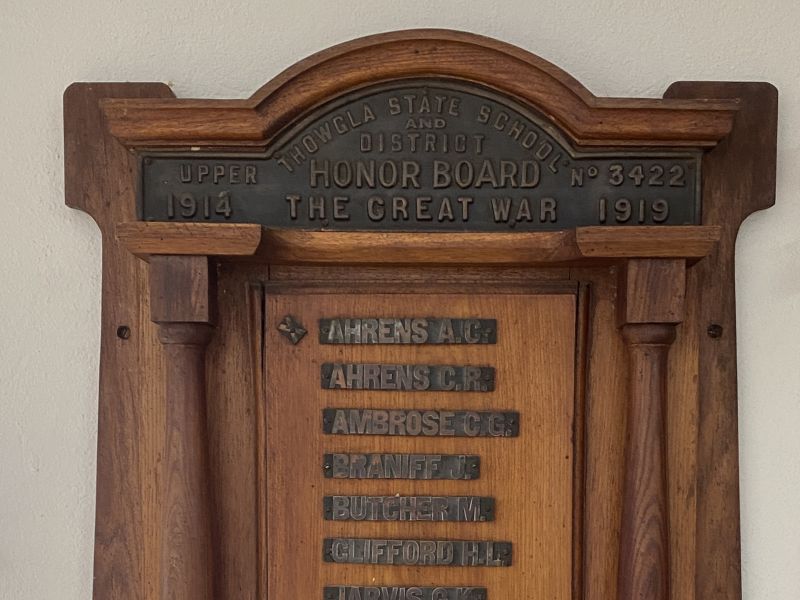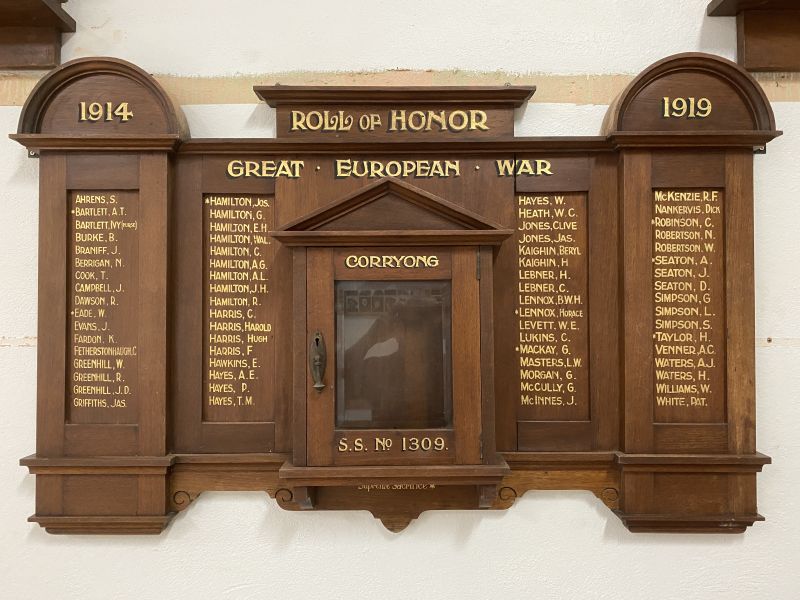
John (Jack) Braniff
 Stephen Learmonth
John (Jack) Braniff was born June 9, 1895, at Tumbarumba, New South Wales, to William John Braniff and Elizabeth. John would have one brother and two sisters.
The October 23, 1913, edition of the Corryong Courier describes Jack’s farewell from Corryong.
“The ‘A’ Grade boys and a few more met at Mrs Whitehead’s home a few nights ago, to wish one of their school companions (Master Jack Braniff) “Good-bye” on his departure to the Training College, Sydney. After all had partaken of a dainty supper, Hoffman Whitehead made an appropriate speech, and, on behalf of the boys and himself, handed Jack a very nice watch, which he trusted would be kindly accepted as a slight token on remembrance of their school days together, adding “We shall all miss you, Jack, and hope you have a jolly time at Sydney.” Each boy in turn endorsed Hofie’s remarks. Jack very freeingly thanked them in a few nicely chosen words, and said their valued gift had come to him as a very great surprise, and he will ever look upon it with much pleasure. He said he trusted he should have the pleasure of congratulating the ‘A’ Grade boys on having passed their Junior Public Examination during his holidays at Christmas time. This terminated an enjoyable evening.”
In 1916, Jack was a teacher with the NSW Department of Education. In October of that year, he transferred from Tottenham State School in the central-west of NSW to Emu Creek and Moona Road on a half-time posting. Prior to this posting, he had been teaching at Mulburruga State School in NSW.
On April 4, 1917, John enlisted in the AIF at Tamworth, New South Wales. He was given the Regimental Number 3349 and was put on strength with the 28th Reinforcements for the 1st Light Horse Regiment.
At the time of enlistment, John was a single 21-year-old State School teacher living at Walcha. His medical records describe him as 5 feet 11 inches (180 cm) tall and weighing 176 lbs (80 kg). His complexion was described as dark, eyes as blue, and hair as light brown. John’s records show that he had the distinctive marks of four vaccinations on the right arm and a scar on the right leg. John’s religious denomination was given as Roman Catholic.
John embarked on HMAT A17 Port Lincoln on June 11, 1917, sailing from Sydney. The trip would take him across the Great Australian Bight to Fremantle, on to Colombo, in Ceylon, before finally disembarking at Suez, at the southern end of the Suez Canal, in Egypt.
John was taken on strength with the 1st Light Horse Regiment at Moascar on September 14, 1917. He arrived at the Regiment in time to participate in the capture of Gaza. Following this, he was present in the advance to Jaffa, the clearing operations, and the occupation of the west bank of the Jordan River. He was with the Regiment when it was involved in the Amman (24 to 27 February 1918) and Es Salt (30 April to 4 May) raids. It was during the repulse of a major German and Turkish attack on July 14, 1918, that John was severely wounded.
On July 17, 1918, he was admitted to the 36th Stationary Hospital at Gaza suffering from a gunshot wound to his face and hips. The wounds were classed as severe. The following day, he was transferred to the 44th Stationary Hospital at Kantara, and finally, on July 19, was admitted to the 14th Australian General Hospital at Port Said. John would remain in the hospital until September 27, when he was transferred to the Rest Camp, also in Port Said. He had barely been back with his unit when he was once again admitted to the 2nd Australian Stationary Hospital, this time suffering from malaria.
It would be almost another month before John rejoined the 1st Light Horse Regiment, but by now the Armistice had been signed with Germany and Turkey. On March 13, 1919, John embarked on HMNZT Ulimaroa at Kantara and sailed home. He was finally discharged from the AIF on June 19, 1919. For his service during the war, he was awarded the British War Medal and the Victory Medal.
After being discharged, Jack went back to teaching. His first school was Canterbury State School, near Botany Bay. He married Nellie Isabel Muriel Cross on June 16, 1920, at her family home, “Navelle”, Moona Road, Walcha. They had one child during their marriage.
John’s teaching career took him to other schools, including Peterhsam Public School, Wiangaree Public School and Rooty Hill Public School in Sydney. He became headmaster at Wiangaree and remained there from 1935 to 1953. He retired from the Education Department in 1961.
John passed away on August 3, 1977, at the age of 82, at Walcha and was buried at Walcha Cemetery in the Catholic section.