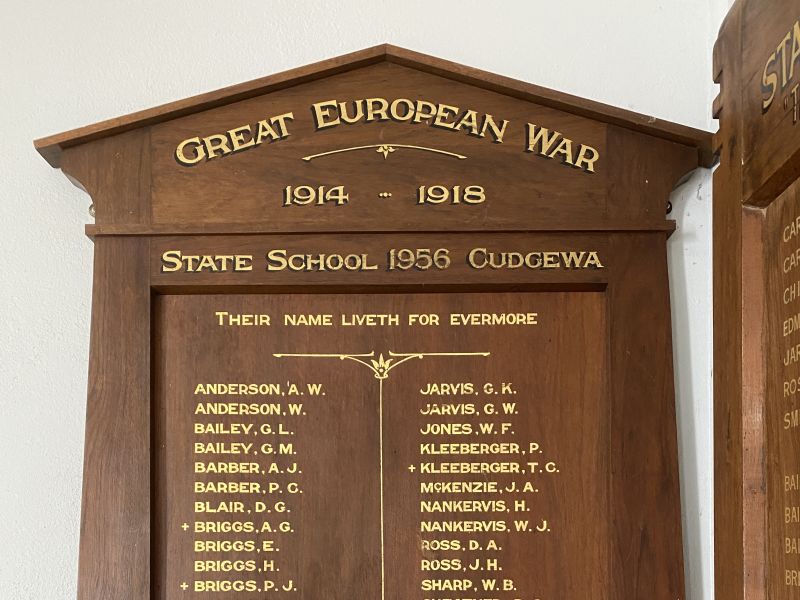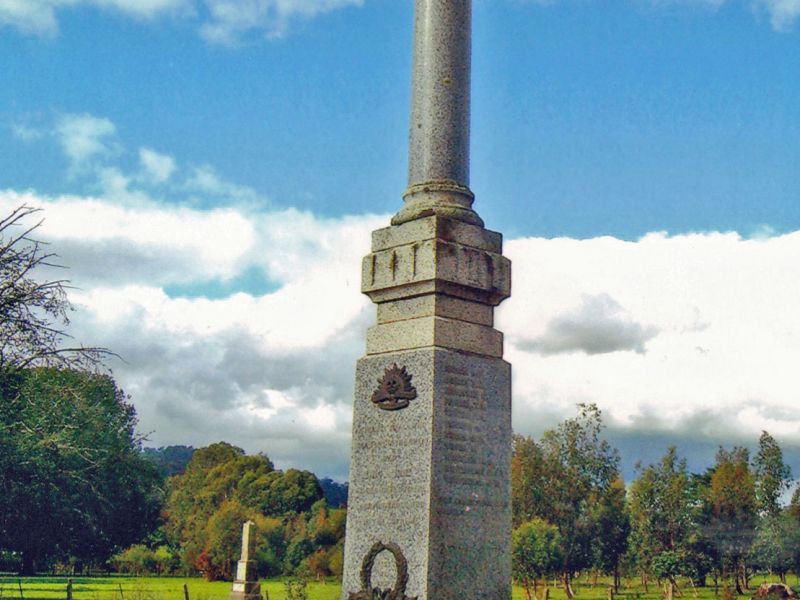
Garnet Wolseley Jarvis
 Stephen Learmonth
Garnet Wolseley Jarvis was born in 1881. Depending upon the resource, he was born at either Cudgewa or Tintaldra, both in Victoria. At the time of his birth, his father, William (1838 to 1909), was 43, as was his mother, Catherine Rebecca, nee Simpson (1838 to 1893). Garnet would be the second-youngest of six surviving children.
At some stage between 1909 and 1913, after Garnet’s father’s death, the family moved from the Upper Murray to take up residence at The Oaks, Camden, Wollindilly, in New South Wales. Garnet would remain in this area, taking on jobs, such as a labourer, until 1947. In 1916, he married Gertrude Williams.
On 5 January, 1916, Garnet enlisted in the AIF at Casula in New South Wales. He was given the service number 1894 and was put on strength with the 11th Reinforcements for the 12th Light Horse Regiment. His medical examination, conducted at Sydney Town Hall, declared him fit for service, except for some minor dental work that needed to be done. The original volunteers in 1914 were required to have perfect teeth; otherwise, they were rejected. As the war progressed, and the need for volunteers to fill the places of the dead, wounded or ill became urgent, the standards were relaxed.
Upon enlistment, Garnet was 5 feet 4 inches (162 cm) and weighed 124 lbs (56 kg). His complexion was described as fresh, with blue eyes and brown hair. At some stage of his life, he had sustained an injury that had left a scar under his left eye. Garnet’s religious denomination was recorded as the Church of England, the most common among men enlisting with some connection to the Upper Murray.
Garnet embarked on HMAT A25 Anglo Egyptian on 19 September, 1916, sailing from Sydney. The trip would take him across the Great Australian Bight to Fremantle, on to Colombo, in Ceylon, before finally disembarking at Suez, at the southern end of the Suez Canal, in Egypt, on 24 October, 1916.
Garnet was taken on strength at Moascar before being transferred to the 3rd Field Troop, of the 2nd Field Squadron Engineers, of the ANZAC Mounted Division. The Field Engineers had many responsibilities supporting the troops of the other regiments. They could be called upon to construct lines of defence, temporary bridges, tunnels and trenches, observation posts, roads, railways, communication lines, buildings, showers, bathing and watering facilities, as well as other materials and mechanical solutions to the myriad of problems faced with fighting in desert conditions. The image below shows members of the 2nd Field Squadron boring for water.
On 24 March 1917, Garnet was admitted to the 3rd Light Horse Ambulance before being moved to the 24th Stationary Hospital and finally the 31st General Hospital with herpes. He was discharged about two weeks later, on 10 October, and returned to his unit.
During the early part of 1918, Garnet’s unit was involved with the location of water and the building of watering facilities for both man and horse. One of the more dangerous jobs was the disposal of Turkish ammunition that had been left behind by the retreating Turkish army. On the morning of 19 April, just as the troop was leaving Selmeh, his horse reared up and fell back onto him, fracturing his pelvis and rupturing his bladder. The doctor was sent for immediately, and he was removed to the Field Ambulance and operated on.
On 4 June 1918, the officer in charge of Garnet’s case, Major John Kennedy, recommended that he be returned to Australia for a period of 6 months in order to recuperate. On 12 August, Garnet embarked on the SS Port Darwin at Suez, returning to Australia some weeks later. He was finally discharged from the AIF on 8 November 1918, three days before the Armistice was declared and the war ended. For his service during the war, he was awarded the British War Medal and the Victory Medal.
The& Camden News of Thursday, 12 September 1918, carries an extensive article detailing Garnet’s return to the district:
“On Saturday last a very successful function was held in The Oaks School of Arts, the occasion being a welcome home (tendered him by his friends) to Gunner Garnet Jarvis, who has recently returned from Egypt. On entering the hall, which was tastefully decorated, the hero was loudly cheered, and a chorus of ladies sang “Home Sweet Home.” Dancing was then indulged in till supper time, when a halt was called and a sumptuous repast partaken of. The tables were nicely decorated, and spread with dainties of all description, while the “Welcome Home” cake was a master-piece. Mr Bennett said, in welcoming Gunner Jarvis, that he was very pleased to see such a crowded gathering present, it showed in what high esteem the hero was held, and also that his deeds in serving Empire so nobly had been appreciated. Mention was also made of Mrs. Jarvis, who had done “her bit” by her ever willing efforts as a consistent Red Cross worker. Messrs. Rowney, Faulder and Devitt all spoke in high esteem of the young soldier, and wished him “welcome home”. Gunner Jarvis in replying said in a few well chosen words that he thanked all present very much for the warm welcome that had been extended to him. He was glad to have served the Empire, and it rewarded his efforts to see so many warm-hearted friends ready to receive him on his return from Duty’s call. The proceedings then terminated with the singing of “For he’s a jolly good fellow,” and “God Save the King.”. Three ringing cheers were also given for the hero. About 150 guests were present, including visitors from all parts of the district. Musical items were rendered by Miss Hennessy, Miss Faulder and little Miss Eva Williams (piano), and Mr. Goodin (violin).”
Not much is known about Garnet’s life after 1918. Electoral rolls indicate that, between 1913 and 1947, other than his time overseas, he lived at The Oaks in Camden, Wollondilly. A move to 21 Pacific Highway at Wahroonga was made between 1947 and 1949 before he finally made his home at Hornby in New South Wales during the 50’s. There is no indication how, or if, Garnet’s injuries affected his way of life.
Records of the family Gertrude and Garnet had during their marriage vary from 1 to 6 children (3 boys and 3 girls). It is known that one of the daughters, Mary, married William Keswell at St Mark's Church in Picton in 1938. She was nineteen at the time.
Garnet passed away on 10 November, 1955, at Hornsby, New South Wales, and was buried at the local cemetery. Gertrude would outlive Garnet by another 17 years before passing away in 1972.