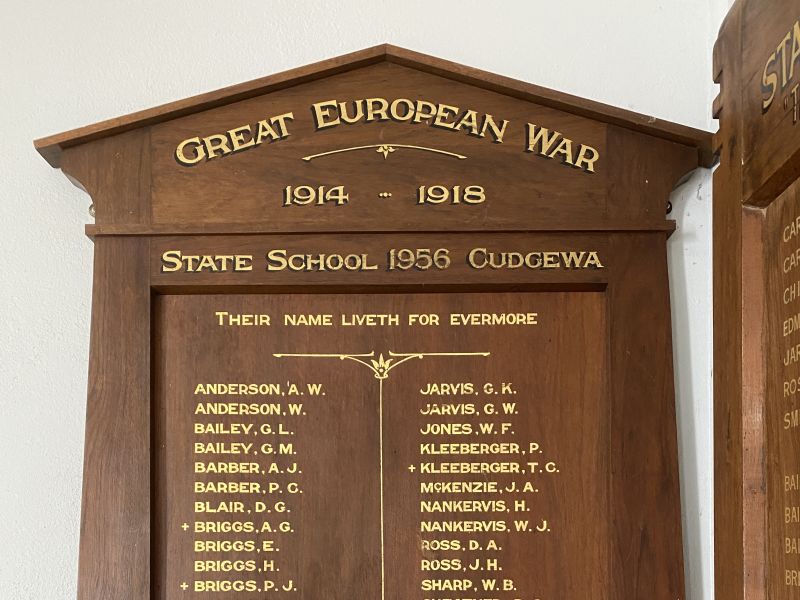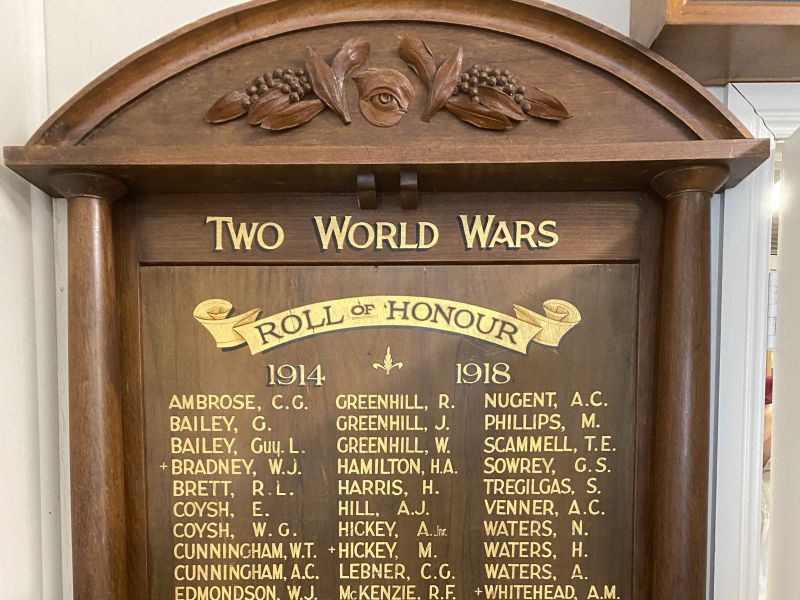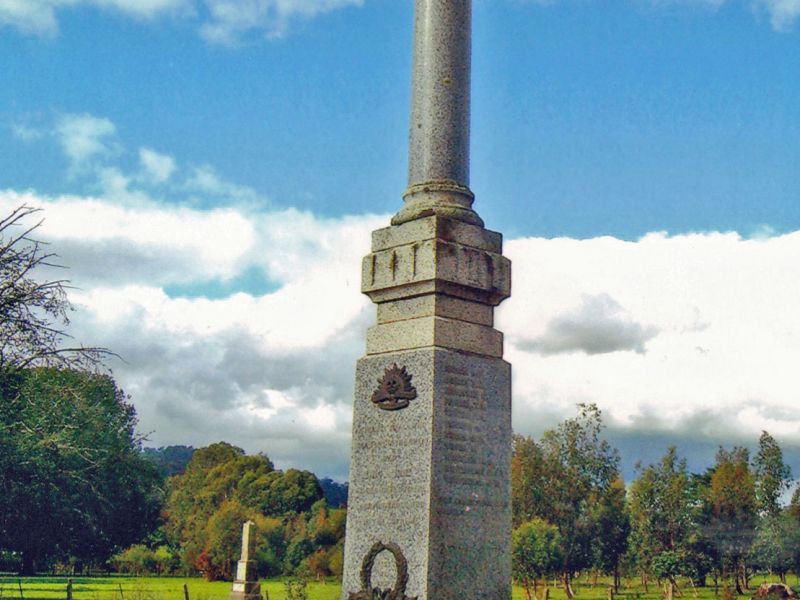
George Maxwell Bailey
 Stephen Learmonth
George Maxwell Bailey was born on August 2 1893, at Cudgewa. He was the fourth of nine children of Richard and Mary Eliza (Nee Rawes) Bailey.
George enlisted on the first day of September, 1915, in Melbourne, Victoria. He was allocated the Service Number 1362, and placed in the 1st Reinforcements of the 29th Battalion. After training with the 22nd Depot Battalion at Broadmeadows, he embarked on HMAT A11 Ascanius at Melbourne on November 10, 1915.
Upon landing at Suez, the reinforcements underwent more training. On February 3 1916, he was taken on strength with the 29th Battalion. In mid-June of that year, the battalion embarked on the HT em>Tunisian and sailed to Marseilles on the French south coast.
The battalion fought its first major battle on the Western Front on July 19 1916, at Fromelles. After one day, the 29th recorded 17 killed in action, 161 wounded and 68 missing. This action would be described by a soldier from the 29th: “the novelty of being a soldier wore off in about five seconds. It was like a bloody butcher's shop.” George was wounded in action with a gunshot wound to the leg. He was taken to hospital, where he stayed for a short while before being transferred to the No. 1 Convalescent Depot. He rejoined his unit on July 28 1916.
On January 1 1917, George was admitted to the North Western Hospital, Hampstead, with an undiagnosed condition while on leave in England. He rejoined his unit after six weeks. In late September, the battalion played a major role at the Battle of Polygon Wood, fought in the Ypres sector in Belgium. In early October 1917, he was promoted to Corporal, and the following day to Sergeant, after the death of another Sergeant in the battalion.
In mid-December he was once again admitted to the 1st Australian Casualty Clearing Station with a foot abrasion and bruised back. He rejoined the battalion four weeks later. Between February 13 and March 1 he was on leave in England. The battalion had a relatively quiet time during the German Spring Offensive, as the 5th Division, to which it belonged, was in reserve for most of it. George’s final action would be an attack on Morlancourt on July 29
In late August of 1918, George was detached for duty with the 14th Training Battalion in England. In October. He transferred to the School of Instruction at Jellalabad Barracks, to undergo training to become a commissioned officer. His final transfer came on November 22 1918, when he went from the 58th to the 5th Battalion.
He left England aboard the Hospital Transport Karoa on March 28 1919, arriving in Melbourne six weeks later. He was discharged from the A.I.F. on June 30 of that year. For his service during the war, he was awarded the 1914/15 Star, the British War Medal and the Victory Medal.
On July 7 1923, George married Eliza Jane (Lila) Beel at Beechworth. George and Lila moved to Bayswater, where they operated an orchard with George’s brother, Guy. They would have two daughters. By 1936, George had left the business and worked as a motor driver with the Vacuum Oil Company at Yarraville. He would rise to the position of foreman.
In March of 1942, George enlisted in the 2nd Battalion of the Volunteer Defence Corps and was given the Service Number V370537. By late May 1943, George had been promoted to Captain. His appointment was terminated on October 31, 19145.
The couple continued to live at 4 Primrose St, Blyth (now Brunswick East) until George’s death on February 18 1979, in Heidelberg, Victoria. He was laid to rest at the Fawkner Memorial Park. Lila lived for another fourteen years, dying on September 16 1993, at Kew, Victoria. She lies next to George.