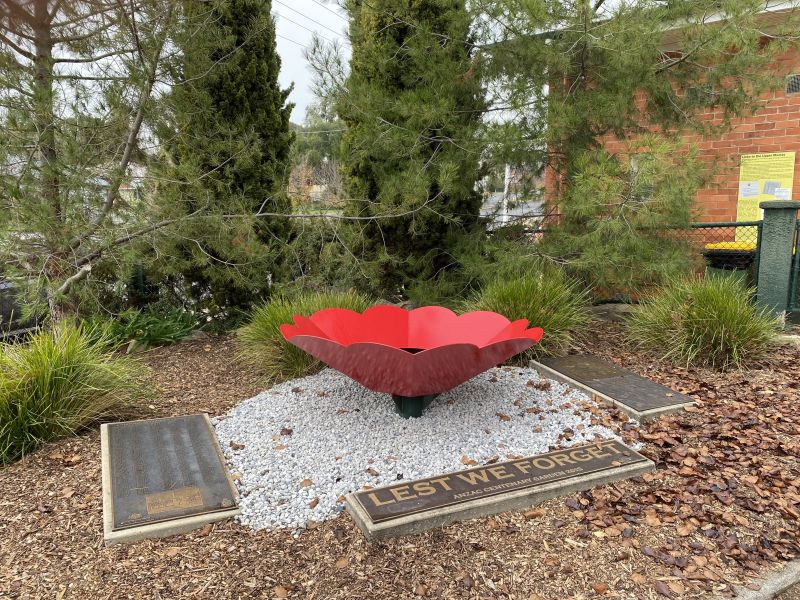
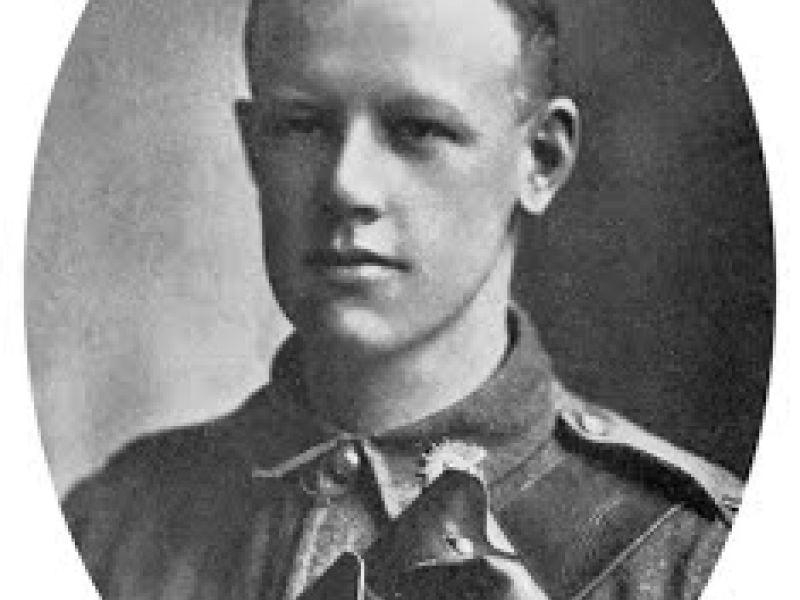
Albert Gordon Burt
 Stephen Learmonth
Albert was born in 1893 in Lichfield, England. At his birth, his father, Albert, was 29, and his mother, Henrietta Mary (née Ward), was 26. Albert would have one brother, Frank Elliot, and two sisters, Elizabeth Maud (from Albert’s first wife, who died in 1889) and Enid Mary.
Albert was educated at Aston Grammar School, Warwickshire, and King Edward’s Grammar School, Stratford-upon-Avon. He earned his Senior Oxford Certificate and gained employment at Kimbolton College as a junior master. With the idea of undertaking church mission work, he came to Australia in 1911. However, he joined the teaching service in March 1913 and was appointed temporary head teacher at School No. 1746, Benambra. In July of the same year, he was transferred to No. 1460 Swift’s Creek; in September to No. 2086 Walwa; and in January 1914, to No. 3647 Mount Alfred. He was described as being bright and enthusiastic.
On 7 August 1915, Albert enlisted in the 1st AIF in Melbourne, Victoria. He was given Regimental Number 2159 and was put on strength with the 15th Reinforcements of the 4th Light Horse Regiment.
Upon enlistment, Albert was 5 feet 7 inches (170 cm) and weighed 164 lbs (61 kg). His complexion was fresh, his eyes grey, and his hair fair. Albert’s records show that he had four vaccination marks on his left arm, a scar on his left shin, and a mole on his left thigh. Albert’s religious denomination was given as the Church of England. Albert had prior militia service, having been a member of the Walwa Rifle Club for 2 years.
Albert embarked on 9 March 1916 on the HMAT A13 Katuna sailing from Melbourne. The trip would take him across the Great Australian Bight to Fremantle, on to Colombo, in Ceylon, before finally disembarking at Suez, at the southern end of the Suez Canal.
Upon arriving in Egypt, Albert was initially taken on strength with the 1st Light Horse Regiment at Tel-el-Kebir. Two weeks later, he was promoted to Corporal and transferred to the 4th Division Cyclist Company, stationed at Serapeum.
In early June 1916, Albert embarked on a troopship at Alexandria and sailed to Marseilles in southern France. On 9 July 1916, he was promoted to Sergeant and taken on strength with the 1st ANZAC Cyclist Battalion in France.
A transfer in October of that year saw Albert detached for duty with the 1st Anzac Headquarters Intelligence Police. It was while with this unit that Albert sustained injuries (contusion and lacerated wound to the head and a sprained ankle) on a motorbike whilst carrying an important message. The Court of Inquiry, held soon after the accident, found Albert was not to blame.
Albert spent two more periods in hospital as a result of illness and injury, one of which required him to be sent to England for treatment. The other resulted in many transfers, initially from the 2nd Australian Field Ambulance to the 12th Casualty Clearing Station and finally the 25th Stationary Hospital in Rouen, France.
On 12 March 1919, Albert was in hospital being treated for neurasthenia. This is a condition that is characterised primarily by physical and mental exhaustion, usually with accompanying symptoms such as headaches, insomnia, and irritability and is believed to result from psychological factors such as depression, emotional stress, or conflict.
Albert was granted extended leave on 3 June to visit his family in Lichfield, Staffordshire, England. Unfortunately, his records indicate that during this period, he was hospitalised with influenza and may not have been able to spend a great deal of time seeing his family.
On 28 August 1919, Albert embarked from England to return to Australia. Unfortunately, tragedy struck on 4 September 1919, when he was reported lost at sea while returning to Australia on board the HMAT A61 Kanowna. The boat was seven days from England when the fatality occurred. Records state that Albert drowned.
Albert’s disappearance went to Court, where numerous witnesses made statements. These included:
Sister Donaldson M.B being duly sworn states:
“I was night sister in charge of “G” Ward on the night 3-4 September in which Sergergent Burt was a patient. About 1.30 am, the Orderly reported to me that Sgt. Burt was missing. I had previously seen him in bed at 1 am. Before midnight, Sgt. Burt was very restless and had frequently got out of his bed and complained of being hungry. After being given some food he went back to bed and seemed perfectly quiet and normal. His previous conduct and manner did not lead me to believe he required special watching or at any time contemplated doing anything unusual. “
2nd Witness - Sgt. Elliot states:
“I am Ward Master for this ship and my tour of duty starts at 8 pm and finishes at 7 am. At 1.15 and 1.30 in the morning of the 4th September I discovered that Sgt. Burt was missing from his cot. I had previously seen him at midnight, when I gave him some supper, he was then in his cot.
During the night in question, I had seen Sgt. Burt on deck after 10 pm and had ordered him below as it was after ‘Lights Out’. From my own observations I had no reason to believe that Sgt. Burt contemplated suicide or anything of the sort. Immediately I missed Sgt. Burt I reported to Sister Donaldson and a search was made over the ship.”
3rd Witness - Pte during duty states:
“I am a Night Nursing Warden in the “G” Ward. On the night of the 3-4 September at about 1.15 am, I missed Sgt. Burt from his cot and reported the manner to Sgt. Elliot. Previously at about 1.05 am I had seen Sgt. Burt lying down in his cot. He was quiet.
Whilst attending to a patient I had seen Sgt. Burt leave his cot at 10.30 pm and again at 12.45 am and on each occasion I followed him up and brought him down.”
4th Witness - Pte Tellon S.G being duly sworn states:
“I am a Patient in the General Hospital on the main deck. About 12.45 am on the night 3-4 September I helped Pte Haynes to bring down Sgt. Burt from the deck, and saw him get into his cot.”
5th Witness - Captain Wilton A.C being duly sworn states:
“I am M.O in charge of “G” Ward. Sgt. Burt who was a patient in “G” Ward was suffering from debility following Influenza, in which the most marked feature was mental dullness. I was of the opinion that he was very susceptible to suggestion and his treatment was based on these lines. I had no reason to suspect suicidal tendencies.”
6th Witness - Major Frase A.C being sworn duly states:
“I am Senior Medical Officer on the H.M.A.T Kanowna. I examined Sgt. Burt on the afternoon of the 3rd September and diagnosed his condition as encephalitis following influenza, the chief measures being physical and mental slowness. At my examination he did not make any statement suggesting that he intended to take his life. He complained that he was unable to walk, but he walked out of my office slowly and clumsily. In my opinion it is quite possible that he made his way to the deck and tripped over some obstacle and fell overboard.”
7th Witness - Captain Landan G.F.S being duly sworn states:
“I am M.O in charge of Wards “H” and “E” . Sgt. Burt was a patient under me for over two months at No 3 A.A.H., Dartford. He was suffering from Debility after Influenza, he was very slow mentally and obsessed with the idea that he was becoming weaker. Under treatment he improved to some extent and never gave any authentic reason to suggest suicidal tendencies.
In regard to para 30 of A.F. B. 179 the “constant attendance of another person”, I took to mean he required company to prevent morbid introspection as far as possible.”
“The Court having duly considered the evidence finds that:
- An exhaustive search has been made without any trace being found and we are of the opinion that he fell overboard, whether accidentally or intentionally it is impossible to determine. In virtue of his complaint, it is possible that in walking along the deck he stumbled and so fell overboard.
- There is no blame attached to anyone and the staff were alert and at their posts.”
Albert is remembered on the Australian War Memorial Roll of Honour, the Villers-Bretonneux Memorial (Australian National Memorial - France), the Hollybrook Memorial, Southampton, England and the King Edward's Grammar School WW 1 Roll of Honour, Stratford-on-Avon, England. For his service during the First World War, he was awarded the British War Medal and the Victory Medal.