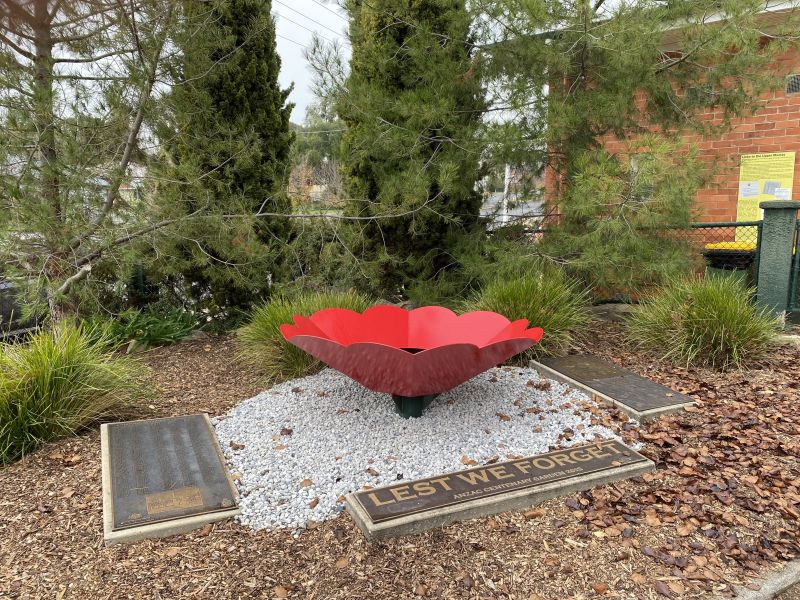
Alexander Baptie
 Stephen Learmonth
Alex Baptie was born on the 13th of September 1890 at Selkirk in Scotland to Alexander and Janet (née Gray) Baptie. He was the second eldest of four children. His father passed away on the 5th of May 1895, only one year after Alex’s youngest sibling, Maggie, was born.
The 1901 Scottish Census shows Alex living with two Aunts on his mother’s side, Charlotte and Margaret Gray, at Carterhaugh Cottages in Selkirk. Both he and a cousin, Janet Lourie, were attending school in Selkirk.
In about 1907, he enlisted in one of the Territorial Battalions of the King's Own Scottish Borders, the 4th Battalion. A Territorial Battalion was a part-time volunteer component of the British Army. Most units in the British Army had associated Territorial units. They were designed to reinforce the regular army for operations abroad, but due to political opposition, they were assigned to home defence. This would all change in 1914. Alex served for three years in this battalion before he was granted a discharge to move to Australia. Alex would encounter his old battalion on the Gallipoli Peninsula, where they were both involved in fighting the Turks.
On the 10th of June 1911, he boarded the SS Suffolk of the Federal Houlder Shire Lines at Liverpool, England and travelled to Australia, disembarking at Sydney. On the passenger list, he gave his profession as a wool spinner. Three years later, the SS Suffolk would be renamed HMAT A23 Suffolk and leased to the Australian Government for use as a troop transport.
At the time war was declared, Alex was 24 and working as a labourer on a farm at Walwa. He enlisted on the 4th of December 1914 at Liverpool in NSW, two days after the 1st convoy of Australian and New Zealand soldiers had disembarked in Egypt. He was allotted Regimental Number 1304 and taken on strength with the 1st Battalion, 1st AIF. On the 11th of February, Alex embarked on HMAT A48 Seang Bee at Sydney, NSW and sailed to join the rest of the 1st AIF in Egypt.
After further training in Egypt at Mena Camp, the battalion entrained for Alexandria on the 3rd of April 1915. They embarked on HMT Minnewaska and sailed to the island of Lemnos, where they disembarked at Mudros Harbour. The ship carried approximately 1900 men and 500 horses, plus a large amount of timber needed to build a wharf. While on the island, further training included disembarkation practice on ships and small boats.
Alex was a member of C Company, 1st Battalion, 1st Infantry Brigade, which landed on Gallipoli on the 25th of April, early in the morning, as part of the second and third waves. The Battalion’s war diarist wrote that they arrived on the beach at ANZAC with no casualties. The 1st Battalion was immediately directed onto 400 Plateau to reinforce elements of the 3rd Brigade. After spending four days in the firing line, the men were withdrawn to the beach to rest and reorganise. The rest was short-lived, and on the 1st of May, they relieved the Chatham Battalion of the Royal Marine Brigade in two portions of the line on MacLaurin’s Hill. The area was heavily shelled during the transition, and Alex was killed. He has no known grave.
Alex’s younger brother, Henry, had also emigrated overseas. However, his choice of country was Canada. In December 1915, he enlisted in the Canadian Army and served in France. Fortunately, he survived his ordeal at the front and returned to Canada in 1920.
Alex is remembered on the Australian War Memorial Roll of Honour, the Corryong War Memorial, the Lone Pine Memorial to the Missing, the Selkirk Roll of Honour and the Selkirk War Memorial. For his service, he was awarded the 1914-1915 Star, the British War Medal and the Victory Medal.