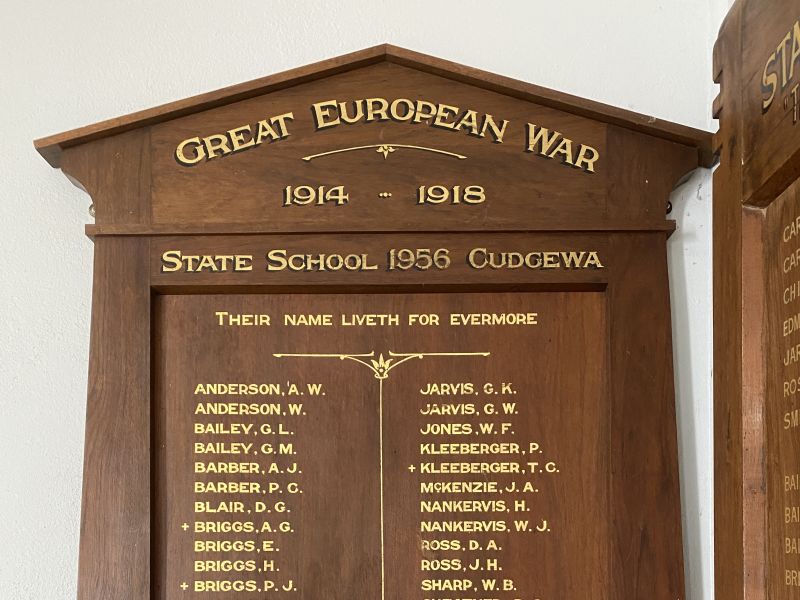
Alfred James Barber
 Stephen Learmonth
Alfred James Barber was born on January 19 1886, at Cudgewa, Victoria, to John Thomas and Ellen Ann Pearce. Percy was the second youngest of eight children, although two of his siblings died at birth. In 1901, at the age of 37, Alf’s mother Ellen died. In July 1902, Alf was out shooting foxes with his brother George when the rifle he was carrying accidentally went off, striking him on the calf and taking a downward course, lodging itself in his foot. While growing up in the Upper Murray, Alf showed great skill at football, playing for Cudgewa in the local competition, and being mentioned in the local news football reports many times. In the 1908 Premiership game against Corryong, Alf and Corryong player W Ambrose both jumped up to take a mark but heavily collided with each other, sustaining painful facial injuries. Corryong won the Premiership, scoring 6 goals 18 behinds to Cudgewa’s one goal.
Alf was one of the few men in the Upper Murray who became a professional soldier. At age 26, he enlisted at Queenscliff, Victoria, signing on for five years in the Permanent Military Forces. He was taken on strength with the Royal Australian Garrison Artillery (RAGA) at Fort Queenscliff. He was allocated the pre-war Army number of VP665 (Victorian, Permanent, Number 665). Alf served in the RAGA for three and a half years. Members of RAGA were not permitted by law to serve overseas, so for Alf to fight overseas, he had to resign from the RAGA and then enlist in the A.I.F. He did so on July 8 1915. He was assigned the Service Number 413 and placed in the 36th Heavy Artillery Brigade (2nd Australian Siege Battery) as a Gunner. Nine days later, he embarked on HMAT A67 Orsova at Melbourne. The following day, he was promoted to Acting Bombardier (Corporal).
In late February 1916, he disembarked at Boulogne, France, after undergoing training in England. The 2nd Australian Siege Battery (also designated the 55th Siege Artillery Battery in the British Army Structure) was used for destroying fortified enemy positions. The battery used 9.2-inch howitzers rather than field guns. Howitzers fired their projectiles at a high angle, which gave a plunging shell rather than the flat trajectory of field guns. These weapons were capable of firing a 130kg projectile up to 9.2km.
Between March and April 1916, the brigade was stationed at Maroeuil, just north-west of Arras. Most of their gunfire was aimed northward along the line of Vimy Ridge. In June it moved to the region of Beauquesne, just north of Amiens. This allowed the brigade to cover British divisions attacking on the northern flank at the Third Battle of Ypres (Pozieres). During this time it made first contact with the Australian divisions operating at Pozieres. The brigade returned to the Arras area two months later.
On May 28 1917, Alf was one of five other ranks who suffered gas poisoning from German gas shells. He was admitted to the 138th Field Ambulance before being transferred to the 17th Casualty Clearing Station. Ten days later he was admitted to the 24th General Hospital at Etaples. He would remain here for almost one month before being discharged to the Australian General Base Depot at Rouelles. He finally rejoined the 55th Siege Battery on July 18 1917.
In October of 1917, the brigade participated in the Battle of Passchendaele. October 4 turned out to be a bad day for Alf and the battery. While supplying covering fire for the advancing British divisions, German guns found their position. In minutes, all four guns were out of action. 17 other ranks were killed, 1 officer suffering from shell-shock, and 16 other ranks wounded or shell-shocked.
Other than the times Alf was in hospital, he had a very busy war. To list all the actions Alf and the siege battery participated in would take up a large amount of space. It’s sufficient to say that Alf and his mates were kept extremely busy between 1916 and late March 1918, when Alf’s war came to a stop.
On March 23 1918, Alf was wounded for a second time, with gas shell burns. He was admitted to the 7th Australian Field Ambulance and then sent to the Division Rest Station. His wounds were severe enough to warrant him being evacuated to England. Alf spent six days in the Military Hospital at Colchester and a further four days in the 3rd Auxiliary Hospital at Dartford.
After being discharged from the hospital, he was granted a two-week furlough in England. In late April 1918, he marched into No. 4 Convalescent Depot at Hurdcott. The next record in his Service Record is that he embarked on HT Orca. Whilst at sea, he was admitted to the ship’s hospital suffering from an abscess.
Alf returned to Australia in February 1919. On May 30, he was discharged from the A.I.F. as medically unfit (disability - gas poisoning). That year, he married Ellen Frances Jackson of Queenscliff. Their first son, John Alexander Barber, was born in April the following year. In July of 1920, he re-enlisted in the permanent forces. Two more sons, Keith in 1922 and Graham in 1924, would be added to the family. Tragedy struck the Barber family on May 22 1928, when Graham died. The couple would also have two daughters, one born in 1926 and the other in 1930.
As Alf’s three-year enlistment term ran out, he would re-enlist for another three years. In 1929, RAGA became affiliated with the Royal Australian Artillery. Alf would remain at Fort Queenscliff and, on November 11 1939, transfer to the 2nd Australian Artillery Brigade (Port Phillip Coastal Artillery).
In 1940 he was awarded the Meritorious Service Medal. Two years later, he was promoted to Warrant Officer 1st Class. Alf was discharged on June 19 1946, having reached retirement age. During his service, Alf was awarded the Meritorious Service Medal, the British War Medal (1914-1918), the Victory Medal (1914-1918), the War Medal (1939-1945), and the Australian Service Medal (1939-1945).
Alf passed away on September 29 1956, in Queenscliff, Victoria, and was buried at Queenscliff Cemetery. Ellen Frances Jackson on September 5 1960, and was buried with her son Graham in Queenscliff Cemetery.