Alfred James Turner
 Stephen Learmonth
Alfred was born in Bethanga, Victoria, in 1892. He was the sixth child of John William and Frances Margaret (née Osmond) Turner. He would be part of a large family, having three sisters and six brothers, although one brother, Joseph, born in 1895, would die at a very young age.
Alfred enlisted on the 26th of July 1915 at Liverpool in NSW. At the time of his enlistment, he was a single, 21-year-old labourer. He was allocated the Regimental Number 2942 and became part of the 9th Reinforcements for the 2nd Battalion, which was currently serving on the Gallipoli Peninsula.
The 9th Reinforcements embarked on HMAT A8 Argyllshire at Sydney, NSW, on the 30th of September 1915, disembarking at the Egyptian port of Alexandria about six weeks later. On the 27th of November 1915, he was admitted to the 4th Auxiliary Hospital at Abbassia, suffering from the mumps. He rejoined his battalion on the 12th of January.
It was at this time that the 1st AIF underwent a major reorganisation and expansion. The 1st Division and the 4th Infantry Brigade were split into two, and their infantry battalions were divided. The resulting halves were brought up to strength with recently arrived reinforcements. So, as a result of this, Private Alfred Turner became part of the 54th Battalion, 14th Infantry Brigade of the 5th Australian Division on the 16th of February 1916.
After more training in the sands around Tel-el-Kebir, the 54th Battalion embarked on HT Caledonian at Alexandria, Egypt, on the 19th of June 1916. It took ten days for the troopship to traverse the Mediterranean and arrive at the Port of Marseilles in the south of France.
Alfred would have been amazed to see the difference in countryside between the region of Tel-el-Kebir and the farmlands of France as he travelled by train towards the battlefields of northern France and Belgium. Sapper Roy Denning of No. 1 Field Company Engineers stated in his memoirs: “The countryside was beautiful. The many fast-flowing rivers and little streams were positively fascinating. We had delightful surroundings of beautiful scenery and green foliage, so radiant with life and fresh growth. What a contrast after the dirty, dusty, sandy sun-scorched Egypt.”
The 54th Battalion and the remainder of the 5th Australian Division (between 10000 and 20000 troops) arrived in France in time to participate in the Australian troops' first battle on the Western Front at a village called Fromelles. In an engagement mirroring those of Lone Pine and Nek in Gallipoli, the attack was intended as a feint to withdraw German troops away from the British offensive on the Somme. On the 19th of July, the battalion moved from Bac-St-Maur at 1400 hours to the front line trenches. Allied artillery had been shelling the German lines for the previous 7 hours. This had robbed the attacking troops of any chance of achieving surprise against a well-fortified village. As a result, when the 54th and the other battalions of the division attacked, they suffered heavily at the hands of the German machine-gunners. The 54th attacked the enemy trenches at 1850 hours and occupied the German front-line trenches about ten minutes later. Lacking flanking support and under fierce counterattack, the Australian line, including the 54th, withdrew to its starting positions. By 0800 the following day, the battle was over. The 54th Battalion casualties included 3 officers and 70 OR killed, 11 officers and 277 OR wounded, 4 officers and 169 OR missing. The 5th Australian Division suffered 5533 casualties. It was incapable of any offensive action for many months afterwards.
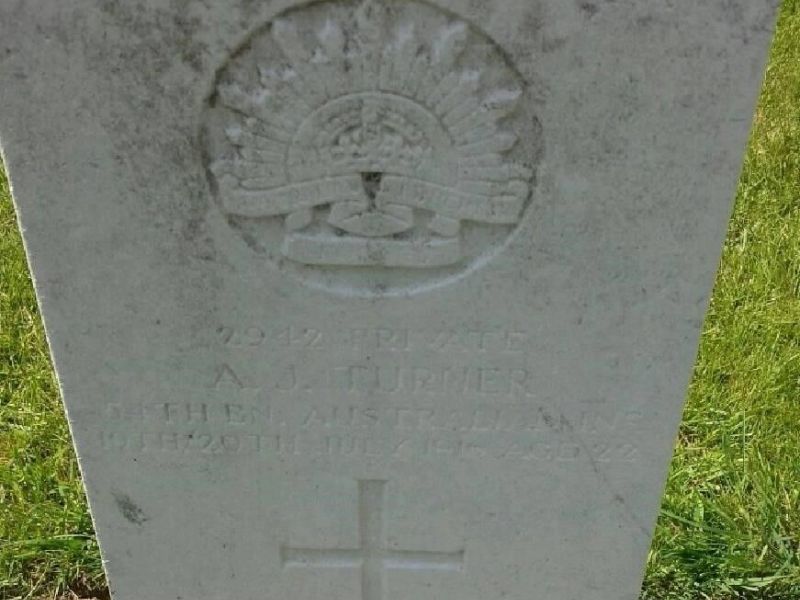
One of those killed was Private Alfred James Turner. He was buried in Anzac Cemetery just north of the village of Sailly-sur-la-Lys, between Armentieres and Bethune, France.
For his service during the First World War, Alfred was awarded the 1914-1915 Star, the British War Medal and the Victory Medal.