Allan Graham Hamilton
 Stephen Learmonth
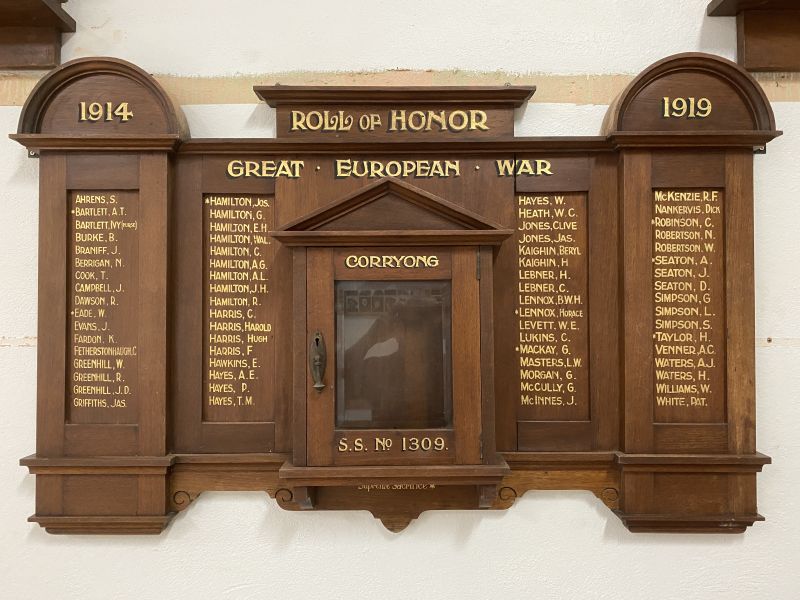
Allan Graham Hamilton was born on August 3 1884, at Moyhu, Victoria. He was the seventh of twelve children of William Charles and Sarah (nee Mills) Hamilton. Although the couple had twelve children, three of them would die before reaching adulthood. William passed away in September 1910.
Allan enlisted on December 17 1915, at Melbourne. He was single, aged 31, and working as a labourer at Cudgewa North. He was allocated the Service Number 20297 and placed in the 8th Field Artillery Brigade (FAB). Three of Allan’s younger brothers, John, Alick and Robert, would enlist in February and March the following year. All three would return home. Allan’s initial muster was as a Gunner, but this changed to Driver three weeks before he embarked on HMAT A7 Medic at Melbourne on May 20 1916. He arrived in England on August 17.
On October 3 1916, Allan was transferred to the 3rd Divisional Ammunition Column (DAC). In late November he proceeded overseas to France. Allan’s role as a driver in the DAC was to supply the 3rd Division Artillery with ammunition. The unit used a variety of methods including motor vehicles, horse-drawn transport and heavy and light railways. Allan would see action in the Battle of Messines in June 1917.
On October 4 1917, Allan would have been busy supplying ammunition to the guns during the Battle of Broodseinde. At the end of this battle, he was remustered as a Gunner at his own request, just in time to be part of the artillery barrages for the Battle of Passchendaele, or 3rd Ypres, on the 12th October.
In January 1918, Allan was on leave in England. Unfortunately, he developed conjunctivitis and, on January 16, was admitted to the 1st Australian Auxiliary Hospital at Harefield Park in Middlesex. After being discharged one week later, he was granted the remainder of his leave. Allan rejoined his unit in France on February 1 1918. One week later he was detached for duty with the 4th FAB. Two months later, he returned to the 3rd DAC.
During the final year of the war, Allan would see action at Amiens and Mont St Quentin in August, and at the breakthrough of the Hindenburg Line in September.
With the Armistice signed on November 11, many soldiers were granted periods of leave to England while awaiting repatriation. Allan spent the period around Christmas 1918 back in England. He returned to France on January 4 1919. In early April, he was sent back to England as part of Quota 21 for repatriation to Australia.
Allan returned to Australia aboard HMAT A30 Borda, and arrived home on June 27 1919. The Cudgewa community held a welcome-home celebration for Allan and others on August 29. The Corryong Courier reported on the event in their September 12 1919 issue.
“CUDGEWA NORTH
On Friday, 29th ult., a welcome home was tendered to three returned soldiers — Sergt. Campbell and Ptes Allan Hamilton and C. Marshesea [Marshallsea]. Mr. A. Freitag occupied the chair, and in a short speech tendered the boys a hearty welcome on behalf of their friends. After a short concert, Pte Marshalsea [sic], on behalf of his comrades and himself thanked the people for their welcome. He laid stress on the good work the Red Cross, the Comforts Fund, and the Young Workers' Patriotic Guild had done. The audience then lustily sang For They are Jolly Good Fellows, and gave the lads three resounding cheers. After a sumptuous supper dancing was continued till day-break.”
He was discharged on September 12 of that year. For his service during the war, he was awarded the British War Medal and the Victory Medal.
Allan returned to the Upper Murray after the war and continued to work as a labourer up until about 1936 when he changed to dairy farming at Walwa. In 1933 he married a Tintaldra girl, Grace Ethel Lowden. The couple would settle in Walwa and operate a dairy farm. Allan passed away on April 7 1959, at Walwa, and was buried in the Walwa Cemetery. Grace died on 13 December 1974 and was laid to rest with Allan.