William Griffin Doughty
 Stephen Learmonth
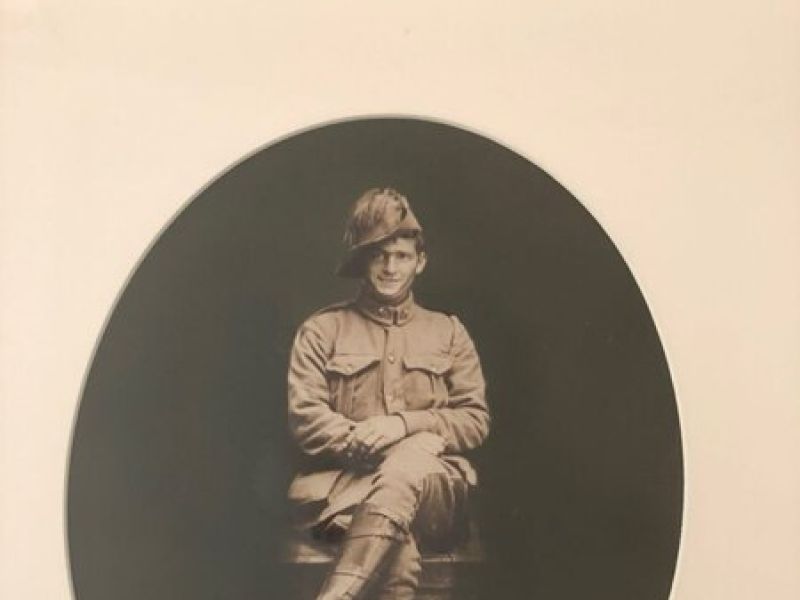
William Griffin (Bill) Doughty was born on 23 August 1891, in the town of Tumbarumba, New South Wales, to Robert William Doughty and Sarah Ann, nee Griffiths. He would be one of seven children in the family.
Bill married Agnes Mary Webster in 1914, and they had two children together. Their names were Mabel Alice Doughty (born 1915) and Edward William Doughty (born 1918).
Four of Bill’s brothers also enlisted in the AIF, although at earlier dates than he did. At enlistment, Bill was a 23-year-old labourer, married with one child, a daughter, Mabel. He was 165 cm tall, weighed 60 kg, and had a chest measurement of 82 cm. According to his enlistment papers, Bill’s hair was brown, as were his eyes, and he had a fair complexion. His religious denomination was given as Church of England. His attestation papers include a note that mentions previous service in the AIF for a period of 146 days before being discharged as medically unfit. There is no further evidence of this period of service in his record, and it leads us to wonder when and where he served.
Bill was taken on strength with the 15th Reinforcements of the 13th Light Horse Regiment on 21 October 1916 and given the Regimental Number 2141. He embarked on HMAT A67 Orsova on 6 December 1916 at Melbourne, Victoria, and disembarked at Plymouth in England on 17 February 1917. One day later, he marched into the 13th Light Horse Regiment stationed at Kandahar Barracks in Tidworth.
Bill was still in England when he was admitted sick to the Sydney Hall Hospital at Weymouth on 10 April, 1917. He would remain here for a period of three months, marching out to the No. 8 Convalescent Depot at Hurdcott. Bill’s illness led to his reclassification to B1 on 29 July, allowing him to undertake Garrison duties abroad. Two weeks later, he was reclassified as C1, fit for Garrison Service at Home Camps. A note in his medical record indicates that the reclassification was due to a general disability after suffering from CSM. CSM (cervical spondylotic myelopathy) is a nervous system disorder of the spinal cord that causes pain and difficulty in walking.
On 27 August, he embarked on HMAT A82 New Zealand to return to Australia. He was discharged medically unfit on 30 November 1917. For his service during the war, he was awarded the British War Medal.
Tragedy struck on 29 March 1921 when Bill and Agnes's daughter, Mabel, died at the age of five. In 1940, their son, Edward, enlisted in the CMF with the 21st Light Horse Regiment. On 21 March 1940, he left Wallgrove Military Camp, where the Tumbarumba Light Horse were training, and began to motorcycle home for a few days' leave. Not far from the camp, he collided with a car. His injuries were so severe that he died the following day. He was only 21 years of age.
Electoral roll records indicate that Bill lived in the Corryong, Goulburn and Tumbarumba areas. He passed away on 8 August, 1969 in Albury, New South Wales, when he was 77 years old. He was buried in Tumbarumba General Cemetery. Agnes passed away two years later