William (Bill) Benjamin Sharp
 Stephen Learmonth
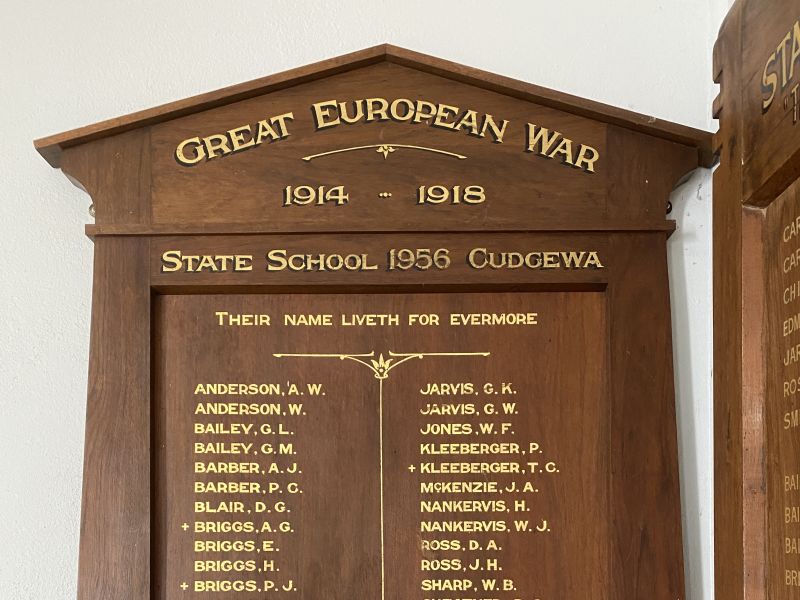
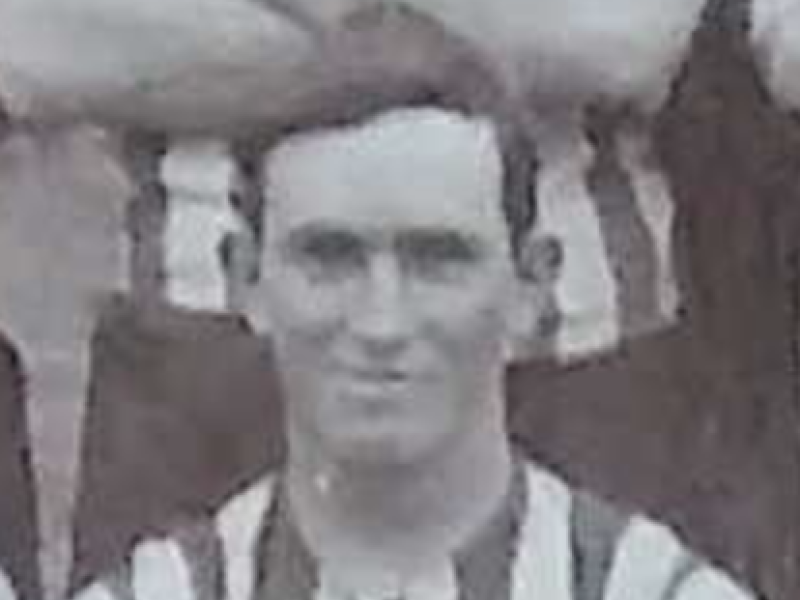
William (Bill) Benjamin Sharp was born on February 28 1890, at Tintaldra, Victoria. He was the eighth of ten children of James Henry and Harriot (nee Jones) Sharp. Harriot passed away in 1900, when Bill was only ten. The boys of the Sharp family enjoyed playing cricket and football. Bill captained the Cudgewa Football Club to the premiership in 1914.
In April 1908, Bill and two of his brothers, Edward and James, applied for separate land grants near their father’s existing property, through the Local Land Board. Bill and Edward both applied for three acres, while James applied for two, intending to make a garden on the block. The Board refused all three applications. The winter of that year was severe, with snow falling on the nearby hills. Many dairymen in the district, including the Sharp family, lost valuable stock.
Bill enlisted at Melbourne on March 22 1915. At the time, he was single, 25 years old, and working as a labourer in the Cudgewa district. He was allocated Service Number 698 and allocated to C Company of the 24th Infantry Battalion. After initial training, he embarked on HMAT A14 Euripides at Melbourne on May 10.
In Egypt, July and August were spent training, making up for the limited training done back in Australia. In early July, Bill was admitted to the No. 1 Australian General Hospital at Heliopolis, Egypt. He remained here for ten days before returning to his battalion. On September 4, the 24th went ashore at Gallipoli and spent the next 16 weeks sharing duty at Lone Pine with the 23rd Battalion.
The battalion was evacuated from Gallipoli on December 20. In March 1916 it sailed to France and the Western Front. On the night of the 29/30 June 1916, Bill took part in a raid on German trenches in the Rue Marle area of northern France. The raid took five German prisoners at the cost of one OR (Other rank) killed and two wounded. Bill would have also participated in the battalion's first major offensive around Pozieres and Mouquet Farm in July and August.
On September 8 1916, Bill was transferred to the 6th Machine Gun Company. This unit was equipped with the water-cooled Vickers medium machine gun. Its role was to provide coordinated and sustained indirect and defensive fire for the infantry battalions. In late May 1917, he was admitted to the 2nd Australian Auxiliary Hospital while on leave in England. He joined his unit in France in late June. On July 13, he was promoted to Corporal.
The British Second Army launched an operation at Broodsiende, near Ypres, in early October of 1917. For the first time in the war, the I and II Anzac Corps were fighting side by side. The 6th MG Company was in support of the advancing troops. At some time on October 4, Bill was wounded by shrapnel in his left shoulder. Over the next few days he would pass from the 6th Field Ambulance to the 1st South African General Hospital, at Abbeville, France. He was evacuated to England aboard the HS Grantully Castle and admitted to the London War Hospital. He spent most of November in the 3rd Auxiliary Hospital at Dartford before being admitted to No. 3 Convalescent Depot at Hurdcott.
On January 2 1918, he was reclassified as B1A4, free from serious medical issues and fit for overseas training camps. Bill would spend two months at the Overseas Training Brigade at Longbridge, Deverill. In early May, he boarded a ship at Folkstone that carried him across the English Channel and back to France. In mid-May he was transferred to the 2nd Machine Gun Battalion, a combination of the 5th, 6th, 7th and 22nd Machine Gun Companies. On June 6, he was wounded in action for the second time, suffering from a gunshot or shrapnel wound to his head. By June 18, he had been evacuated to England, to the General Civil Hospital in Birmingham. Bill was diagnosed as having a severe contusion to the back, most likely caused by the impact of shrapnel. He was transferred to the Military Hospital at Dartford, where he remained for three weeks. After being discharged from the hospital, he spent nearly six weeks recuperating at the No. 3 Convalescent Depot at Hurdcott.
On October 22, Bill was transferred to the Overseas Training Battalion. One week before the signing of the Armistice that would end the fighting, Bill was transferred again, this time to the Machine Training Depot at Parkhouse on Salisbury Plain in Wiltshire. In mid-January 1919, he moved out to the Reserve Brigade Australian Artillery at Heytesbury to await repatriation to Australia. This occurred on February 19, when he embarked on HMAT Orca. On the last day of March 1919, Bill set foot back in Australia.
He was discharged on June 6 1919, at Melbourne. For his service during the war, he was awarded the 1914/15 Star, the British War Medal and the Victory Medal. He returned to Cudgewa where he resumed his occupation as a labourer.
On July 14 1921, Bill married Jeanie Lockhart Boyd Scott at South Melbourne. Jeanie was born in Glasgow, Scotland, in 1900 and sailed to Australia on the SS Benalla in May, two months before her marriage to Bill. We can only presume that Bill and Jeanie had met in England, while Bill was either on leave from France or recuperating from being wounded.
The couple settled in the Corryong District and had two children, Belinda in 1923 and William in 1928. William Senior continued to work as a labourer in the district. At some point before 1936, Bill became a dairy farmer. Tragedy struck the family when their son, William, died at age 12 on December 19 1940, at the Corryong District Hospital, following an attack of appendicitis. By 1963, the couple had moved to Wangaratta and were living at 9 Taylor Street.
Jean died on September 11 1976, and was buried in the Cudgewa Cemetery. Bill passed away at Wodonga three years later on April 11 1979, and was buried alongside Jean.