William (Billy) Vernon Swingler
 Stephen Learmonth
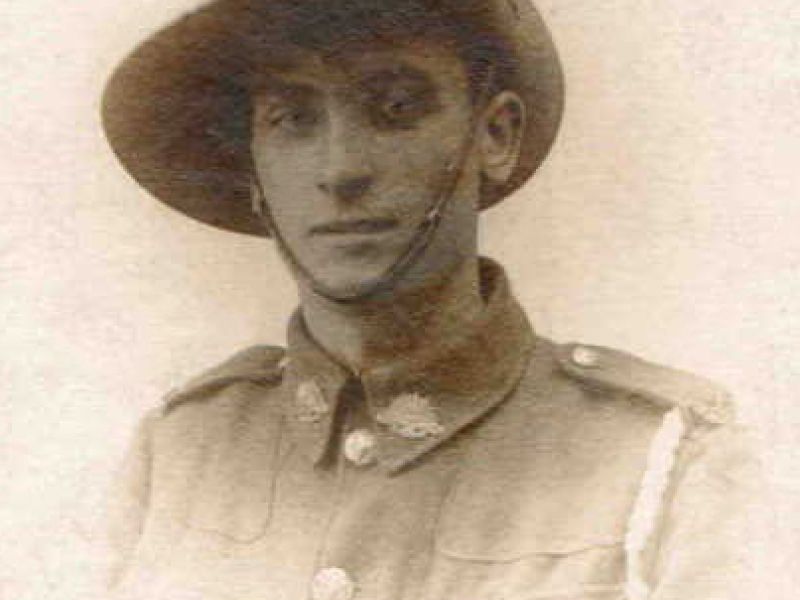
William (Billy) Vernon Swingler was born on 6 May 1897, the youngest of two children of Benjamin Thomas and Bertha (née Sanderson) Swingler of 44 Jesse St., Bradford, Yorkshire, England. His only sibling, Lily, was one year older. In 1910, his mother passed away. Two years later, he and his father emigrated to Australia, while his sister remained in England with family. The passenger list gives Benjamin's profession as a casemaker, while Billy is listed as an apprentice. Prior to emigrating, Billy was employed as an axle greaser.
Billy enlisted in Sydney on 27 August 1914. At the time, he was single and working as a station and farm hand for C. A. Hill in the Corryong District. He was allocated the Service Number 654 and placed in C Company of the 4th Battalion. On 19 October, the battalion embarked on HMAT A14 Euripides at Sydney. After a brief stop in Albany, she sailed with the rest of the first ANZAC Convoy, arriving in Egypt on 2 December.
On 25 April, the battalion landed at ANZAC in the second and third waves. It played an integral part in the defence of the beachhead. Billy would fortunately miss the charge at Lone Pine during the battalion's August offensive, as he had been evacuated to Mudros with influenza. It’s unclear from his records whether he returned to ANZAC, as within a week of being discharged from No. 2 Australian Stationary Hospital at Mudros, he was evacuated to the Military Hospital on Malta with dysentery. In early September, he was sent to England; however, the text in his Service Record is difficult to interpret as to what he was suffering from.
In mid-January, he returned to Egypt and rejoined his battalion at Tel-el-Kebir. It wasn’t long before he was back in hospital suffering from a dose of gonorrhea. It would be another two months before he would rejoin his battalion. In late March 1916, the battalion embarked on the HT Transylvania and disembarked at Marseilles, France, one week later. Billy would spend another few weeks in hospital before catching up with the 4th Battalion in the field.
The battalion’s first major action on the Western Front was at Pozieres in July. On 16 August, Billy was wounded in action with a gunshot to the thigh. He would rejoin the 4th a little over two weeks later. During 1917, other than fighting with his battalion in the difficult conditions around Ypres, he would be hospitalised twice, once with influenza, the other with scabies. Following his recovery from the latter, he was given a two-week furlough in the UK.
In March 1918, the battalion had returned to the Somme Valley in time to push back the Germans during their spring offensive. In mid-April, the battalion occupied trenches in the Strazeele sector of the front. The battalion’s war diary for 16 April reads: “CO visited the front line with Col. Stacey 1stBn enemy put down a very heavy barrage & attacked Bn on our left getting METEREN. Ab[out] 7.30 pm Capt Hay took C Coy & advanced our line some 500 ft & attacked a German trench. Operation very successful but Heavy Enemy M.G. [machine gun] fire encountered. 2/Lt Bauquea killed & Lt Green & Bainbridge wounded with 50 other casualties.” One of those casualties was Billy, who had been shot in the left foot. Within a week, he had been evacuated to a hospital in England. Billy’s war was over.
On 31 January 1919, he embarked on HMAT A40 Ceramic and returned to Australia. He was discharged on 23 June of that year. For his service during the war, he was awarded the 1914/15 Star, the British War Medal and the Victory Medal.
Billy returned to Corryong after the war. However, in 1925, he moved to Melbourne and joined the Victorian Police. That same year, he married Myrtle Petrie Watson. In 1929, the couple’s first child, Donald, was born. Two years later, they had moved to 40 Draper Street, Melbourne South. By 1933, there were two children in the family, Donald and Shirley. Tragedy struck that year when Donald died while a patient at the Children’s Hospital. In 1937, the Swingler family lived at 292 Victoria Street West, West Brunswick. The family would remain here for many years.
A number of Melbourne newspapers describe some of Billy’s experiences of being a city policeman. The earliest article is from July 1926 in The Argus. It details how Constable Billy Swingler was part of a police investigation team that closed down an illegal betting ring in Geelong. In a 1931 article in The Herald, Billy and Sergeant Deeley investigated the illegal sale of lottery tickets and arrested and prosecuted those involved. In 1933, Billy and another constable from the Gaming Squad were assaulted when they closed down an illegal betting ring in Brunswick. Finally, a 1938 report in The Argus details the arrest of three men at North Melbourne by Senior Detective Davis and Plain-clothes Constable Swingler for the theft of rails from old quarries.
On 7 February 1947, Billy collapsed and died in hospital that day. The 8 February issue of The Age reported on his death.
“POLICEMAN DIES AFTER COLLAPSE
Senior-Constable William Swingler, 49 years, Victoria-street West Brunswick, attached to Carlton police station, collapsed at the corner of Russell and Victoria streets yesterday afternoon. He was admitted to St. Vincent’s Hospital, where he died yesterday evening. Before being transferred to Carlton he was attached to the gaming branch, and later at Russell-street, Victoria Dock and Finders-lane police stations. He leaves a widow and daughter.”
Billy was buried in the Fawkner Memorial Park.
Billy’s father, Benjamin, deserves his own story. Born in 1874 in Yorkshire, by the time he was five, his father, mother and brother had all died. With no family to support him, he became an inmate of the Leicester Union Workhouse. Conditions here were harsh, the diet grim, and the labour punishing. Benjamin was held in the workhouse at the same time as Joseph Merrick, a young man whose disfigurement led to his being called the Elephant Man. It’s possible Benjamin may have known him. At the age of 19, Benjamin enlisted in the Royal Navy. Six months later, he was invalided out, although no reason is provided in his Service Record. Moving forward to August 1915, we find Benjamin enlisting in the A.I.F. in Liverpool, NSW. He would serve on the Western Front for almost one year. During that time, he was wounded in action and spent some time in the hospital recovering from illness. In May 1917, he was invalided back to Australia and discharged on 14 August 1917. He passed away at the age of 81 in August 1955.