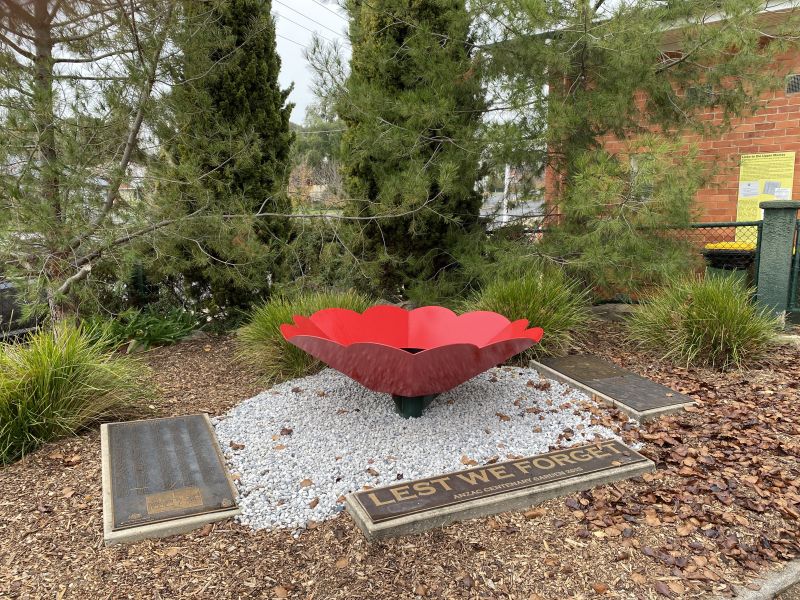
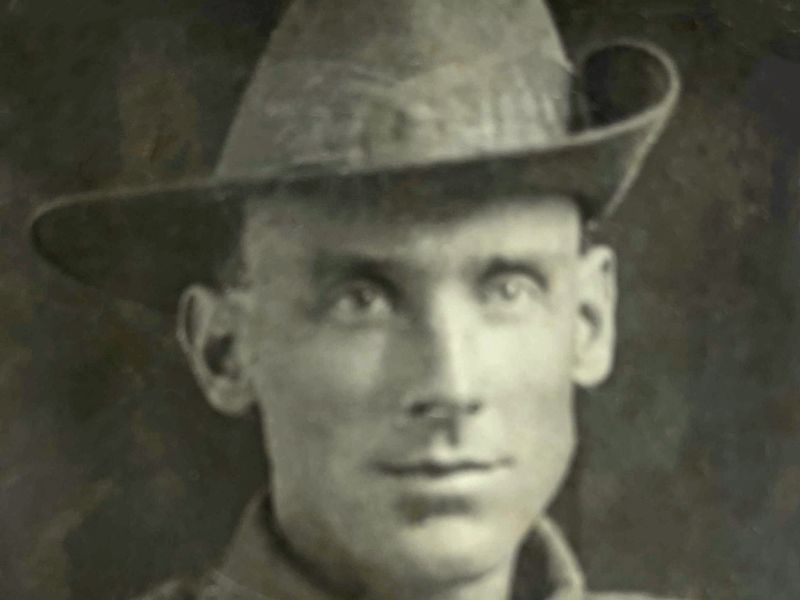
Centenary Appleton
 Stephen Learmonth
Centenary was born on 23 February 1888 at Jingellic, New South Wales. He was the third of eight children of William Jeremiah and Sarah Ann Frances (Nee Jones) Appleton. Tragedy struck the family in early February of 1903 when his oldest brother Ernest died of acute tuberculosis at the age of 18. In late October of 1911, a further tragedy occurred when Centenary’s younger brother Thomas drowned in the Murray River when his boat sank.
On 8 August 1915, Centenary travelled to Walwa for his medical examination before enlistment. Four days later, Centenary enlisted in Melbourne. He was allocated the Service Number 4431 and placed in the 14th Reinforcements for the 5th Battalion. This Battalion, as part of the 2nd Brigade, 1st Australian Division, had, days earlier, participated in the attack on Lone Pine. They would need the reinforcements! In late January of the following year, he embarked on HMAT A32 Thermistocles at the Port of Melbourne.
He arrived at Alexandria on 28 February. After six weeks' training, he was transferred to the 46th Battalion of the 12th Brigade, 4th Australian Division. This was part of the doubling of the AIF prior to moving to the Western Front.
From 6 to 15 May, Centenary was hospitalised with influenza. Two weeks later, he embarked on HT Kinsfauns Castle and proceeded to Marseilles in the south of France. Centenary was hospitalised three times over the next two years. In early April 1917 he was admitted to the 11th Stationary Hospital at Rouen, with trench fever. In October of 1917, he was wounded with a gunshot wound to his left shoulder. This sent him back to England for a lengthy stay at the Wellington Rd Hospital in Liverpool. His final hospitalisation, at CTD Parkhouse for a period of 55 days, was caused by a dose of a venereal disease that he received whilst on furlough after being discharged from Liverpool.
The 10 October 1916 edition of the Border Morning Mail and Riverina Times published a letter from Centenary to his father.
“Mr. W. J. Appleton, Burwood, Jingellic, has received a letter from his son, Centenary, who is fighting in France with the Lewis Machine Gun Section. He says 'We have been back and, had an other slap at Fritz, and he has split us up a little. Leslie Nichols, of Ournie, and I are all right, and came out without a scratch. Several of our chaps are wounded, and one killed. He was one of our pals. I was in the trench with him the night he was knocked. He was hit in the back and died very quickly. He was with us about four months, so we miss him very much. Several of our old mates in the company are killed. We walked over several of them the first after noon we went into the front line. One chap in our section got hit in the arm be fore he got in. It was nearly all shrapnel and shell fire. I was hit several times with shrapnel and pieces of shells, but never got hurt. When the pieces lob they are burning hot. One night we were asleep three miles from the front line, and a high explosive shell lobbed, and a piece about six inches long hit my steel helmet, which I had over my head. I picked the piece up to throw over to Les. Nichols, and burnt my finger. I let him pick it up for I didn't see why he should not be had as well as me. 'Nick'' is a bonza mate in the front line. He never gets excited when things are lively. I mean when Fritz is lobbing his iron foundries close to your 'possy' and you think the world is coming to an end, and you are nearly suffocated with smoke, and dust. One night I walked down the trench, to see the sergeant, and when I came back 'Nick'' was just crawling out from under some sand bags which a shell had knocked over on him and buried our guns. I didn't get his steel helmet till next morning, but I went up the trench and found him another. In his excitement he had forgotten about me going away and he said he thought I was buried in the bottom of the trench, and he was in a state when I got back. He was a bit shook up, but otherwise all right. Another night we were both together and we got knocked over and nearly covered with dirt. 'Nick' fell on top of me and I thought it was the end of the chapter. But we were all right when we picked ourselves up. We didn't have the luck to strike a charge, but the other lads tell me that when you hop into Fritz's trench he throws up his hands and yells out, ' 'Mercy Comrade!' Several of them came over to our trench and gave themselves up. I have got some shrapnel, bullets and a German rifle which I would like to take back with me, but if I get only myself back I will be well satisfied. I saw one of our aeroplanes brought down. It fell to earth somewhere behind the German lines. 'Nick' and I and three other chaps have been picked to go to a school for seven days. It has been raining here the last few days, but up till then it has been nice weather.”
The 46th Battalion fought in many of the major engagements along the Western Front. These included Pozières, Bullecourt, Messines and Passchendaele. Centenary was promoted to Corporal in late July 1917.
In mid April 1919, Centenary embarked on HMAT A73 Commonwealth and sailed home. For his service during the War, he was awarded the British War Medal and the Victory Medal. His name is recorded on the Tumbarumba War Memorial and the Upper Murray Great War Participants Roll.
On 23 June 1919, Centenary married Isabel Matilda Bates at St Matthew’s Church, Prahran. Their first son, Arthur, was born in 1916, and was followed by five more boys and two girls between 1920 and 1931. Unfortunately, one son, Ronald, died at the early age of two in 1933.
The Appleton family continued to live on the land at Jingellic. In May 1921, Centenary and his brother Samuel decided to dissolve their joint farming venture at “Burwood”, Jingellic. The 1949 Electoral Roll for the Commonwealth Division of Farrer records that Centenary and Isabel lived “off Fallon Street” in North Albury. Centenary’s occupation was listed as a poultry farmer.
Centenary passed away on 4 December, 1968, at age 80, in Albury. He was laid to rest with his wife, Isabel, at the Waugh Road Cemetery, Albury.