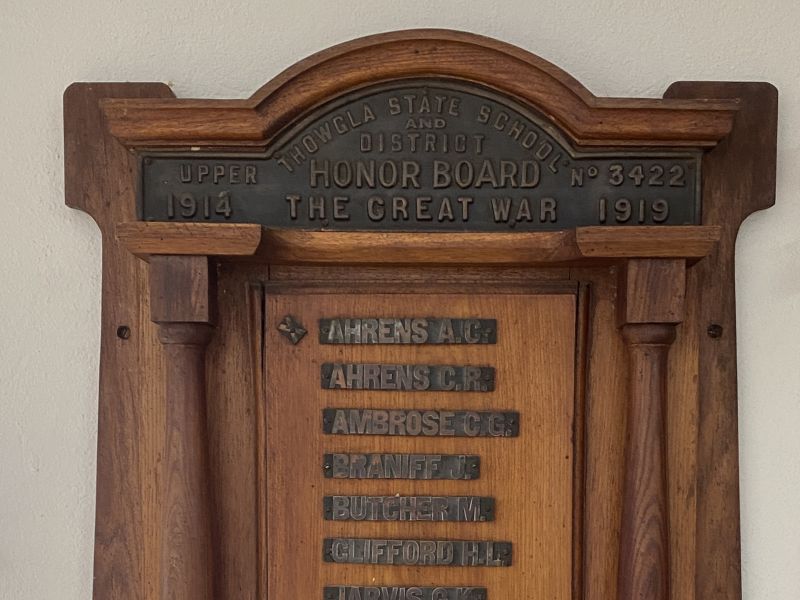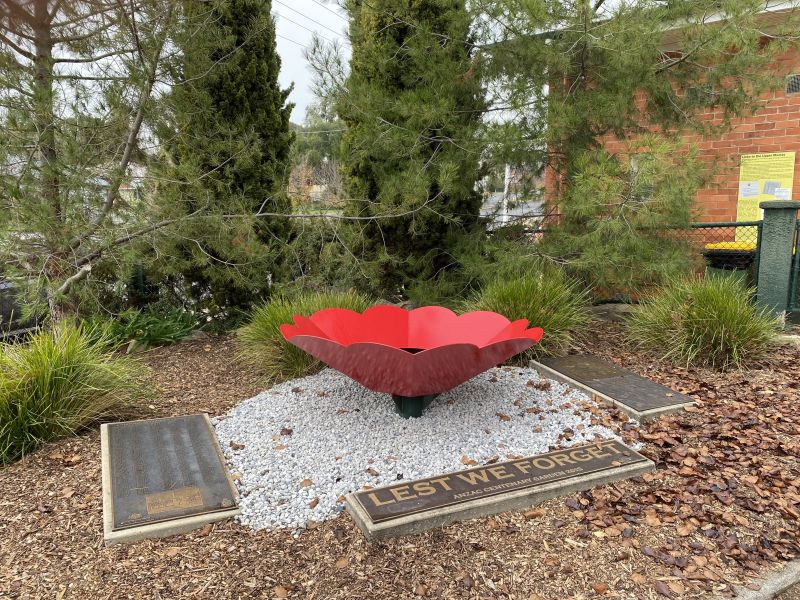
Charles Ahrens
 Stephen Learmonth
Charles Ahrens was born on April 4, 1888, at Corryong, Victoria, to Ferdinand Francis and Catherine, nee Denny, Ahrens
At the age of six, Charles and his family would suffer the first of many losses. One of the youngest members of the family, Prince Bismark Ahrens, died at the age of ten months. The Corryong Courier of February 15, 1894, reported the death.
“There has been considerable infantile mortality in this district in the last few weeks, and on Saturday last the youngest child, ten months old, of Mr and Mrs Ahrens of Colac Colac, was added to the list. The little one had been brought in to Dr Armstrong about a fortnight before its death, and he found that it was then suffering from troubles arising from teething. The child for a time seemed to be recovering but at the end of last week a relapse occurred and death supervened on Saturday. The remains were interred in the Corryong Cemetery on Sunday, the greatest sympathy being shown for the parents by the residents of the district.”
Tragedy struck the Ahrens family again in May 1895, when Charles’ eldest brother, Francis, passed away. The May 16 edition of the Corryong Courier of that year once again reported the death.
“The death occurred on Monday of a son of Mr F Ahrens, of Thougle Creek. The deceased, who was 19 of age, had been wasting away for a considerable time, having suffered from mental enfaeblement from birth. Latterly he refused to take food, and gradually wasted away to a shadow. Under the circumstances - there being no hope of his mental incapacity being overcome - death was a happy release. His remains were interred in the Corryong Cemetery on Wednesday.”
Charles was part of a family that played an active part in the Upper Murray community. Charles, and his older brothers Ferdinand and Swift, played football for Corryong and Thougla. His father, a native of Hanover, Germany, carried on the trade of a hawker. He purchased land at Upper Thougla and cultivated a market garden, supplying Corryong with vegetables. No doubt, all of the children would have been required to work in the garden.
At some stage prior to 1907, Charles moved to Western Australia and lived near Wickepin in the wheatbelt region. An area where his uncle and family had moved to from South Australia. Charles picked up work as a sleeper hewer for the railway.
He enlisted at Blackboy Hill, WA, on September 14, 1914. He was allocated Regimental Number 49 and placed in B Company of the 16th Battalion. The Battalion embarked on HT Indarra on November 21 and disembarked at Melbourne seven days later. Charles went into Broadmeadows Camp, where he underwent further training. He embarked on HMAT A40 Ceramic at the Port of Melbourne on December 22 and sailed to Albany, WA, where the second convoy was collecting. The convoy disembarked at Alexandria on the first day of February, 1915. On the journey over, Charles had been promoted to Lance Corporal.
After further training, the battalion embarked and travelled to Lemnos to join the Allied Forces attacking the Gallipoli Peninsula. It landed at ANZAC on April 25. Between April 27 and May 10, it was in action at Gaba Tepe. Within the space of one month, Charles was promoted to Sergeant and then commissioned in the field to 2nd Lieutenant.
His wounding at Gallipoli on August 14 was described in a news article in a Western Australian newspaper and reprinted in the December 13, 1917, edition of the Corryong Courier.
“A W.A. paper relates the following anecdote in connection with Lieut. C. Ahrens, now Capt. Ahrens:-
The Scotchman proverbially has but small appreciation of humor, but like the Irishman, continually creates it unwittingly. When Lieutenant Ahrens of the old 16h got his crack on Gallipoli a Scotch ate of mine rendered him yeoman service by making him laugh, and incidentally scored enough tobacco - real tobacco, which is what we seldom get there - to keep the two of us comfortably smoking for a week. It was at No. 5 outpost on a blazing summer day, and although a fierce battle, which Ahrens was breaking his heart to get to, was raging on our right, we ourselves had seen nothing to shoot at for the last couple of days. I had the last “pozzie” in the trench, with a parapet unprotected by sandbags. Scotty was firing though a loophole made by overlapping the sand bags in front of him; Ahrens was sitting in the trench chatting - and he had in his pocket a pound tin of Officers’ Navy Tabacco!
And just then, at 500 yards, I saw a string of Turks crossing a bald patch on a green hillside, and started pumping lead. So did Scoty, and the lieutenant jumped up to see what we were firing at. “Here, gimme your rifle,” he gasped, and I answered him in picturesque language. “Give me yours,” he said to Scotty, and Scotty yielded it up without a murmur. It was already lying through the loophole, and Ahrens grasped it eagerly and squinted along the sights. And just at that psychological moment a Turkish bullet hissed through the loophole and smacked him in the shoulder. “Got it,” he said, and staggered up against the back of the trench. It was a bad hit, but he took it like a Briton, and we had his tunic off and the first field dressing applied before the stretcher-bearers got up to him, but he looked very white and ill.
“Are ye feelin verra sick, Mister Ahrens,” asked Scotty solicitously. “Not too good,” admitted Ahrens. “Then,” said Scotty, “ye’ll no be needin’ the wee bit ‘bacca ye hae in y’r pocket?” The manifestation of the national trait of never letting a chance slide was too much for the poor wounded Ahrens and I don’t doubt the laugh that ensured did him as much good under the circumstances as the tobacco did us.”
Charles was evacuated to the hospital facilities on the Isle of Mudros and then sent to England aboard the HS Aquitana. In England, he was admitted to the 3rd London General Hospital. After his discharge from the hospital, he was reposted to the 16th Battalion, which by this time had evacuated Gallipoli and returned to Alexandria. He was promoted twice within the space of one month, first to 1st Lieutenant and then to Captain.
The next twelve months saw the battalion involved in many of the major battles on the Western Front. These included Pozieres, Mouquet Farm and First Bullecourt.
In early February 1917, the battalion relieved the 14th Battalion in the front line at Flers. Part of the line was handed over to the 13th Battalion to enable them to attack a trench known as Stromy Trench. They would go in 140 strong and, in the 24 hours, lose 92 officers and men. They were relieved by D Company of the 16th, led by Charles. For his actions that night, Charles would be awarded the Military Cross.
A few months after the action, his mother received a letter from him. It was reported in the May 31, 1917, edition of the Corryong Courier.
“Mrs Ahrens, Thougla, is in receipt of a card from her son, Captain Charles. The card is written by Major General Holmes, commanding the 4th Australian Division, and congratulates Capt. Ahrens “on the good leadership he displayed during the operations on 5th and 6th February 1917.” With the card she also received the following letter under date March 9th: - “Just a line to let you know I am still going strong ….. I am sending you another card which was presented to me by our Divisional Commander the other day. You may think they are cheap mother, but I can assure you they are not. Out of 1000 men in our battalion, there were two given for our last battle, so you have got to win them to get them, and I am proud of them and I know you are too. I will in all probability get a decoration as I have been recommended for one, and I would like to get one for your sake. Things are much the same here. It is snowing like h____ and cold. You cannot imagine what it is like. Give my regards to any inquiring friends … Arthur [brother] has just been to see me. He is looking well.”
On December 21 of that year, Arthur would die of wounds received in battle.
In late March 1918, the battalion was involved in heavy fighting near the village of Hebuterune, ten kilometres north of Albert. During this action, Charles was awarded the Distinguished Service Order, as well as being Mentioned in Despatches. In August 1918, during the battalion’s advance on Cerisy, he was severely wounded in the back. The wound was severe enough to prevent him from participating in any further active service.
Charles award of the Distinguished Service Order was reported in the January 2, 1919, edition of the Corryong Courier.
“Mrs Ahrens, Thoulga, recently received the following letter from the Defence Department.
Dear Madam,- I have much pleasure in forwarding hereunder copy of extract from Fifth Supplement No.30813, to the London Gazette, dated 26th July, 1918, relating to the conspicuous services rendered by your son, Captain C. Ahrens, M.C. 16th Battalion.
AWARDED THE DISTINGUISHED SERVICE ORDER
“His Majesty the King has been graciously pleased to approve of the above award to the undermentioned officer in recognition of his gallantry and devotion to duty in the field :-
CAPTAIN CHARLES AHRENS, M.C.
For conspicuous gallantry and devotion to duty. He moved his company forward by night, established contact with the enemy, and dug in, supervising the siting and construction of the posts under constant sniping and machine-gun fire. The next night, after a daring reconnaissance, he manoeuvred his company to within 30 yards of a strong enemy post, compelling them to withdraw. On another occasion he led his company against a strongly held crest line, capturing 78 prisoners and 4 machine guns. On several other occasions his splendid handling of his company caused heavy losses to the enemy at small cost.
The above has been promulgated in Commonwealth of Australia Gazette, No. 185, dated 27th November, 1918.
The above soldier, we understand, is now on his way to Australia.”
On November 21, he left the AIF Detachment Camp at St Budeaup near Plymouth and embarked on the HT Burma, bound for Australia. He was discharged on March 23, 1919.
Electoral Rolls indicate that Charles returned to Corryong upon being discharged and lived at Upper Thougla, working as a labourer. By 1941, he had moved to 44 Buckingham St, Richmond. In 1943, he moved to the Olderfleet Building at 475 Collins St, Melbourne, where he took on the caretaker role. This building was being used by the Australian military as a top-secret training facility for Allied translators and censors and by the Dutch Navy as its office for Dutch naval Control.
Charles married Frances Ellen Clugston in 1946. The Electoral Roll for this year shows that the couple lived at 475 Collins St, Melbourne. Charles died on February 18, 1957, at Mordialloc and was buried in the Springvale Botanical Cemetery. Frances passed on February 24, 1980.