Clarence Henry Carkeek
 Stephen Learmonth
Clarence Henry Carkeek was born on July 18 1893, at Cudgewa, Victoria. He was the eldest of two children of Thomas Henry and Barbara Christina (nee Eastwood) Carkeek. The following year, Barbara gave birth to a daughter, Alice. On May 12 1896, Barbara was “seized with a violent illness … the cause of death, which was internal hemorrhage brought about by the bursting of a blood vessel”, as reported in the Saturday, May 16 1896 issue of the Ovens and Murray Advertiser. Barbara was buried in the Cudgewa Cemetery. Thomas was left with two children under the age of three. In 1899, he married Jane Eade at the Wesleyan Church in Cudgewa. Between 1902 and 1907, Clarence would gain three more siblings: a sister, Via, and two brothers, Keith and Reginald.
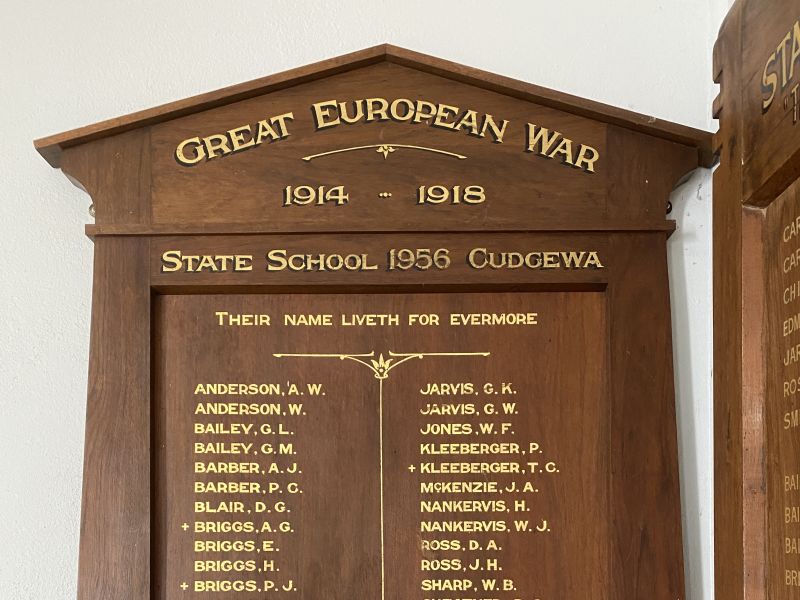
Clarence and his siblings attended Cudgewa State School No. 1956. In May 1907, he was among eleven students who had gained their Standard Certificate. Later in that same year, he was among thirty local residents who staged the operetta “Cinderella” at the Cudgewa Hall, playing the part of a paper boy and a trumpeter. Like all children growing up in the country, Clarence had his share of mishaps. One in particular made it to the January 21 1909, issue of the Corryong Courier.
“Master Clarence Carkeek was the victim of a rather painful accident on Monday evening last. He, with several other lads, went for a swim in the Cudgewa Creek, it being their usual practice during the hot weather. Clarence dived from the bank, and to the consternation of his mates immediately rose with blood, pouring from his head down over his face. He was unable to walk, and was assisted by the boys to Mr Sharp’s residence. Arrangements were hurriedly made to take the sufferer to Corryong, where Dr Stang discovered a terrible gash over the eye and along the side of the head. No less than six stitches were necessary, and the lad, who was suffering from', shock and pain, was placed in Nurse Wickes’ charge at Victoria Cottage, where he will remain for a few days. It is surmised that he struck a snag embedded in the creek.”
Clarence enlisted in the A.I.F. at Melbourne on July 13 1915, perhaps being inspired by the landings at Gallipoli. At the time, he was a single 21-year-old grocer living in Cudgewa. He would initially list his father as his next of kin, but would change this to his wife after marrying in England in 1918. Allocated Service Number 10327, he was placed in the 13th Reinforcements for the 2nd Field Artillery Brigade.
His initial training was undertaken with the 8th Depot Battalion in Melbourne. On January 5 1916, he embarked on HMAT A19 Afric at Melbourne. By mid-February, Clarence had arrived in Egypt. On the 10th of that month, he was taken on strength by No. 4 Section of the 1st Field Artillery Brigade. On April 3, he arrived at the Port of Marseilles in France and transferred to No. 4 Battery of the 2nd Field Artillery Brigade. He was remustered from Gunner to Driver.
Most Australian soldiers on the Western Front received at least one two-week furlough back to England. Clarence was given his first one between August 18 and September 2, 1917. Upon arriving back to his unit in France, he was admitted to the 26th General Hospital at Etaples, suffering from varicose veins. His condition warranted evacuation back to England aboard the HS (Hospital Ship) Panama. He was initially admitted to the Beaufort War Hospital in Bristol before being transferred to the 3rd Australian Auxiliary Hospital at Dartford, Kent. Clarence was discharged after six weeks and sent to No. 1 Convalescent Depot at Sutton Veny, Wiltshire. His fitness classification was downgraded to B1A3, declaring that he would be fit to attend an overseas training camp in two to three weeks.
He was granted a second two-week furlough from October 29 to November 12 and was instructed to report back to the 3rd Australian Depot at Sutton Veny. He overstayed his furlough by one day, was charged with being absent without leave (AWL) and forfeited two days' pay. Perhaps it was on this furlough that Clarence met 20-year-old Alice Barrie of 31 Polworth Crescent, Edinburgh. Alice’s father, George, was a boot warehouseman. A little over three months later, on February 5 1918, Clarence and Alice were married at Alice’s home, “according to the rites and Ceremonies of the United Free Church of Scotland.”
In mid-March 1918, Clarence arrived at Rouelles, France and returned to his unit. As a Driver, it would have been his responsibility to manage the horse teams that pulled the 18-pounder field guns and ammunition wagons. As part of the 2nd Field Artillery Brigade, Clarence would have been involved in the 1918 Battles of Hazebrouck (12 - 15 April), Amiens (11 - 18 August), Albert (21 - 23 August) and Epehy on the Hindenberg Line (18 September).
He returned to England on March 5 1919. At the Australian Base Depot he would have been preparing for his and Alice’s return to Australia. For two days in April 1919, he went AWL, no doubt to find some time with Alice. He was charged but let off with a reprimand and the loss of one day’s pay.
Clarence and Alice embarked on the HT Dunegan Castle on July 4 1919. Clarence was discharged on October 17 1919. For his service during the war, he was awarded the British War Medal and the Victory Medal.
The couple lived in Cudgewa, where Clarence found employment as a labourer. The Carkeek family was expanded in 1920 and again in 1921 with the arrival of a daughter, Jean, and then a son, Roy. In 1926, he secured a position with the railways as a repairer. In 1926 and 1927, Clarence and Alice moved to Pyalong, a small town 90 kilometres north of Melbourne, while Clarence worked on the railway. In 1928, the repairs were completed, and it was back to Cudgewa. The couple’s third child, Marjory, was born in 1928. Sometime between 1928 and 1934, the Carkeeks moved to Beech Forrest in the heart of the Otways, where Clarence continued working for the railways. In 1936, a move was made to Little River. The 1949 Electoral Roll records that Clarence, Alice, Roy and Sarah (Roy’s wife) were living at 31 Hearn Street, Colac. Roy had also gained employment with the railways.
Clarence passed away on February 7 1952, at Werribee, Victoria. Alice lived for a further 37 years, outliving all three of her children, passing away on April 5 1989, at Werribee. Both were buried in the Werribee Cemetery.
The March 13 1952, edition of the Werribee Shire Banner contained Clarence’s obituary.
“OBITUARY.
CLARENCE HENRY CARKEEK
The death occurred on Friday last of Clarence Henry Carkeek, 58 years, a ganger employed by the Victorian Railways at Werribee.
Deceased, who was born at Corryong, came to Little River in 1936 in the course of his employment in the railways, and transferred to Werribee about eighteen months ago. For the past eight months he had not enjoyed the best of health and passed away on Friday at the residence of his daughter, Mrs. C. King, Farm Road, Werribee. He also leaves a widow and a son, Mr. R. Carkeek, who are residents of the district. The funeral took place at the Werribee cemetery on Tuesday.”