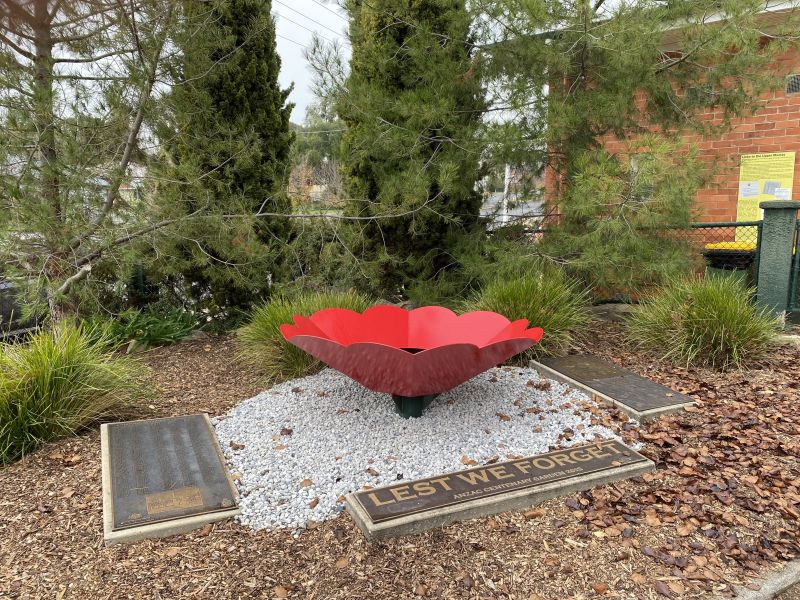
Clifford Cardiss Thwaites
 Stephen Learmonth
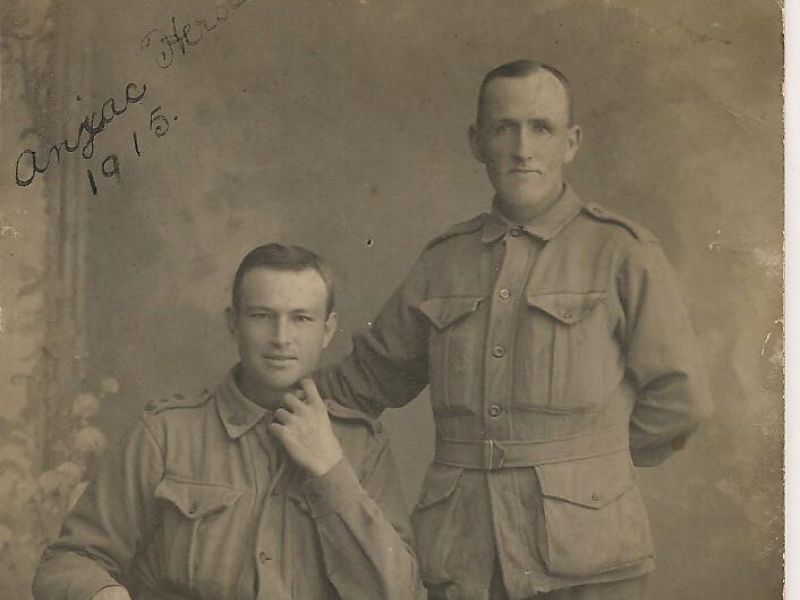
Clifford (on left in photograph) was born on the 16th of December 1893 at 81 Toogood Street in Erskineville, New South Wales. He would be the youngest child of William Johnson and Mary Ann (née Cardiss). Clifford’s older siblings were George Bright, William Johnson and Myrtle Ada.
Clifford’s father's initial surname was Waites, but for some unknown reason, he changed it to Thwaites when he was in his early teens, just after his father had passed away in 1869. Mary was William’s second wife; his first, Jane Elizabeth Lister, had died only three years after they married. In 1882, William married Mary, and they moved out to Australia in 1884.
It is noted on Clifford’s attestation papers that he was apprenticed for five years to Tiley and Deaton Corporation Building, Hay St, in Haymarket, New South Wales, but served only 18 months on account of ill health. Nothing is mentioned as to what caused his ill health.
Clifford enlisted on the 30th of April 1915 at Liverpool in NSW. He was assigned Regimental Number 2242 and placed into the 6th Reinforcements for the 13th Battalion. This battalion was part of the 4th Infantry Brigade of the 4th Infantry Division. The reinforcements departed Melbourne on HMAT A62 Wandilla on the 7th of June 1915. The War Diary of the 13th Battalion for the 2nd of August reads,
“1 Officer and 136 o’Ranks of 6th reinf. Men of good stamp. 6 weeks training, 1 week Egypt”.
Clifford had arrived on Gallipoli when the battalion was stationed at Reserve Gully. Four days later, he and the rest of the battalion moved up to No. 3 Post at Australia Gully. They were entrenched on the right of the 5th Wiltshire Rifles with the 14th Battalion AIF on their right. That night, an attack further up the line drove a party of Turks into their position. They managed to capture two officers and 16 other ranks. The following night, while the 14th, 15th and 16th Battalions attacked Abdel Rahman Blair, the 13th plus one battalion of the King's Own Royal Lancashires held the line. The Australian attack failed. The 13th had 11 killed and 21 wounded. For the remainder of August, the battalion held the line at No. 3 Post but continued to suffer heavy casualties.
On the 26th of August 1915, Clifford was taken to the 4th Field Ambulance at Walden Grove, suffering from gastroenteritis. He remained there for some time. He returned to his battalion after they had been taken off Gallipoli and moved to the Isle of Mudros. Christmas on Mudros was celebrated with a campfire concert on Christmas Eve and the distribution of Christmas billies on Christmas Day. The last of the battalion embarked on HT Tunisian and arrived at Alexandria on the second day of the new year. The following day, they went into camp with the remainder of their Brigade opposite the Ismailia Railway Station.
On the 23rd of January, Clifford went absent without leave for six days. It’s not known whether he was apprehended by the Military Police or returned on his own account. He was awarded 14 days of No. 2 Field Punishment and forfeited six days of pay. No. 2 Field Punishment consisted of heavy labouring duties, possibly being restrained in handcuffs or fetters.
February and March were quite busy for Clifford. Apart from training and other responsibilities, on the 12th of February, he was admitted to the 1st Auxiliary Hospital at Heliopolis with bunions but then transferred to the 3rd Australian General Hospital. He would remain here until the 20th of March, when he rejoined his battalion. Almost a week later, on the 26th, the 13th Battalion commenced the march from their current location at Tel-el-Kebir, Egypt, to their new camp at Serapeum, Egypt, a distance of over 40 km. The journey took three days, with two of those travelling over very heavy sand.
One of the regular pastimes of soldiers billeted near the Suez Canal was swimming. It was one way to cool down in the hot, dusty conditions. Often, soldiers would line the bank even as troopships passed along the canal, as shown in the photograph. The maximum temperatures would have been around the low to mid-30s in April. On the 11th of April, Clifford was swimming in the canal with a group of mates when tragedy struck.
The Red Cross Report from the 3rd Australian General Hospital gives the circumstances that resulted in Clifford’s death.
“He was diving in canal on Sunday previous to 11th into shallow water, when he fractured his spine high up, causing complete paralysis in the lower extremities, and also loss of sensation in limbs. He died on the morning of the 12th, 4:50. The case was quite hopeless from the beginning. He was buried in Old Cairo Cemetery, Military Side. Grave No. F. 31
Chaplain: Rev. Captn. Makeham, C.F. C.E.
F.B.Leney
3rd A.G.H.
Cairo
6.6.16”
For his service, Clifford was awarded the 1914-1915 Star, the British War Medal and the Victory Medal.