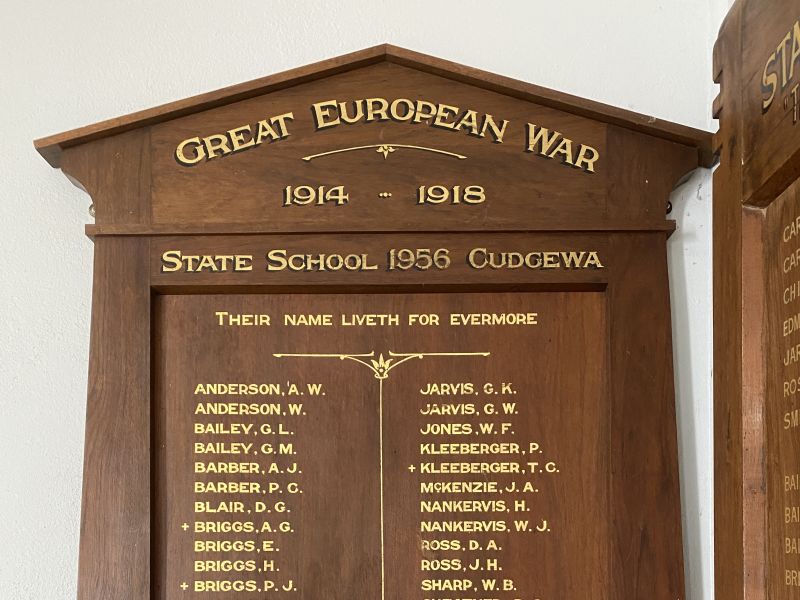
David Alexander Ross
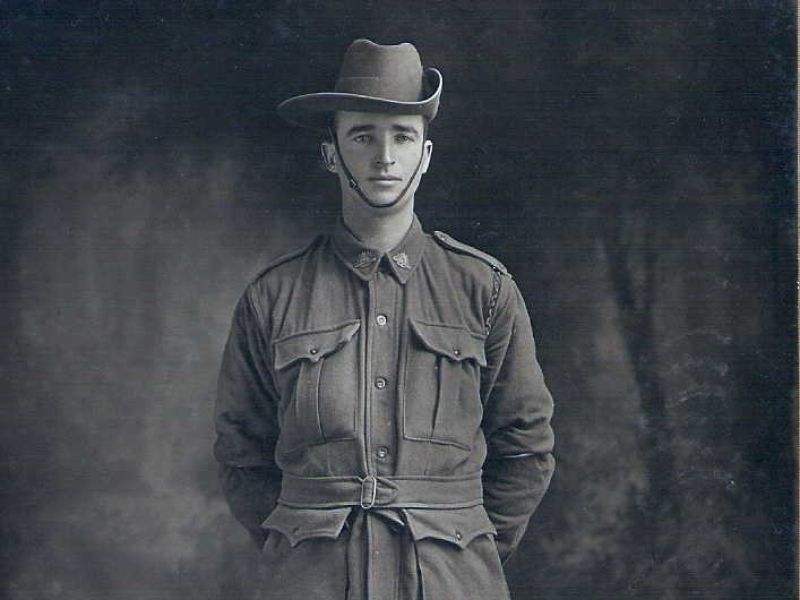
 Stephen Learmonth
David Alexander Ross was born on August 16 1892, at Corryong, Victoria. He was the sixth of eight children of David Henry and Mary Ann (nee Welshman) Ross of Cudgewa, Victoria.
He enlisted at Tallangatta, Victoria, on February 2 1916. At the time, he was single, a 23-year-old farmer. David was allotted the Service Number 1270 and placed in D Company of the 37th Battalion. The battalion was formed at Seymour as part of the 10th Brigade of the 3rd Australian Division. After initial training, the battalion embarked on HMAT A34 Persic at Melbourne on June 3 1916. One month later, David’s brother, James, also enlisted.
The Persic disembarked at Plymouth, England, on July 25. David was transferred to the 2nd Training Battalion at Perham Downs, located on the eastern edge of Salisbury Plain in Wiltshire. While there, he undertook further training in trench warfare and advanced weapons. He proceeded to France on October 7 1916, where he was transferred to the 59th Battalion. In mid February 1917, he was promoted to Lance Corporal. One month later, he was admitted to hospital with influenza. He was discharged six days later.
On April 20, he appeared at the 5th Dressing Station, where he was thought to have influenza. When taken to the 56th Casualty Clearing Station, his condition was identified as advanced trench fever. The crowded and unhygienic conditions in the trenches, not to mention the poor quality of the food, gave rise to an illness known as trench fever. This was a bacterial-based illness transferred via infected lice. Its symptoms included sudden, recurring fevers, severe headaches, dizziness and extreme bone pain, predominantly in the shins. David rejoined his unit in the field three weeks later.
On June 15 1917, he was promoted to Corporal. In late September, the battalion participated in the Battle of Polygon Wood. At 5:50 am on September 26, the Australian Infantry advanced behind a massive creeping artillery barrage. David made it through the first day, but on the second day of battle was wounded by a gunshot to the face and left arm. In two days, the 59th Battalion’s casualties were 5 Officers and 263 ORs (other ranks), either killed, wounded or missing in action. One week later, after being transferred among various medical facilities, David was evacuated to England aboard the HS St Andrew. He was admitted to the Military Hospital at Woking. By late November, he was sufficiently healed to be granted a two-week furlough. On February 15 1918, he was taken on strength with the Overseas Training Brigade to become familiar with new weapons and techniques, and to build up his strength. Three weeks later, David rejoined his unit in France. From May 21 to June 6, he was stationed at the Corps Scouting, Observation and Sniping School in Lingham, France.
In late November 1918, David was transferred back to England for duty with the Overseas Training Battalion at Tidworth. He was attached to the permanent cadre of this battalion until early March of 1919. David embarked on the SS Kildonian Castle at Devonport on March 21 1919. He received his discharge on June 21 1919, and was awarded the British War Medal and the Victory Medal for his service during the war.
On April 2 1930, he married Agnes Catherine (Kit) Coysh at the Cudgewa Presbyterian Church. Kit was the youngest daughter of George and Anna Coysh. The couple settled in Cudgewa.
In late March of 1942, David answered his country’s call again and enlisted in the 22nd Battalion VDC (Volunteer Defence Corps) for part-time duty. He was allocated the Army No. V402628. David spent two years in the VDC, rising to the rank of Corporal. He was discharged on October 10 1945.
He passed away on November 25 1961, at Cudgewa and was buried in the Cudgewa Cemetery. Kit died in 1972 and was buried with David.