Douglas Granville Blair
 Stephen Learmonth
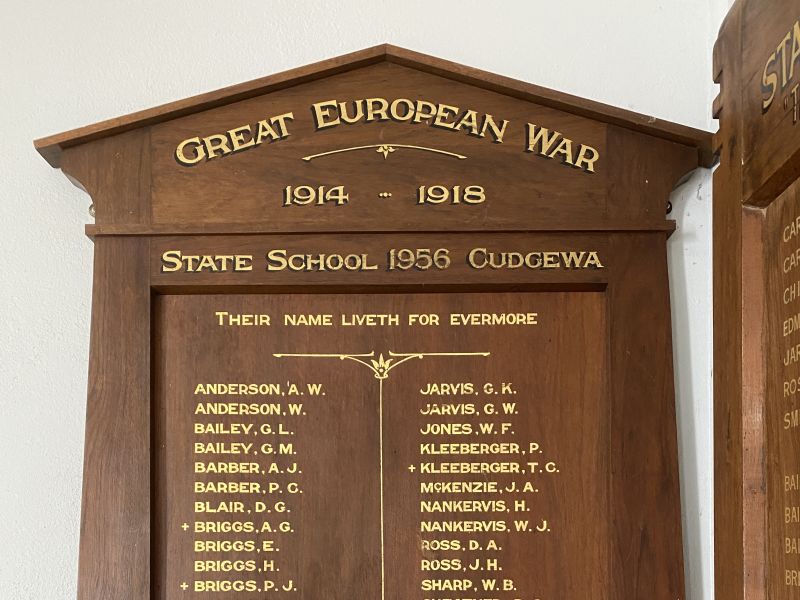
Douglas Granville Blair was born on May 14 1893, at Cudgewa, Victoria. He was the youngest of seven children of William and Elizabeth Maud (Nee Fennell) of Cudgewa. On January 6 1901, Douglas’ only sister, Ada, passed away at the age of 19. In his early years, Douglas was a keen and skilled football player, often being selected as captain of various Cudgewa teams.
Douglas began his working life as a teacher, passing his final examination as a third-class junior teacher at North Williamstown State School in October of 1910. After two years, Douglas decided that teaching was not for him and resigned from the Education Department, becoming a clerk in the Titles Office. He then applied for, and obtained a transfer to the Law Department. His first appointment was as an assistant clerk of courts at Wangaratta.
Three times, Douglas was rejected for active service on medical grounds (slight heart problem). In December 1915 he was finally successful in an application for home service, being granted the rank of Corporal in the Paymaster’s Department. In April 1916, he was further successful in securing this extension to overseas service, but only in a clerical role. He was assigned the Service Number 20117 and placed in the 32nd Battery of the 8th Field Artillery Brigade (FAB).
The May 25 1916, edition of the Corryong Courier included information about Douglas’ farewell from the Upper Murray.
“CUDGEWA.
FROM A CORRESPONDENT.
On Monday night, 1st inst., a number of friends met in the local hall to publicly farewell Bombardier Douglas G. Blair, who leaves for the front (in the clerical division) during the month. The arrangements were in the capable hands of Messrs R. A. Baker and T. H. Carkeek, though unfortunately Mr Carkeek was called away on business at the last moment. The first part of the programme was devoted to table games, quoits, etc. At nine o'clock Mr Baker took the chair, and, in referring to the object of the gathering, expressed his satisfaction at so many attending on very short notice to honor another lad, determined to help the motherland in some way. As many of them already knew, their guest had been rejected two or three times as physically unfit for the front, but was so persistent that he eventually received an appointment in the clerical division (Army Pay Corps) for home defence, with the rank of corporal. Again, last month he presented himself for medical examination, and was passed, but for clerical work only. Douglas immediately resigned from home defence, and enlisted for the front, and was accepted, taking the rank of bombardier. Mr Baker referred to the determined stand taken by all our lads in going to a strange land, amid untold hardships and dangers to uphold the Empire's honor and her traditions for justice and liberty. They were worthy of the best we could do for them. All could not go, therefore honor those who go. He then called upon their guest— Bombardier Blair, who, in acknowledging, expressed his sincere thanks to the promoters of the evening for giving him an opportunity of meeting many friends he could not otherwise have done in the short time at his disposal. He had not expected to participate in a send-off as tendered to his old schoolmates, having practically left the district on leaving the old school yonder, and only visiting since. It was indeed, kind to be remembered and to receive the good wishes of the large gathering. He still claimed to be a Cudgewa boy. The chairman called for cheers for our boys at ths front and for those going, the Allies, etc. Musical and instrumental items were rendered by Mrs Baker and Miss Carkeek, vocal items by Mrs Baker, Mrs P. Humphrey, Master Reg. Car-keek and Miss Coral M'Kenzie, while
Miss A. Carkeek acted as accompanist. Supper was then dispensed by lady friends, after which dancing was indulged in until the early hours, music being supplied by Miss Robinson and Mr Otty (piano); and Messrs W. Humphrey and J. Otty (violin).”
He embarked on HMAT A7 Medic on May 20 1916, in Melbourne and arrived in Plymouth, England, almost two months later. The March 1 1917, edition of the Corryong Courier included information about Douglas’ experiences upon arriving in England.
“Corporal Douglas G. Blair cabled,
"Greetings from France; feeling grand," to his parents, Mr and Mrs Wm. Blair, Cudgewa, during the past fortnight. As Private Lou Masters and he have been together since leaving Maribyrnong camp we may infer Lou has also crossed over to France.
"The following says the 'North Eastern Despatch,' is from a letter received from Corporal Douglas G. Blair, formerly assistant Clerk of Courts in Wangaratta, by an official in this town. Writing from Lark Hill, Dec. 12, he says:—'We arrived at Devonport on 18th July. Landing at such a nice time of the year I considered England about the prettiest place I had seen. I could not make the days out at all. I have read the paper inside the hut before putting on the light at 10.15 p.m., and I'll guarantee the sun rose at 3 a.m. However, it makes up for it now by getting dark at 4.45 pm., and daylight at 7.15 a.m. I had the good luck to be one of 100 sent to a school of instruction at Swanage, a holiday resort on the south coast, for nine weeks. While there we had a fair sized tent, and I used to sleep in it as guard. It was in a bit of a dip, and, of course, the good old ground floor was very often muddy, as every time it rained the water came in tent, and I tell you it did rain at times. I had 14 days leave and went to London. I have seen all places of historic note, and attended service at St. Paul's Cathedral and Westminster Abbey. I also went to the famous Bow street Police Court. It was nothing startling. The clerk sits sideways, and the prisoners' dock is situated straight behind, where we have the barrister's table. They don't stand on their dignity at all. Our simple police court trials are conducted with much more ceremony, though there were more police and an usher in attendance. I noticed the clerk digging up old records when a vag was up to see how similar cases were dealt with. Talk about the weather, we have had three lots of snow, and the rest of the time it was too cold to snow. Water running from showers at 8 is frozen at 8.30 This morning we had a decent fog ; the outline of a building 30 yards off could not be distinguished, and mind you, we are comforted by the news that it do s not get cold till after Christmas.'"
Douglas crossed to France on December 30 1916. A letter that Douglas wrote to his Aunt and Uncle was reprinted in the June 28 1917, edition of the Corryong Courier. It describes what Douglas got up to in France.
“BOMBARDIER BLAIR
Mr. Archie Blair, of Lightning Creek, has received the following letter from his nephew, Bombardier Douglas G. Blair, a Cudgewa boy, who, when he enlisted, was assistant court clerk at Wangaratta. The young soldier is in the 8th Field Artillery Brigade, and is battery clerk: —
FRANCE, 6/3/17. Dear Aunt and Uncle,— Last night brought in 7 Australian and 1 English letter for me—the best haul I have had for months—and your letter of 11 pages, with snapshots included, was most welcome. The papers did not arrive last night; they often take a bit longer. Those views were all-right, I can assure you, and have been duly exhibited. That is the first time I have got an idea of how your place is situated. Billy Blair, from Tallangatta, strolled in a couple of days ago, and showed me a view you had sent him also. He is doing all-right and looks well. He has met David Blair, who is also about these parts, and he is bringing him along next time he calls. Isn't it strange that we three cousins should be here? Well, to tell you what little we are allowed about ourselves. We finished our training in England, and got to France, after 20 hours on the water, on 31/12/16. (Oh, yes; we were in France in 1916.) We buzzed around, of course, and, after a night in a camp, we buzzed around some more, and then entrained, and went for a 27 hours' jaunt. We messed around a bit, and then got to a billet. We sleep in the shed, and, I tell you, billeting is not what you might imagine. However, my mate and I found a hay-loft, above a calf-pen, and we slept up there. We shifted again in about 10 days, and I slept on bean-pods, on the cement floor of a loft above a pig-sty. Finally we got a move on, and, after a long trip through ice, snow and slush, on a dark hound of a day, we got into the lines, and commenced our work of fighting the savage Hun. Strange to say, I am more comfortable in the lines than at any time since I left Wang. I have a good office, a stove, and also a bed. The latter is a big item. I undressed and got into the blankets for the first time for 3 weeks, and slept on a bed for the first time for 14 months, excepting when on leave. So I am quite a “campaigner” by now. I am still in the office, though no different from anyone else, thank goodness! In fact, when things get busy, I dash out and lend a hand on the guns. They say "The pen is mightier than the sword.” However, I fail to see that my indelible pencil is mightier than our howitzers. We had cruel weather here for a time. I have seen the following official readings of the thermometer:—9 a.m. 10 deg.; night, zero; and a little below zero. Of course, it was snow and ice everywhere. Fellows were skating on a river near —. Thank goodness, though, it has warmed-up a lot. Still, we had a lot of snow yesterday, and it is still about. We received a parcel from the Australian Comforts Fund, and in it were 20 sheep-skin vests; so of course we won't feel the cold. When it was bad, I had on two pairs of woollen sox, knee boots, football guernsey, sheep-skin vest (from those at home) mittens and balaclava helmet. Oh, it was over the odds—the gum and the ink (in a wine-glass, or course) would freeze in a moment's notice, day or night. My feet, I think, got a touch of frost-bite, and, of course, I must place them in front of the fire every night, and they would swell-up; and, when I turned-in, the blankets would hurt them too much to allow me to move. However, I am feeling well, and am probably as heavy as ever I was—about 11 st. 8 lb., I think. The French language is a bit of a twister, but they have had more practice than we have—eh? Still, with a little trouble, we can always understand each other. I was thinking of learning a bit, but discovered that it required a bit more energy than I can bother to rake-up ; and, above all, I'm bothered if I can remember anything. When we first came here, I had a pretty busy time. They put me in charge of the stores, as well as my own ordinary work in the office; and, when rations came up at night, I had to leather-in to them. Fancy me rolling into a lump of bullock, and dealing it out, with the sugar and tea, bread and so forth! But I was really too busy altogether, and they noticed it without my demurring, and now I have a storeman and a messenger and things are much brighter, I tell you. You say you are looking forward to my visit to Lightning Creek on my return. I won't need any reminding, as I want to see it, and the Mitta Valley.”
Douglas embarked on HMAT A39 Port Macquarie on March 23 1919. For his service during the war, he was awarded the British War Medal and the Victory Medal.
Upon his discharge on March 4 1920, Douglas continued to work as a civil servant in the Law Courts. In May 1920, he passed his examination to become a Clerk of Petty Sessions or Clerk of Courts with credit. Up until 1926, Douglas did relieving duties as clerk of courts throughout the State. In 1926, he was appointed clerk of courts at Benalla. In April of that year he married Isobel (Bille) McNamara, eldest daughter of Mr J McNamara of Coff’s Harbour and adopted daughter of Mr and Mrs Cuthbert Vallender (Isobel's sister and husband) of Wangaratta. The marriage took place at St Patrick’s Cathedral, Melbourne. The couple would have two children during the marriage, Katherine and Jack.
Over the next forty years, the Blair family would live in Benalla, Brighton and Ivanhoe before moving back to Brighton and living at 14 Killrush Street. By 1942, Douglas had risen to the position of Stipendiary Magistrate and would hold that position until his retirement in 1968. He passed away on December 7 1975. Isabell lived to the age of 94 and died on March 15 1989. They now lie in the Brighton General Cemetery alongside their daughter Katherine, who also lived to 94.