Ernest Angus Briggs
 Stephen Learmonth
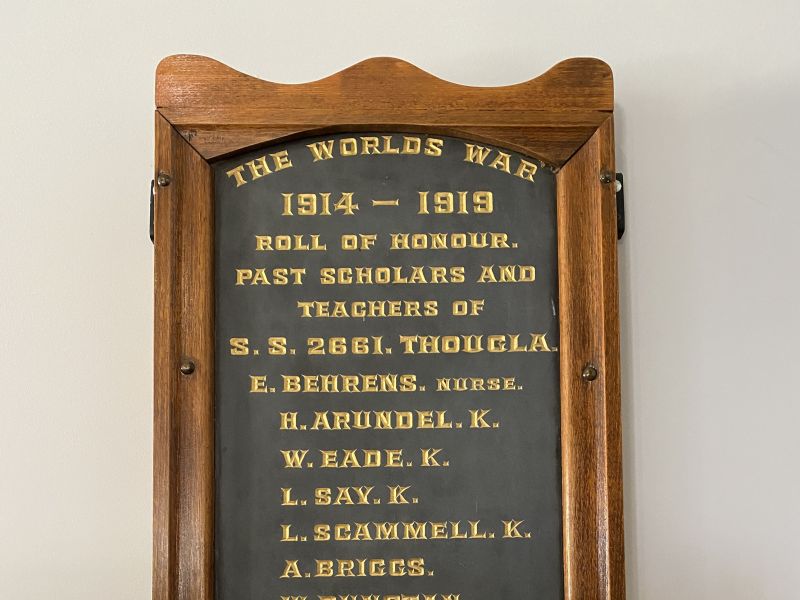
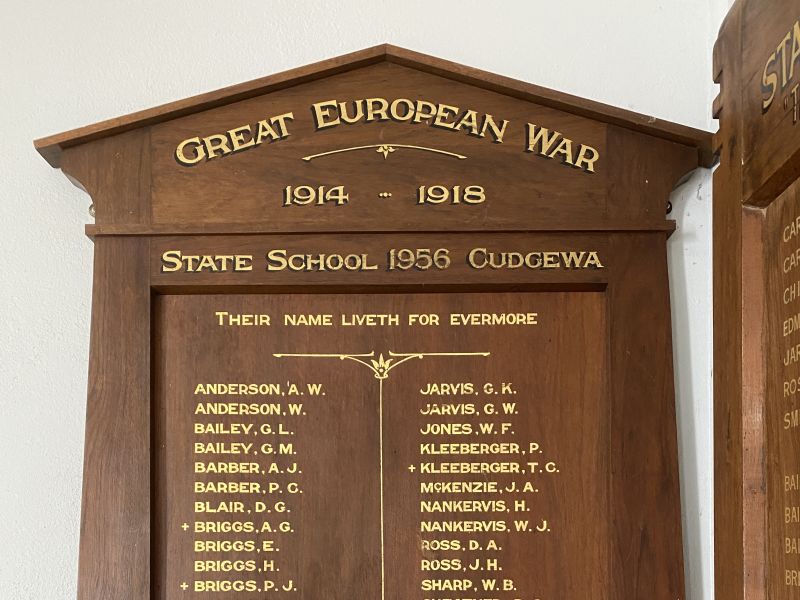
Ernest Angus Briggs was born on July 6 1890, at Cudgewa, Victoria. He was the second eldest of six children of Angus McIntyre and Ellen Jane Frances (Nee Burke) Briggs. Angus eventually passed the Briggs’ sawmill business to his sons, as his father had passed it to him.
Ernest enlisted at Tallangatta, Victoria, on February 28 1916. He was 24 years old and single, working as a sawmiller at the family sawmill. He listed his father, Angus, as his next of kin. Ernest was allotted the Service Number 1148 and appointed to D Company of the 1st Reinforcements for the 37th Battalion.
He embarked on HMAT A34 Persic at Melbourne on June 3 1916, and proceeded overseas to England. Two days after embarking, one of Ernest's younger brothers, Percy, was killed in action at Pozieres. After two months of training in England, Ernest was transferred to the 6th Battalion and joined them at Etaples, France. Two weeks later, he was further transferred, this time to the 59th Battalion. This lasted six weeks, when an order came through for him to transfer to the 5th Division Salvage Company. The company was an administrative engineering unit of the AIF. It was tasked with recovering abandoned weapons, ammunition, clothing and equipment from the battlefield. He spent over two weeks in March in hospital suffering from the mumps. Ernest was given two weeks' leave in early October 1917, although it’s unclear where he spent them.
In November 1917, the company moved into the Dranoutre region of Flanders, approximately ten kilometres northwest of Armentieres. On the 14th, Ernest was posted as being missing in action. Six weeks later, it was discovered that the Germans had taken him prisoner, and he was being held at Dulmen Group 3 POW Camp. The company’s war diary of November 14 briefly describes what happened to Ernest.
“Three other ranks with instructions to proceed to ROSE WOOD area to report on salvage in the area did not return.”
As an example, during November, the company collected over 26,000 rounds of German and British small-arms ammunition, 3,854 live 18-pounder shells, 22,592 brass 18-pounder shell casings, over 1,000 live 4.5-in howitzer shells, 949 British .303 rifles, and 2,783 pairs of ankle boots. This did not include all the other equipment, large and small.
A copy of a letter written by Stephen Strong to his father appeared in the April 4 1918, edition of the Argus. Stephen was one of the other two men captured alongside Ernest on November 14 1917.
“PRISONERS IN GERMANY
Mr Henry Strong of 131 Mark street, Moonee Ponds, has received a long letter from his son, Stephen Strong, of the Salvage Corps, who has been a prisoner of War at Dulmer, in Germany, since November last. Amongst other things he says:- “We are permitted one post-card a week and one letter a fortnight. This is the third letter and the fifth post-card I have written. The Red Cross people look after us very well. Each man receives a parcel every 10 days, containing 2lb. of biscuits, three tins of meat, two of cheese. 1/4lb. Of tea, one tin of cocoa, three tins of milk, and half a pound of dripping. When we arrived here word was sent on to the Red Cross of the size of boots and clothing, new uniform, safety razor, &c. The uniform is heavy blue serge tunic, long trousers and blue military cap, and chaps who have recieved them look very smart. After this, instead of one parcel in ten days, each man gets three a fortnight, and three loaves of bread a week. These parcels contain all sorts of things imaginable, cake, pudding, tobacco, and cigarettes. Every week we have a variety show, admission 10 pfenning (one penny), and we have a splendid theatre, a full orchestra, and plenty of first-class artists, including a large number of professionals. I do believe there is a picture show, but I have not been to it.”
This is in direct contrast to other letters and the experience of repatriated prisoners, who described Dulmen as a hell camp, with men being starved by poor and inadequate rations.
Ernest was released from Dulsen Camp and was transferred to the POW Embarkation Camp at Calais, France, on December 19 1918. He arrived at Dover, England, the following day. On January 21 1919, he was posted as being absent without leave. He was apprehended in London on March 4 1919, by Military Police. At trial on March 14, he was found guilty and was required to forfeit 70 days' pay. Two weeks later, he embarked on HMAT A9 Shropshire for repatriation to Australia.
Disembarking in Australia on May 16, he was discharged six weeks later. For his service overseas, Ernest was awarded the British War Medal and the Victory Medal. After the war, he returned to farming in the Cudgewa district.
Ernest once again answered his country’s call and enlisted in the VDC (Volunteer Defence Corps) on March 25 1942, at Corryong. He was allocated Service Number V374364 and posted to the 22nd Battalion. On August 18 1943, he was promoted to Lance Corporal. He was discharged on October 10 1945.
Ernest passed away on December 16 1965, at Corryong, at the age of 75. He was buried in the Cudgewa Cemetery.