Ernest Coysh
 Stephen Learmonth
Ernest was born on June 18 1896, at Cudgewa, Victoria. He was the fifth of eleven children for George and Anna Elizabeth Catherine (nee Klippel) Coysh. On March 18, 1907, Ernest's youngest brother, Claude, died. He was almost three weeks old.
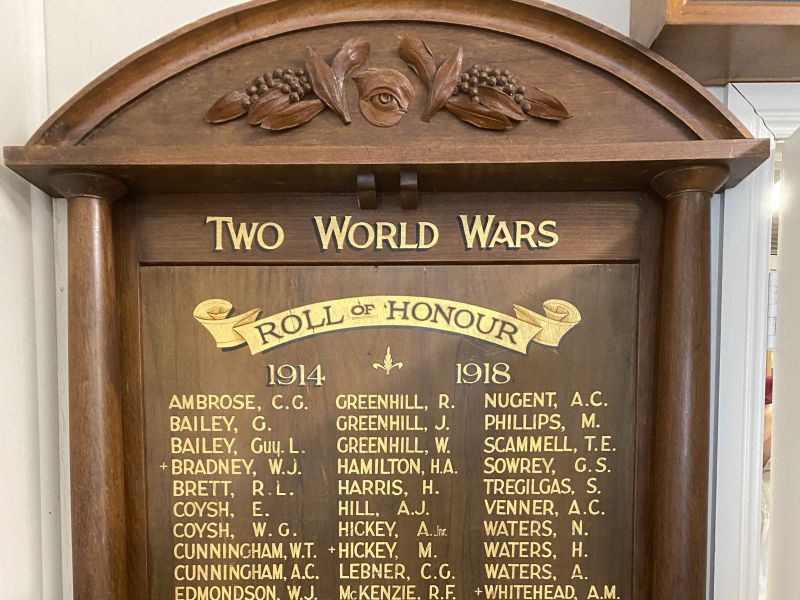
Ernest enlisted on February 2 1916, at Tallanagatta, Victoria. His next-oldest brother, William, had enlisted six months prior. At the time of his enlistment, Ernest was a single 19-year-old labourer living and working on the family property. He was given Service Number 1321 and placed on strength with D Company of the 37th Battalion.
On May 22 1916, the local community held a farewell social for a number of local boys who were about to head overseas and a teacher who was being transferred. The May 11 1916, edition of the Corryong Courier reported on the event.
“On Saturday night, 22nd ult., a combined farewell social was tendered to Miss Shauley, head teacher of Wabba school (transferred to Dry Creek, Mansfield), and Privates Jas. McKenzie, Ernie Biggs, Alex Ross, Ernie Coysh, Jno. Hamilton, Alex Hamilton, Ernie Whitehead, Jno. Whitehead, and Boyd Laverty (Berringama). Although the arrangements were made on a few hours' notice, a crowded hall was in evidence, and a splendid programme of vocal, instrumental music, and elocutionary items was presented. Mr R.A. Baker presided, and in his introductory remarks referred to the gathering as one befitting its object - a loyal, and noble hearted good-bye to our lads, who were honouring their King and Country as never before - offering their lives, if need be, leaving all near and dear to them for a noble duty.”
On June 6 1916, he embarked on HMAT A34 Persic at Melbourne. Upon arriving in England, he marched in from the 37th Battalion to the 2nd Training Battalion at No.3 Camp at Perham Downs, Wiltshire. Ernest spent his time here learning about trench warfare and how to fight and live on the Western Front. Arriving in France, he was transferred to the 59th Battalion. One month later, on November 9, he was transferred to the 7th Field Company as a sapper (the engineering equivalent of private).
Field Companies were responsible for the upkeep of physical infrastructure, such as trenches, dugouts, bridges, roads, and water supply systems, as well as erecting barbed wire, just to name a few. Ernest would experience the battles of Second Bullecourt (May 1917), Menin Road and Broodseinde (September to October 1917), Amiens (August 1918) and Mont St Quentin and Peronne (August to September 1918).
During late August and early September 1917, Ernest was given a two-week leave to England. For two months in early 1919, he was appointed as “Driver”. By late March, he had reverted to Sapper to enable him to perform his duties. On June 5 1919, he and his brother William embarked on the HT Mahia and returned to Australia. Ernest was discharged on August 31 1919. For his service during the war, he was awarded the British War Medal and the Victory Medal.
In 1921, Ernest married Marie Kathleen Scammell. They would make their home in Cudgewa and raise a family of two children. Ernest enlisted again when war came to Australia. He was allocated Service Number V402530 and placed on strength of the 22nd Battalion VDC (Volunteer Defence Corps). In May of 1945, he was promoted to Corporal. He was discharged on October 10 1945. By 1963, Ernest and Maria had moved to Corryong, living on Farran Street. The following year, on January 4, Ernest passed away at Corryong. Rederick Coysh, Ernest and Maria’s son, died in 1975 at the age of 49. Marie died in 1979, four years later. Marie was interred in the Cudgewa cemetery with Ernest.