Ernest McInnes
 Stephen Learmonth
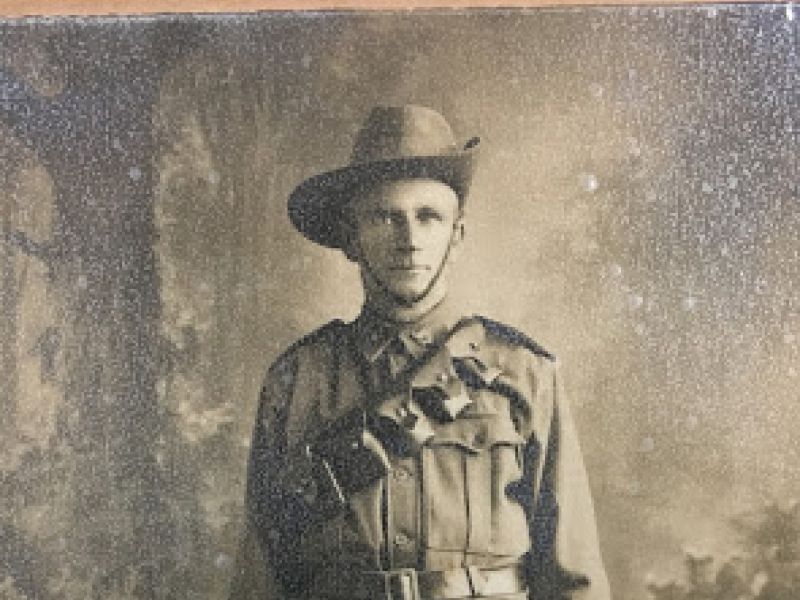
Ernest (Ernie) McInnes was born in 1895 at Towong, Victoria, to Alexander Douglas and Ada Blanche, nee Stockwell, McInnes. Ernest had three brothers: William Henry (Harry), Walter Claude, and Frank. All of the boys would attend the local school at Towong.
On 3 September 1915, Ernest enlisted in the AIF at Melbourne, Victoria. He was given the Regimental Number 1600 and was put on strength with the 8th Light Horse Regiment.
Upon enlistment, Ernest was 5 feet 9.75 inches (179 cm) and weighed 10 stone 3 lbs (65kg). His chest measurement was shown as 36.5 inches (93 cm). His complexion was given as ruddy; he had blue eyes and light brown hair. Ernest’s records show that he had the distinctive marks of one scar on the right knee, moles on the right underarm and vaccination marks on the right arm. His religious denomination was given as Presbyterian.
Ernest embarked on HMAT A11 Ascanius on 10 November 1915, sailing from Melbourne, Victoria.
Ernest had not been in Egypt long before he was admitted to hospital at Heliopolis, although there is no indication of the reason for his admission. Upon being discharged from the hospital he was placed on strength with the 3rd Reserve Regiment before being transferred to the 4th Division Artillery and remustered as a Gunner.
In early June, his unit proceeded to join the BEF in France, disembarking at Marseilles on the evening of 9 October, 1916. While in action during late May of 1917, he received gunshot wounds in his right arm, which also resulted in a number of fractured ribs. The wound was serious enough for him to be sent to England, being admitted to the 13th General Hospital on 31 May. Ernest wasn’t discharged from the hospital until early October, when he was given seven days' leave and told to report to Weymouth on 16 October. He overstayed his leave by one day and, in doing so, was awarded five days confined to barracks and forfeited two days' pay.
During 1918, Ernest served in France with his unit but was also admitted to hospital in England a number of times, suffering from ailments ranging from a sprained right knee to dysentery.
Ernest served in so many different units, and the 8th Light Horse was only one of them. The 8th Light Horse was the first unit that he served in, but he also served in the 45th Battery of the 12th Field Artillery Brigade. A camouflaged 18-pounder of the 45th Battery, 12th FAB is seen in the image above. Ernest was known as “The Handy Man” as he served in so many different units.
On 13 April 1919, Ernest embarked on the SS Wyreema, returning to Australia some weeks later. He was finally discharged from the AIF on 31 May 1919. For his service during the war, he was awarded the 1914/15 Star, the British War Medal and the Victory Medal.
Ernest married Ethel Alma Julia Philby at Tumbarumba in New South Wales on 19 May, 1921. During their marriage, they had three children. Their names were Silas Keith, Vernon John and Roy Ernest.
Ernest passed away on 11 August, 1968, at Towong and was buried at Corryong, Victoria.
Co-researched and co-written by Jorja (Great great niece of Ernest), for "Light Horsemen of the Upper Murray", Grade 5 and 6, Corryong College 2018