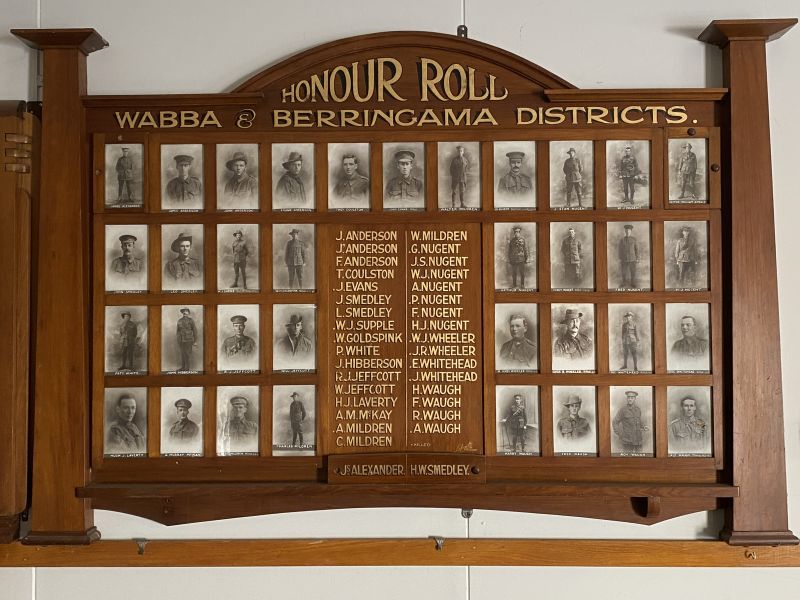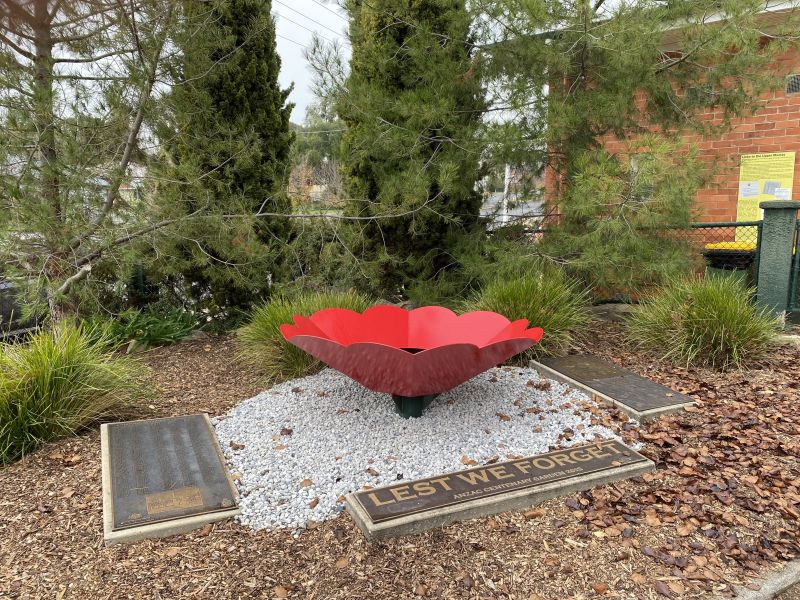
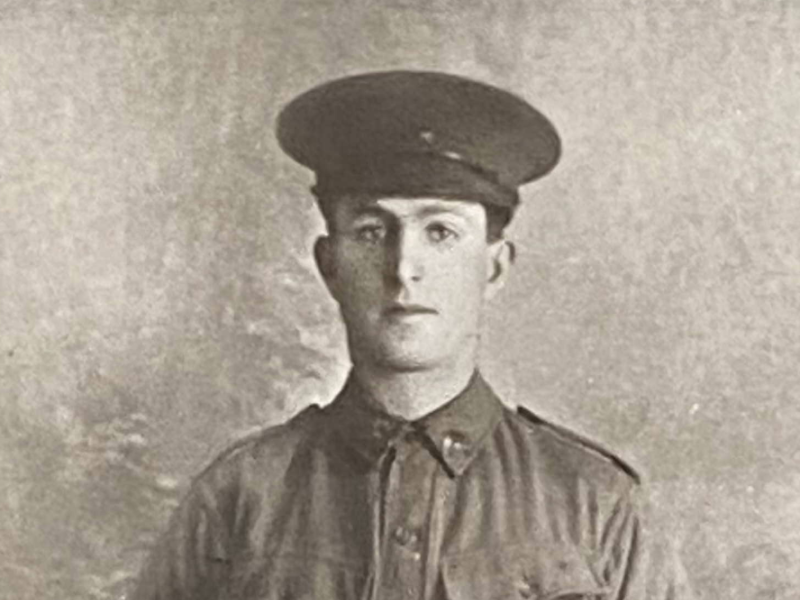
Frederic Nugent
 Stephen Learmonth
Fred Nugent was born in Corryong, Victoria, on 9 September 1894 to Thomas and Lucy, nee Wheeler. He had one brother, Harry, who was two years younger.
Fred and his younger brother Harry enlisted on the same day, 5 July, 1915, and were both put on strength with the same unit, the 6th Reinforcements of 13th Light Horse Regiment. Fred and Harry would have adjacent service numbers of 1263 and 1264. At the time of joining up, Fred was a single, 21-year-old farmer from Berringama. He was 5 feet 7 inches (170 cm) tall and weighed 10 stone (64 kg). He had blue eyes, dark brown hair and a fresh complexion.
On 27 October 1915, Fred and Harry embarked on HMAT A38 Ulysses and sailed from Melbourne, Victoria. The trip would take them across the Great Australian Bight to Fremantle, on to Colombo, in Ceylon, before finally disembarking at Suez, at the southern end of the Suez Canal. He was taken on strength with the 4th Divisional Cavalry at Tel-el-Kebir on 28 February, 1916.
In Egypt, the AIF underwent major restructuring following the Gallipoli campaign. The infantry component of the AIF was expanded from two divisions to four divisions, while the 13th Light Horse was broken down to provide divisional cavalry squadrons for the 2nd, 4th and 5th Divisions. These squadrons proceeded to France with their divisions in March and June 1916 and were eventually reunited in July when the 13th Light Horse was reformed as the cavalry regiment for the 1st ANZAC Corps.
On the Western Front, terrain and the nature of the war there limited the roles mounted troops could fulfil. However, they were still heavily employed. The 13th Light Horse carried out duties such as traffic control, rear-area security, and prisoner escort tasks, and, when the tactical situation permitted, the more traditional cavalry role of reconnaissance. It was most active during the more mobile phases of the war on the Western Front, including the pursuit of the German retreat to the Hindenburg Line in early 1917, the stemming of the 1918 German advance, and the Allied offensives of August and September 1918. The Regiment's largest engagement was during the operations to capture the Hindenburg Line between 5 and 9 September, 1918, when it provided the advance guard, along a front of 13.5 kilometres, for the advance of the Australian Corps. The Regiment had become the Australian Corps Cavalry Regiment upon its formation in November, 1917.
From the time Fred arrived in France on 10 June, 1916, up until it is recorded he was promoted to Temporary Corporal on 12 January, 1918, there are no records of what he was doing. We can only assume that Fred served with his unit wherever they were in France. The 13th’s War Diaries provide us with some information on where Fred could have served.
On 21 July 1918, Fred was detached to the Australian Corps Gas School. Here, he would spend one week being trained on how to handle gas attacks in the field. The rest of 1918 saw Fred back with his unit in France and being promoted to Corporal on 1 September. At the time of the Armistice, Fred was detached to the Australian Corps School to participate in a course. Early in 1919, he was on leave in England, the same time as his brother, who had unfortunately been admitted to hospital with influenza.
Like much of the Australian Corps, the 13th Light Horse was completing a period of rest and retraining when the war ended on 11 November, 1918. After the Armistice, its personnel were progressively returned to Australia for discharge. Fred embarked on the SS Ypiranga and arrived home in Australia on 15 May 1919, being discharged on 27 August of that year. For his service during World War 1, Fred was awarded the 1914/15 Star, the British War Medal and the Victory Medal. As an aside, the ship Fred arrived home on, the SS Ypiranga, was one of the ships in contact with the SS Titanic as she sank on 15 April, 1912.
On 31 May 1922, Fred married Daisy Jane Whitehead at the Presbyterian Church, Corryong. Fred and Daisy were to make their future home at Tintaldra. In late April of 1923, the couple had a daughter, Dawn Audrey Whitehead Nugent. Tragedy struck nearly two years later on 8 February 1925 when Daisy passed away at the age of 30. Fifteen years later, on 6 July 1940, Fred married Veronica Magdalene “Vera” Dobereigh Belgrave Heights. They would have one son, Anthony Frederick Nugent, born in 1941. During this time, Fred worked as a labourer until, in the 1940s, he became a foreman.
Fred passed away on 2 June 1963 at Corryong and was buried in the Corryong cemetery.