Gregory Ivo Humphrey
 Stephen Learmonth
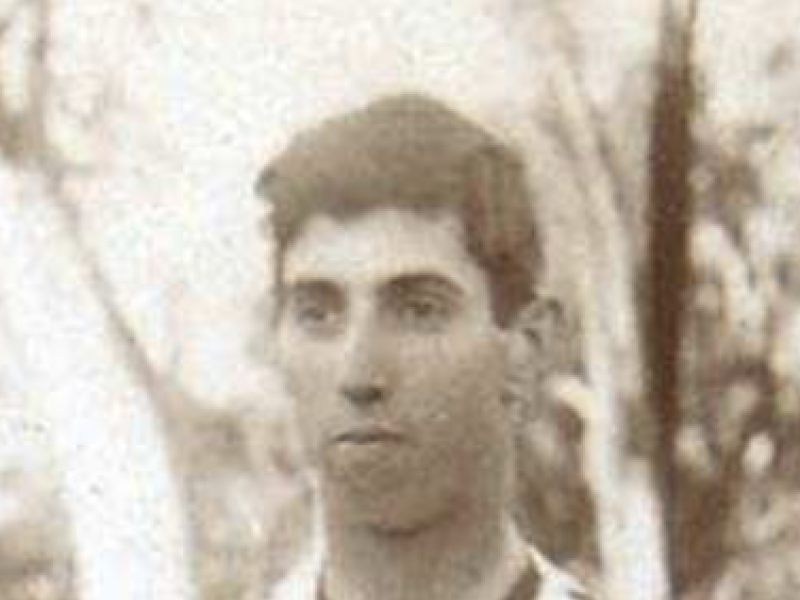
Gregory Ivo Humphrey was born on December 28 1897, the youngest of seven children of John and Sarah (nee Hazell) Humphrey of Cudgewa. While growing up in the Upper Murray, Greg loved to play cricket in summer and football in winter. He played for his beloved Cudgewa side. Newspaper reports of the day suggest that he was good with the bat and scoring majors in football.
Greg enlisted on August 31 1915. He may have been motivated by reports of the Allies' August Offensive at Gallipoli. As he was only 18, he needed his parents’ permission to enlist in the AIF for overseas service. He was allocated Service Number 3509 and placed in the 8th Reinforcements for the 24th Battalion. Greg embarked on HMAT A19 Afric at Melbourne on January 1 1916.
Upon arriving at Zeitoun, Egypt, Greg was allotted to the 6th Training Battalion. On February 24, he was taken on strength with the 8th Battalion. Greg would be admitted to hospital for about a week, suffering from vomiting. He was transferred to the 46th Battalion and, on June 2 1916, embarked on the SS Kinfauns Castle and sailed to the Western Front.
It wasn’t long before the battalion was manning the frontline trenches near what was once the village of Fleurbaix. The 46th Battalion's War Diary entry July 9 states “During the afternoon enemy shelled sectors 43 and 44 using High explosive and Shrapnel. No damage done. Our Artillery retaliated.” During the shelling, Greg was knocked off a parapet, the front wall of a defensive trench. We don’t know whether Greg had been covered by the churned-up remains of the wall, or how close the shelling was to where Greg was standing. But damage was done. It appears from Greg’s service records that there was no physical damage, but there was psychological damage done. Greg was diagnosed as suffering from shell shock. Greg was transferred through a variety of Field Ambulances, Casualty Clearing Stations and Ambulance Trains until, on July 17, he embarked on the SS Brighton at Calais for evacuation to England. Later that day he was admitted to the Norfolk War Hospital. His time at the front had been about one week.
On August 18 1916, Greg underwent a medical assessment while he was at Harefield Park. Almost one month after being blown off the parapet in the frontline trenches, Greg's condition was recorded as “very tremulous, eyes painful, pupils widely dilated, precordial pain, pulse 130, severe frontal pain, has night tremors.” It was recommended that he was temporarily unfit for General Service for 6 months and that he was also unfit for Home Service and that he be discharged as permanently unfit. Greg embarked on the NZHS (New Zealand Hospital Ship) Marama on August 31 1916, and arrived in Melbourne on October 17. He was discharged on November 17 1916. For his service during the war he was awarded the British War Medal and the Victory Medal.
After being discharged from the Army, Greg returned to Cudgewa and worked as a carpenter in the district. In the 1920s, he moved to Benalla where his football skills were put to good use. The April 24 1925 edition of the Benalla Standard reported that “after a good deal of discussion it was decided to elect a captain and vice-captain for the coming season. Mr. Greg Humphrey, the crack forward who played with Wangaratta for the last three years, was unanimously elected captain.” Two years later, on February 12 1927, he married Gabriel Mary (Molly) Herrick at Bendigo.
During the 1930s, Greg and Molly lived on Holloway Street in Benalla. Greg continued to play football and skippered “The Diggers” cricket team. In one particular match against the Friendly Society’s team, Greg made 85 runs in 55 minutes. Other newspaper articles indicate that Greg had an interest in musical performance, competing in Eisteddfods and becoming President of the local music company. The April 2 1937 edition of the Benalla Standard reported on Greg’s change of employment.
“Mr Greg Humphrey, who has been caretaker of the Memorial Hall for several years, has tendered his resignation. Mrs Humphrey has been librarian at the hall for the same period. Mr. and Mrs. Humphrey will probably be leaving Benalla. “Greg.,” as he is popularly known, has been a keen member of the All Blacks Football Club, while Mrs Humphrey has been a familiar figure in social circles. Their departure will be regretted by a very large number of friends.”
On November 26 1938, Greg and Molly’s only child, Pauline, was born in Benalla. The Humphreys remained in Benalla, and by 1939 Greg was coaching the All Blacks. Greg’s sporting prowess continued into the 1940s, with a greater focus on cricket, especially against RAAF teams from No. 11 Elementary Training School at Benalla.
The 1972 Electoral Rolls place Greg and Molly living at 18 Arundel Street, Benalla. Greg was working as a clerk at the grand age of 72. Four years later, on July 31 1976, Greg passed away and was buried in the Benalla Cemetery. Molly died in February 1983 and was laid to rest alongside Greg.