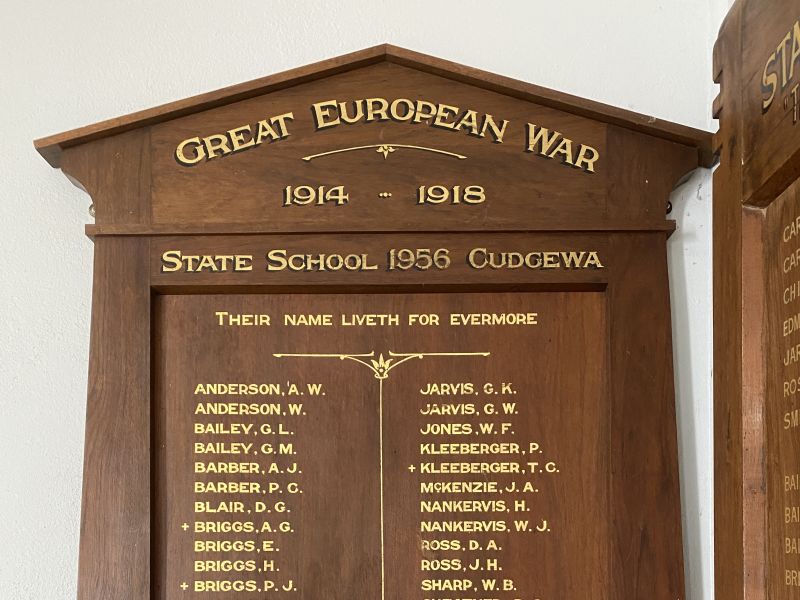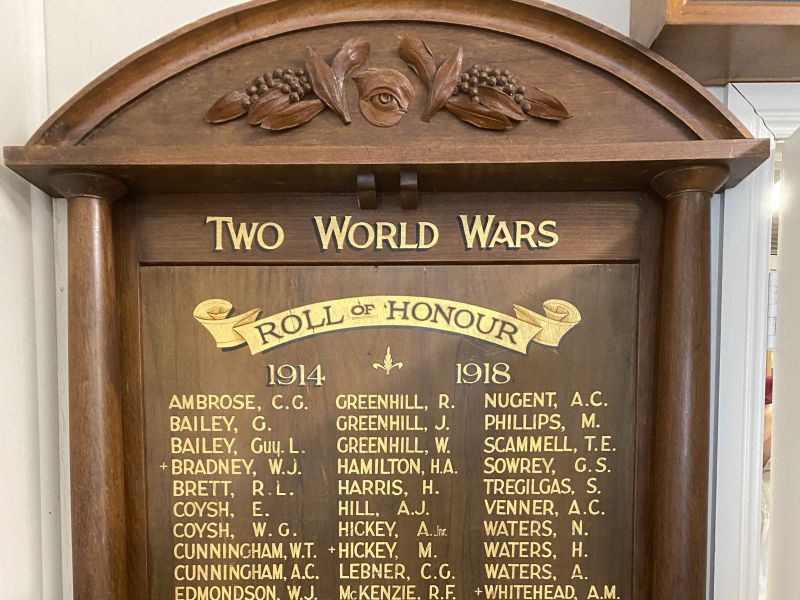
Guy Leslie Bailey
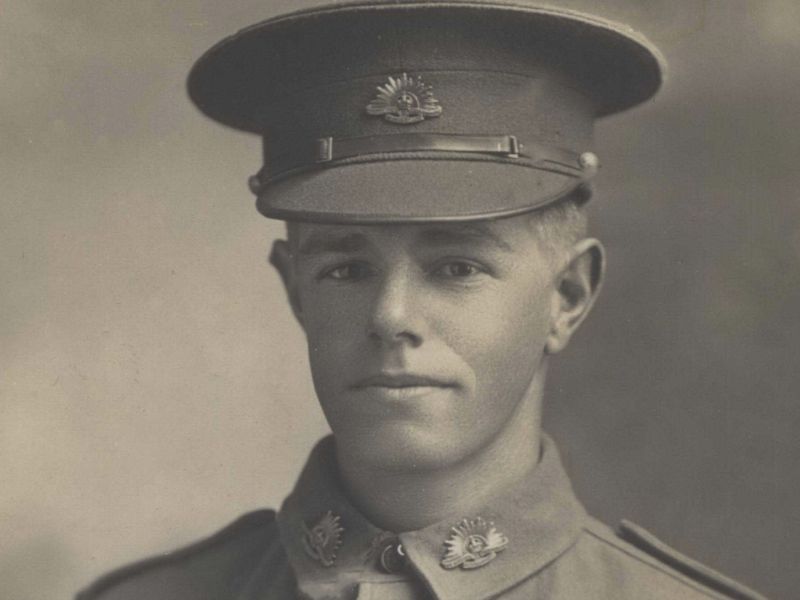
 Stephen Learmonth
Guy Leslie Bailey was born on May 5 1891, in Corryong, Victoria. He was the third of nine children for Richard and Mary Eliza (nee Rawes) Bailey. As Guy grew older, he developed an interest in athletics and became the Honourable Secretary of the Corryong Oddfellows’ Sports.
Guy enlisted on September 1 1915, at Melbourne, Victoria. He was placed in the 1st Reinforcements for the 29th Battalion and allocated the Service Number 1361. His brother George enlisted at the time and received the Service Number 1362. They were placed in the same unit and would travel overseas at the same time.
George and Guy reached Alexandria on February 2 1916. After a further two months of training, they embarked on the HT Tunisian and arrived at Marseilles, France, on June 23. They both were taken on strength with the 29th Battalion, in time to take part in the Battle of Fromelles. The battalion suffered over 240 casualties, killed, wounded or missing, in 24 hours.
On March 3 1917, he was wounded in action by a high explosive on the left forearm and right knee. He was admitted to the 15th Australian Field Ambulance before being taken to the 1st South Midland Casualty Clearing Station and then finally to the 7th Canadian General Hospital at Etaples. His wounds were severe, so he was evacuated to England. Guy spent five weeks at the 1st London General Hospital in Camberwell, then nine weeks at the Holborn Military Hospital in Mitchell. By June 29, he was sufficiently healed to be given a two-week furlough. He returned to duty with the 29th Battalion on July 30 1917.
A letter to his parents was reproduced in the March 15 1917, edition of the Corryong Courier.
“You will be very pleased to hear that George and I have made names for ourselves in a small way. In our orders a few days ago there was a paragraph which read:- “The C.O. specially commends the following men for devotion to duty in acting as runners - Ptes. Senior, Oakman, Bailey, G.M., Bailey, G.L.. These men kept up communication under heavy enemy artillery fire, and never failed to bring in their despatches.” It sounds all right, doesn’t it. Geo. and I were detailed for runners the last time we went in, and had to carry despatches, etc., overland for nearly half a mile and back every two hours during darkness, and I can tell you that between shells and machine guns we had some thrills and narrow squeaks. We had a good deep dug-out, and we would just crawl into our pozies and sleep till night again.”
Guy was with the 29th Battalion when they took part in the Battle of Polygon Wood in September 1917. In early 1918, he was sent to England to attend the 8th Brigade School of Bombing and Rifle Bombing but returned in time to participate in the Battle of Morlancourt on July 29. In August and September, the battalion took part in the great advance that followed the Battle of Amiens. It fought its last major action near the St Quentin Canal in 1918. On October 12, the 29th Battalion was disbanded to provide reinforcements for other units in the 8th Brigade. Guy was transferred to the 32nd Battalion.
In mid-April 1919, he left England to return to Australia on board the SS Wyreema. One week out, Guy was admitted to the ship’s hospital suffering from epididymitis. He was discharged after one week. The Wyreema reached Melbourne on May 31 1919. Two months later, on July 25, Guy was discharged from the AIF with the rank of Lance Corporal. For his service in the war, he was awarded the British War Medal and the Victory Medal.
After returning home, he continued to live and work in Cudgewa. He married Vera Amelia Tullock on October 28 1924, at Christ Church, South Yarra. After spending their honeymoon on a motor tour of the Western District, the couple moved to Ferntree Gully, near Melbourne, where they lived along Bayswater Road. Guy operated an orchard in partnership with his brother George. This partnership dissolved during the late 1920s, when George decided he needed a change and became a motor driver. Guy and Vera continued to run the orchard. Vera passed away in 1966, but Guy stayed on the orchard even into his 80s.
Guy passed away on June 19 1974, at Bayswater, Victoria, at the age of 83.