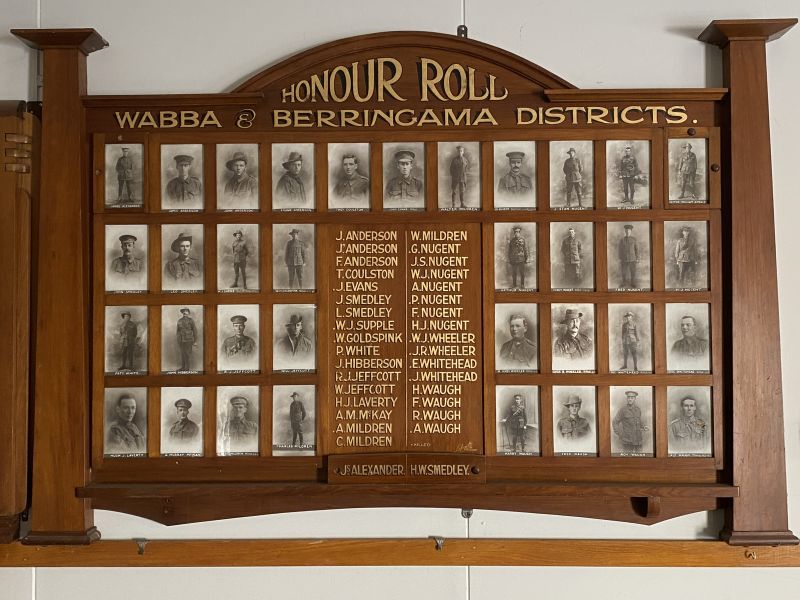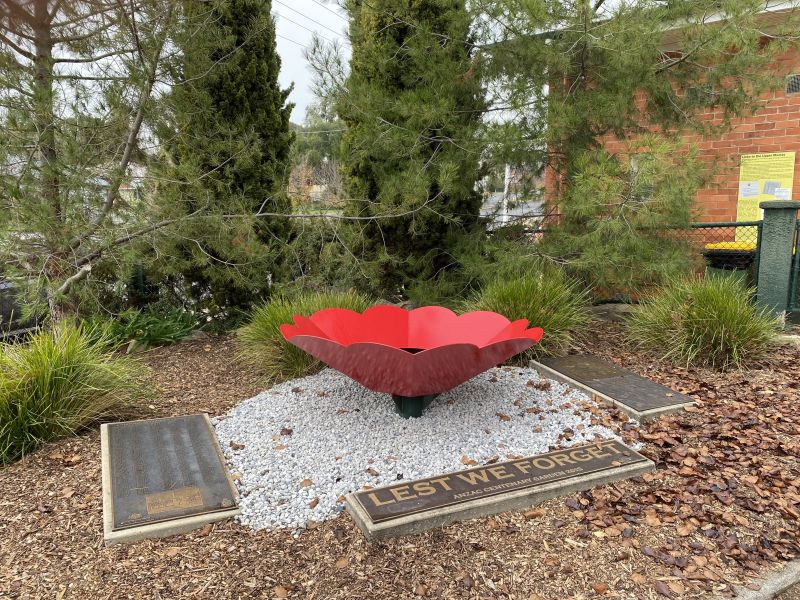
Henry James Nugent
 Stephen Learmonth
Henry James Nugent was born on 16 May 1881 in Walkerville, South Australia, to Henry James Snr and Helen, nee Hehir. Henry would be one of six children.
On 1 April 1905, he married Lily Thompson in Melbourne. Tragedy struck during the birth of their son in October 1905, when Lily died giving birth to Robert.
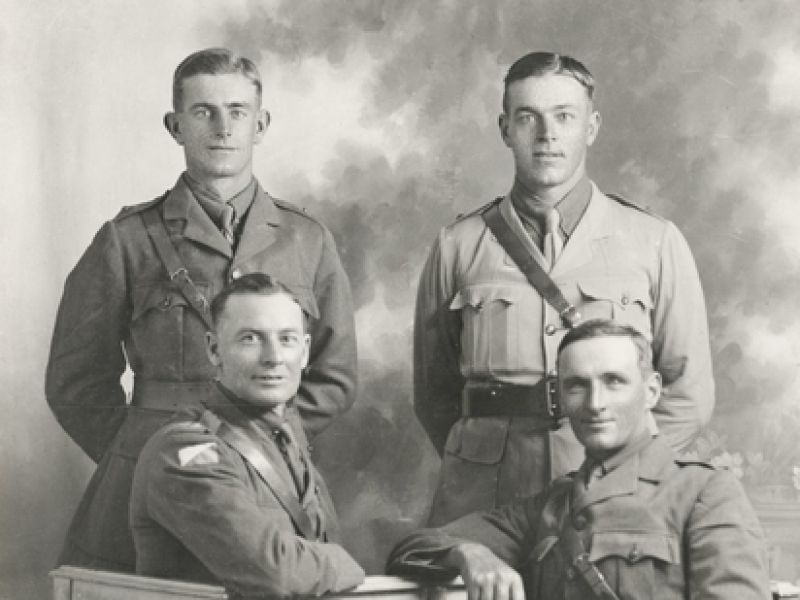
Henry (seated on the left in the picture) enlisted in Melbourne, Victoria, on 22 September, 1914. At the time of his enlistment, he was a 34-year-old stockman who gave his address as 108 Albert Street, Port Melbourne. Henry also states that he had prior military experience, including 156 days of service in South Africa with the Midland Mounted Rifles and 6 months as the Commander-in-Chief’s bodyguard.
Upon returning from South Africa, Henry became engrossed with the sport that he loved, Australian Rules Football. He played several seasons in the metropolitan competitions, but was injured. Not wanting to leave football, he turned to umpiring. It was during this time that he was able to talk to the VFL’s number one umpire at the time, Ivo Crapp. Henry asked him what a person needed to do in order to become a successful umpire. Ivo replied, “Get yourself in first-class condition, learn the rules thoroughly and be fearless and prompt with your decisions.” Henry took that advice and, during the following years, he umpired many matches, including in the VFL. In both the 1913 and 1914 seasons, he even umpired in country Victoria and Tasmania.
Upon enlisting, Henry’s description listed him at 5 feet 7 inches (170 cm) tall and weighing 143 lbs (65 kg). His complexion was described as ruddy, his eyes grey, and his hair brown. He gave his religious denomination as Roman Catholic. He was initially put on strength with B Squadron of the 8th Light Horse. He had the service number 195. Henry also had tattoos on both forearms, though what they depicted is not recorded; two vaccination marks on his left arm and a scar on his left shin.
Clearly, his prior service had developed the qualities the AIF required in its men, as he was promoted to Sergeant just one month after enlisting. On 25 February 1915, the 8th Light Horse embarked on HMAT A16 Star of Victoria at Port Melbourne and sailed for Egypt. Initially, the men on the troop ships believed that they were sailing to England. However, due to problems in setting up sufficient training camps, the cold weather in England, and Turkey's declaration of war, the Australian convoy of troopships was redirected to Egypt and the Suez Canal.
Upon arriving in Egypt, the 8th Light Horse underwent a variety of training exercises in desert warfare. They also managed to see the sights and take in Cairo's numerous aromas. There were many places that they were able to visit. The Light Horse camps, being situated at Mena, under the shadow of the pyramids, would provide much discussion in letters home.
In a letter Henry wrote to his mother, and reproduced in the Saturday, 10 July 1915, edition of the Port Melbourne Standard, he describes his impressions of the Heliopolis Camp;
“We have shifted from Mena to Heliopolis racecourse,” writes Sergeant H. J. Nugent (B Squadron, 8th A.L.H.) to his mother, Mrs E. Nugent, 108 Albert Street, Port Melbourne. “ Heliopolis is a better camp than the other. It is not in the desert. The racecourse adjoins Luna Park, and within bounds is the town, which is a lovely place with magnificent buildings. The restaurants and fruit shops are built of sandstone and have polished marble and granite columns.”
Initially, the Light Horse were not involved in the Gallipoli Campaign, as the terrain was unsuitable for cavalry or Light Horse maneuvers. However, after the initial horrific battles and high casualty lists, it was decided to send the Light Horse across without their horses. And so it was that Henry embarked on SS Minomineeon on 16 May 1915, at Alexandria, bound for the Dardanelles.
During the months of May through to August, the 8th Light Horse spent its time manning the trenches along Walkers Ridge and Russell’s Top. They alternated between the front line and rest areas. Although the rest areas were also under constant shelling or sniper fire. In early August, the Allies launched a major offensive, landing more troops north of ANZAC Cove. In order to try and pull Turkish forces away from the landing areas, ANZAC forces would conduct attacks on Hill 971, Chunuk Bair, the Nek and Lone Pine areas. While some of these initial battles were taking place, Henry recalled,
“We had to sit in the trenches all night and heard the other attacks around us. All night we sat and the strain was awful. About 2am, I went to sleep for about an hour. About 3am, rum was served out.”
The 8th Light Horse was part of the infamous attack at the Nek, which decimated both the 8th and 10th Light Horse Regiments. Henry managed to clear the trench. He launched himself from the peg in the front wall and managed to get running before a bullet crashed into his left hand, spinning him around and knocking him to the ground. He was transferred by HMHS Caledonia to Alexandria, then admitted to the No. 1 General Hospital, and finally to the No. 3 Auxiliary Hospital at Heliopolis. He would remain in hospital, or at convalescent camps until 17 September, 1915.
Once again, Henry wrote to his mother, describing the fateful charge of the 8th Light Horse. His mother had the letter printed in the Saturday, 30 October 30, 1915, edition of the Port Melbourne Standard.
“I do not know to what force I will be attached when I get all right again as there are only about 20 of B Squadron left.
The morning that we made the charge was awful. We had had to sit in the trenches all night, and to listen to the boys charging on both flanks, first from our left about nine o’clock, and then from our right at 12 o’clock. We had to sit tight and wait, as we were given the hardest job to do. All night long we sat, and I tell you the strain was awful. About 2 o’clock I went off to sleep. It is wonderful what you do. I slept for about an hour. Then I went round and served out the rum to the men, as it was cold. At 4 o’clock the bombardment commenced on our front. I had got all the boys to dig footholds in the trenches with their bayonets during the night. The word was passed down to stand-by, and that the order to charge would be ‘one minute to go’ then ‘two minutes to go’ then ‘Charge!”. It was grand to see the way the boys went over the top at the word of command. Every man knew that he was going to certain death, but not one hesitated. When I tell you that the enemy had about 100 machine guns playing on to 70 yards of trenching you can imagine how it was. We had only 40 yards to go to the Turks’ trenches, but not one man reached them. Our men fell dead and wounded about 30 yards from our own trench. It was just hell, and through the wall of bullets no man could live. The whole squadron was cut about. Ours was the first line and we had to face it all. Only 17 of our squadron were not casualties. Among the men to fall wounded or killed outright were Colonel White, C.O. of the Regiment, Major Redford, Mr. Henty, Mr. Borthwick, Mr. Wilson, Sergeant-Major Marsh, Sergeants Ford, Cameron, Pickett, and all my troop, except four troopers and myself. It was hard to lose all the officers and the men of my squadron, but we have the satisfaction of knowing that we did our duty.
The General intended to move a battalion through a valley dominated by a machine gun on our right, which I was sent to bomb. I was to send word back when I destroyed the gun. Instead of one gun there were a dozen. A bullet came my way, and I got it in the hand, and it put me out of action.
The doctor told me this morning that he would save my finger for me, but it will still be bad. Every wound over here takes a long while to heal up. So I am doing all right.”
From February 1916 to June of that same year, Henry was in and out of hospital for a range of complaints, ranging from influenza to the more serious enteric fever. He would finally be taken on strength with the 8th Light Horse on 23 July 1916, and one week later would be promoted to Regimental Sergeant Major. The promotions continued, and early in 1917, he was to become a 2nd Lieutenant. In early 1917, he attended several instructional classes, including the School of Instruction at Masaid and the Imperial School of Instruction at Zeitoun, where he graduated as an instructor of the Hotchkiss “A” Guns.
On Saturday, 24 March 1917, the Port Melbourne Standard published another letter from Henry to his mother. In this letter, he describes an event that occurred in January of that year.
" We have just finished another 'stunt' against the Turks. Travelling 30 miles by night, in the morning of the 9th we found the Turks in a strong position on a hill possessing three redoubts (fortresses). Between the enemy and us was wide open plain, bounded by the sea on one side, and the Turkish position on the other. We moved forward at 9 o'clock in the morning, and the battle began. Our artillery began sending over shells. Our cavalry moved up under the shell fire to a given point. Then we charged. This was one of the grandest sights I have seen - our mounted troops moving into action over the plain. We captured 1600 prisoners. At 4.30 the fight was ours. We had won. Many Turks were killed, and more were wounded. Our regiment stayed on the field all night, guarding the injured. Next day, with the adjutant. I went over the remains of the redoubts. They had been bIown to bits. The ground was strewn with dead Turks, dead horses, dead mules, and dead camels. We left in the afternoon at one o'clock and returned to camp.
As the fight took place over the frontier the Light Horse, after all, had a fight mounted, and out of Egypt. We are having a spell again for a few days, but expect to have another go again soon. We have done a lot of work the past two weeks - two stunts' in a fortnight, and both successful and in which we took 3000 prisoners. So you can see that the mounted division has plenty to do."
On 19 April 1917, Henry and his unit were involved in the second attempt to take the town of Gaza. The 3rd Light Horse Brigade was charged with taking the Atawinah Redoubt, a well-defended position by a series of trenches and artillery emplacements. Henry led B Squadron into the line 500 metres from the Redoubt. Immediately, they came under heavy fire, and it was then that Henry demonstrated the leadership qualities needed. Unfortunately, for a variety of reasons, the 2nd Battle of Gaza was an Allied defeat. The town itself would not be taken until some months later.
Two weeks after Gaza, Henry became ill, which resulted in his being evacuated to hospital. The Field Ambulance was a series of tents on open ground. Three days after being admitted, Nugent’s tent was blown off him as a result of a very near miss during a Turkish air raid. The plane bombed and strafed from one end of the hospital to the other, killing four and wounding sixteen. Henry, although not one of the physical casualties, was evacuated to the 14th Australian General Hospital suffering from hysteria. It was while he was recuperating at the Convalescent Camp at Alexandria that he was notified of being awarded the Military Cross for acts of valour in the field. His citation read;
AWARDED THE MILITARY CROSS
HIS MAJESTY THE KING has been graciously pleased to confer the Military Cross on the undermentioned officer, in recognition of his gallantry and devotion to duty in the Field :-
Second Lieutenant HENRY JAMES NUGENT
For conspicuous gallantry and devotion to duty. He set a fine example to his men in every way during our advance, carrying a Hotchkiss rifle into action as well as leading the troops. His conduct through the whole of the fighting was marked with great coolness."
Henry would be admitted to the No. 1 Syrian Convalescent Camp at Bulkeley and would spend nearly three weeks here. He was finally discharged to duty on 14 June, 1917, and taken on strength with the 3rd Light Horse Regiment at Moascar. After a further stint at the School of Instruction, he was transferred back to the 8th Light Horse.
His appointment here would not last long, however, and he was admitted to the 3rd Light Horse Field Ambulance on 14 August, suffering from dermatitis, before being sent on to the 24th Stationary Hospital at Kantara, and then finally the 14th Australian General Hospital at Abbassia. It was during this time that he received confirmation he had been promoted to 1st Lieutenant.
His condition was serious enough to warrant his transfer to the HMAT A18 Wiltshire for return to Australia. On 12 November 1917, Henry boarded that ship for a six-month change of conditions to allow his dermatitis and subsequent eczema to clear. Unfortunately, it was not meant to be, and Henry was discharged from the AIF on 1 March 1918.
For his service during the war, he was awarded the Military Cross, the 1914/15 Star, the British War Medal and the Victory Medal.
Upon returning from overseas, he married Annie Margaret LeSueur in 1918, and they had three sons together: Henry, Ernest, and Norman. He also wasted no time in applying to join the ranks of the VFL umpires. However, after umpiring only two matches, he resigned his VFL appointment and took up the role of recruiting officer for Gippsland. He held this post until the end of the war in November.
After the Armistice, Henry returned to Melbourne and to umpiring. He was elected VFL Umpires Association President in 1919. Although he did not return to umpiring at a VFL level, he continued to umpire matches all over country Victoria. Henry would also begin working for the Returned Soldiers, Sailors and Airmen’s Association, at ANZAC House, and would continue to do so until 1921.
After a court case in which Henry was found not guilty, he left the RSSAA and, for the next 18 years, was admitted to a series of repatriation hospitals between jobs as a skilled labourer with various government departments. His symptoms ranged from memory loss and blackouts to screaming in his sleep about troops he could not help. In 1930, he was diagnosed with neurasthenia. Today, it would be diagnosed as post-traumatic stress syndrome.
By 1939, many of his symptoms had gone, so Henry applied to enlist in the Australian Military Forces and was accepted “Fit for class II service”. On the 16th of October, 1939, he was taken on strength of the 3rd Garrison Battalion of the Reserve Forces, stationed at Queenscliff, with the service number V80885. He was soon promoted to Acting Warrant Officer and over the next three and a half years served at various garrison battalions, the Ordnance and Headquarters battalions. On 1 February, 1943, he was discharged having reached the retirement age (at least for the age he stated on his enlistment papers - 1885)
Henry passed away on 20 October 1955 in Heidelberg, Victoria, the result of a heart attack, at the age of 75, and was buried in Melbourne General Cemetery.