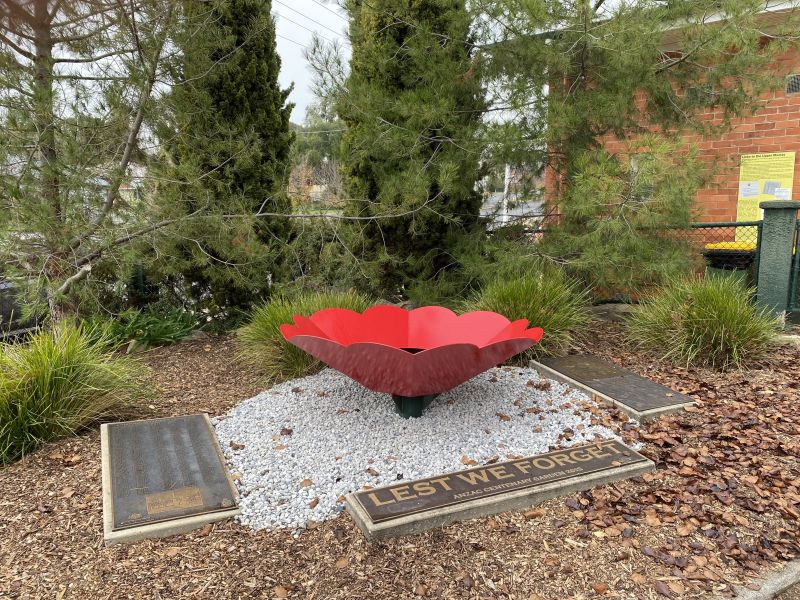
Hugh Gordon Hanna
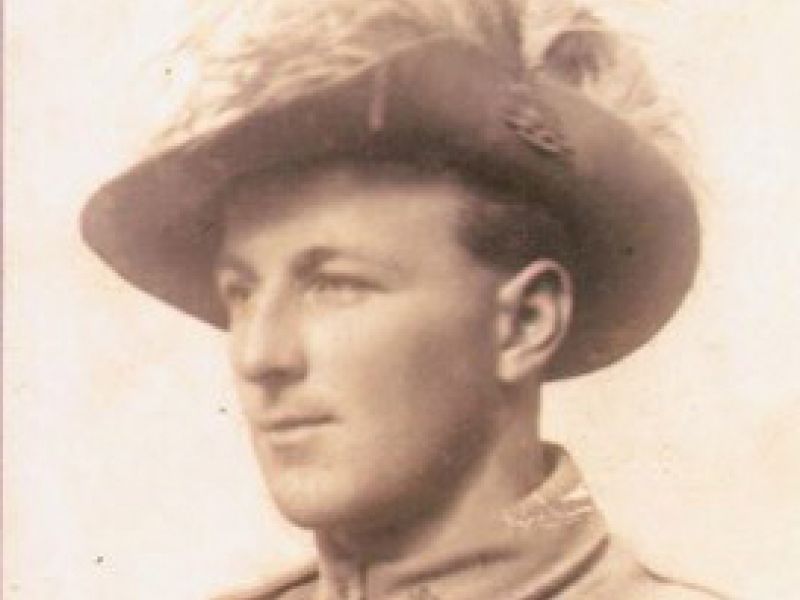
 Stephen Learmonth
Hugh Gordon Hanna was born on 12 December, 1890, at Tintaldra, Victoria, to Robert and Margaret Jean, nee Clyde (1868 to 1939), was 23. Hugh would be the second-eldest of six children.
On 16 November 1914, Hugh enlisted in the AIF at Melbourne, Victoria. He was given the service number 728 and was put on strength with the 2nd Reinforcements of the 4th Light Horse.
Upon enlistment, he was a single, 23-year-old grazier from Walwa, Victoria. He stood 5 feet 10 inches (178 cm), weighed 11 stone 10 pounds (74 kg), and had chest measurements between 35 and 38 inches (89 to 97 cm). His complexion was described as fair, his eyes as blue, and his hair as brown. Hugh’s records show that he had the distinctive marks of a scar inside his left knee and a vaccination on his right arm. Hugh’s religious denomination was given as Presbyterian. His chosen next of kin was his father, Robert Hanna, who lived in Springfield, Walwa, Victoria.
Hugh embarked on HMAT A13 Katuna on 3 February, 1915, sailing from Melbourne, Victoria. The trip would take him across the Great Australian Bight to Fremantle, on to Colombo, in Ceylon, before finally disembarking at Suez at the southern end of the Suez Canal in Egypt.
Hugh arrived on the Gallipoli Peninsula on 27 August 1915 as a member of the 4th Light Horse Machine Gun Section attached to the 1st Infantry Brigade. He remained at Gallipoli until the general evacuation, disembarking at Alexandria on 27 December 1915.
On 12 May 1916, he was admitted to No. 1 Stationary Hospital at Tamalia suffering from influenza. He was discharged a month later to the Training Depot at Tel-el-Kebir and rejoined the 1st Light Horse Regiment. One month later, Hugh was transferred to the 13th Machine Gun Company, embarking at Alexandria on the Franconia on 8 August to join the BEF in France. Here he was taken on strength with the 15th Machine Gun Company. On 6 March 1917, he was admitted to the 14th Field Ambulance with cellulitis in the ankle. Two weeks later, he was transferred to the 5th General Hospital at Rouen, this time suffering from influenza. He rejoined his company three weeks later.
On 21 May 1917, he was at the 5th Army School, having been selected to attend a Machine Gun Cadet School at Bisley, England. Upon successfully completing the course, he was appointed 2nd Lieutenant and posted overseas to France. Eventually, he was posted back to the 15th Machine Gun Company on 1 April and was promoted to 1st Lieutenant.
On 3 May 1918, Hugh wrote a letter to Inspector Armitage. It was reported in the 1 August edition of the Myrtleford Mail and Whorouly Witness:
“I have at present in the front line a complete machine gun section under my charge. In a recent operation one of my guns came rather into the limelight. At a critical moment I rushed it forward and caught the Huns in the open. The result was that the enemy lost very heavily, and his advance was held up on a fairly wide sector. As a result of a recommendation I received some very nice, flattering communications from Generals downwards. I think the sweetest of the lot were those from my own splendid Australian boys. It looks so funny to get letters addressed ‘Lieut. Hugh G Hanna, M.C.’ Nevertheless I am proud of the decoration for the sake of the dear folk at home. I expect to meet my brother Douglas and cousin Mont in the near future, as a recent letter tells me they expect to be in France in a few days. I only hope that their good fortune sticks to them as well as mine has done to me. It has so far made no difference - high explosives and shrapnel barrages, machine gun blasts or gas - I seem to come through all unscathed. Just as I wrote that last a 4.2 high explosive shell fell within ten yards of my dug-out, and things got a bit of a shake. In fact it put my candle out and left me in the dark.”
On 30 August, Hugh received his official notification for his Military Cross. His citation read:
“For conspicuous gallantry and devotion to duty during several days of severe fighting, when he displayed the greatest courage, skill and determination in handling his guns. On one occasion, late in the operations, the enemy broke through a portion of the line, and it was largely due to his able disposition that the advance was stopped on that sector with heavy loss to the enemy.”
On 30 August, he was wounded in action and admitted to the 61st Casualty Clearing Station with shrapnel wounds to the right shoulder and head. He was immediately transferred to the 2nd Base Red Cross Hospital and, after two weeks, to England, where he was admitted to the 3rd London General Hospital on 18 September, 1918. Two days after the Armistice, he was transferred to Cobham Hall.
On 9 December 1918, he left England on the HMAT A8 Argyllshire, disembarking at Melbourne on 1 February, 1919. He was discharged from the AIF on 23 June, 1919. For his service during the war, he was awarded the Military Cross, the 1915/15 Star, the British War Medal and the Victory Medal.
Records indicate that Hugh married Lillian Bessie Kiddle on 9 September 1920, in Melbourne, Victoria. During their marriage, they had four children.
Lillian herself had a service record that is worth mentioning. The first snapshot is taken from an article that appeared in the Thursday, 6 February 1919, edition of the Border and Riverina Times.
Sister Lilian Kiddle, who wears the 'Mons' Medal (awarded to those who served with the first British army in France and Belgium), is returning to Melbourne by the S.S. Demosthenes, after having spent four years in France with The British Red Cross. She was personally congratulated by Field-Marshal Sir Douglas Haig for her work on ambulance trains behind the lines. Sister Kiddle is a daughter of Mr. Richard Kiddle.
The second article appeared in the Saturday, 15 March, 1919, edition of the Australasian.
Last week Miss Lilian Kiddle, who was the first of 30 Army Sisters to cross from England to France, in October, 1914, returned to Melbourne. Her trials on first taking up duty were dreadful. Afterwards a more organised state of affairs came about. She nursed men of many nationalities, including Germans. Her collection of souvenirs tells her story. There is her apron pierced with shrapnel. Her electric torch was often the only light allowed an hospital for fear of air raids. Her passport is so covered with endorsements that it bears quite a history. Miss Kiddle was in the retreat from Mons, and side by side with her Royal Red Cross ribbon is the ribbon of her Mons Medal, awarded to those who rendered service with the first British Army in France and Belgium. More pleasant memories attend the fur-lined cape and muff, with large serge hood, Queen Alexandra's gifts to the first nurses. There is the Duchess of Westminster's autographed photograph and arm badge worked with her coat-of-arms, farewell gifts, Sister Kiddle having practically concluded her services in her Grace's hospital. Even the cover on the table where on the souvenirs were displayed had its sorrowful history, for it was among the last pieces of linen and lacework done by the women of Lille. Extremely clever and devilish in its ingenious construction is the German sniper's mask in her possession, of the finest golden-brown gossamer, with the most beautifully and deftly worked eye holes, the only part of his face visible when the mask is on; while the colour makes it impossible to locate the wearer.
For the purpose of enabling these interesting souvenirs to be seen, Mrs. Richard Kiddle gave a small tea at The Waldorf, St. Kilda, on March 7, when a company of relatives and old friends welcomed home her daughter, who had been abroad for six years. Miss Kiddle was in a smart frock, which she brought out with her, of black.
taffeta, with a super-bodice of georgette, embroidered with gold, and a black velvet hat, set off by a gold rose. Before going to England, two years before the war Miss Kiddle trained at the Homoeopathic Hospital, St. Kilda road. Before leaving England she was personally congratulated by Sir Douglas Haig for her work on ambulance trains behind the lines. Sister Kiddle is the second daughter of Mr. and Mrs. Richard Kiddle, of New South Wales, and is niece of the late Mr. Lewis Kiddle and Mr. William Kiddle. Among the guests who welcomed her home with warmth and affection were Mrs. John Kiddle, Miss Marion Kiddle, Mrs. P. J. Brient, Mrs. Raynes Dickson, Mrs. Archibald Currie and Miss Currie, Miss Kelly, Mrs. Hubert Parker, and Mrs. G. Hodgson. Sister Kiddle describes in glowing terms the deeds of her countrymen, who, she says, very often saved an evacuation of hospital near the line by their bravery.
When war with Germany once again arrived on the scene, Hugh answered the call, enlisting in the Citizen Military Forces at Jingellic. He was given the service number V402684.
Both Lillian and Hugh passed away in 1974, in Walwa, Victoria and were buried there, together.