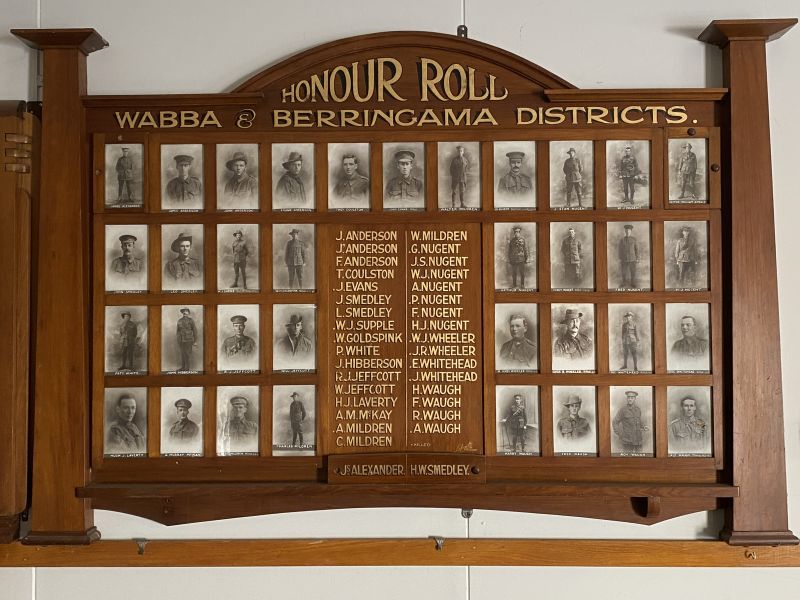
James Alexander
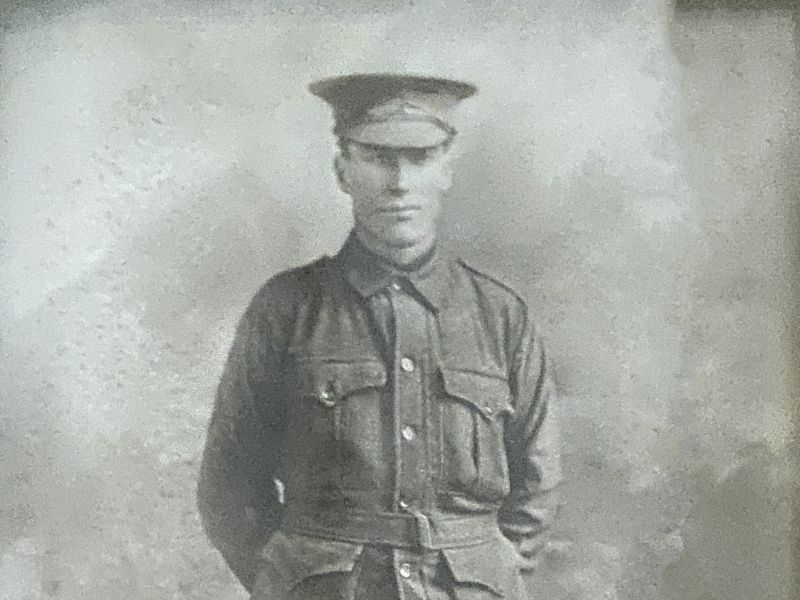
 Stephen Learmonth
James was born in January of 1883 in Sale, Victoria, to David Duncan Ellen, nee Royle. He would be one of five children. He married Barbara Isabel Gifford in 1915 in Holbrook, New South Wales. They had one child during their marriage.
James enlisted for the AIF (Australian Imperial Forces) on 18 December, 1916, and was given the Regimental Number 2643. He was taken on strength as a part of the 23rd Reinforcements for the 13th Light Horse Regiment. At the time of enlistment, James was nearly 31 years old. He was 5 feet 3 1⁄2 inches tall (160 cm) and weighed 133 lbs (60kg). James’ chest measured 34 inches (86 cm), his complexion was fresh, eyes blue, hair brown and religion Church of England. He had three vaccination marks on his right arm and some moles on his back.
At the time of enlistment, James was living in Holbrook at Lankeys Creek with his wife, Barbara. Lankeys Creek is a community in the eastern part of the Riverina. It is about 18 kilometres north-west of Jingellic and 36 kilometres south-east of Holbrook. James was a grazier on his property.
On 8 January 1917, James was sent to the Recruit Depot at Seymour in Victoria. While there, he was transferred to the 3rd Australian Camel Regiment. On the 20th of April, James was once again transferred, but this time to the Langwarrin Camp, as he was suffering from a venereal disease. The troopers and soldiers at Langwarrin were certainly not allowed to rest and recuperate. A record of the training that he underwent while at Langwarrin states that he completed 232 hours of squad drill (without arms), 170 hours of squad drill (with arms), 876 hours of guard duty and 65 hours of platoon duty. James returned to the Training Depot based at Seymour on 21 December 1917.
His unit embarked from Sydney, New South Wales, on board HMAT A18 Wiltshire on 2 February, 1918. James was 31 at the time. He finally disembarked at Southampton in England on 20 April 1918 and was immediately taken on strength with the 3rd Brigade Field Artillery and remustered as a gunner.
On 4 May 1918, James was admitted to the Military Hospital at Sutton Veny, in Wiltshire, England, suffering from an ulcer on the cornea of his eye. He was discharged nearly two and a half months later on 16 July. In early August, he was awarded four days confined to barracks and forfeited one day’s pay for being AWOL (absent without leave) from Heytesbury from noon to 10 p.m. on 1 August.
On 23 September 1918, James went to France. Initially, he was sent to the Australian General Base Depot at Rouelles before marching out to the Australian Corps Reinforcements Camp. James was taken on strength with the 3rd Australian Field Artillery Brigade in the field, where on 1 October, he was remustered as a driver.
Seven days before the Armistice with Germany, on 4 November 1918, James was again admitted to the 3rd Australian General Hospital for an ulcerated eye. He was transferred to England one month later and, on Christmas Day, he embarked on the HS Takada for return to Australia as an invalid. He disembarked at Melbourne on 11 February, 1919.
As James enlisted in Victoria rather than his home state of New South Wales, his wife, Barbara, was not provided with travel tickets to meet him off the boat. Barbara’s letter, asking for an explanation as to why she was not provided with the tickets, is in James’ file. The return letter from the Officer in Charge of Base Records is complete with the officialdom that was popular with official responses. She was advised to “notify the Shire Secretary of the Shire in which you reside of your address, in order that, should any public welcome be extended to returned members of the Australian Imperial Force, the Secretary will be aware of your husband’s regimental particulars and whereabouts.”
James was discharged from the AIF on 25 March, 1919, receiving the British War Medal and Victory Medal for his service. He died on 25 May 1963 in Sydney, New South Wales, at the age of 80 and was buried in Rookwood Cemetery, Sydney.
Researched and Written by Georgia Daly, Corryong College