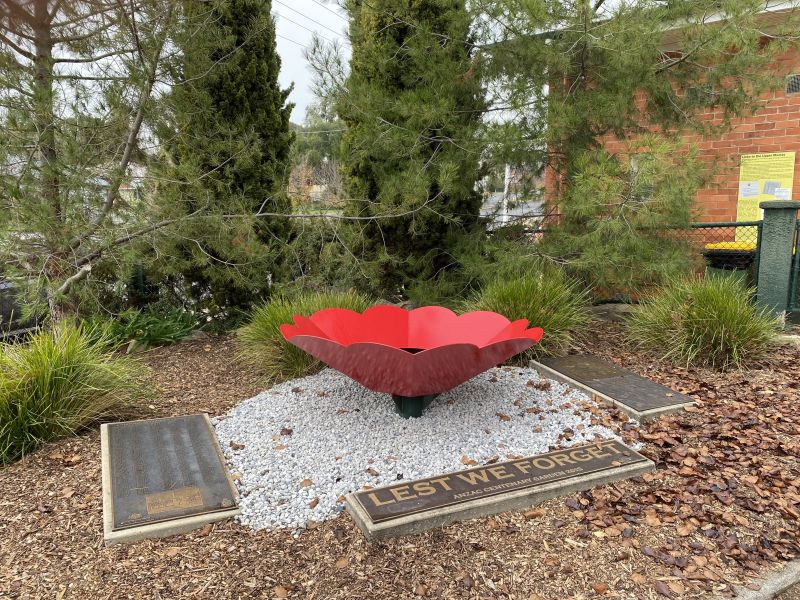
James Strachan
 Stephen Learmonth
When James Strachan was born on 26 March 1886 in Jingellic, New South Wales, to Alexander and Mary France Georgina, nee Roy. He had four brothers and two sisters
On September 3 1915, James enlisted in the AIF at Melbourne, Victoria. He was given the Regimental Number 1620 and was put on strength with the 12th Reinforcements of the 8th Light Horse.
Upon enlistment, James was a single, 29-year-old labourer. He stood 5 feet 10 inches tall (178 cm) and weighed 11 stone (70 kg). His complexion was described as fresh, with blue eyes and dark brown hair. His records show that he had the distinctive marks of 2 warts on his back and a scar on his right knee and stomach. James’ religious denomination was given as the Church of England.
On November, 10 1915, James embarked on HMAT A11 Ascanius, sailing from Melbourne, Victoria. The trip would take him across the Great Australian Bight to Fremantle, on to Colombo, in Ceylon, before finally disembarking at Suez, at the Southern end of the Suez Canal, in Egypt.
It wasn’t long after arriving in Egypt that James was hospitalised with mumps at the No. 4 Australian Hospital at Abbassia. He would spend a total of eleven days in hospital from January 7 to January 18, 1916. Upon returning to his unit, he was taken on strength with the 3rd Reserve Regiment at Heliopolis, before being transferred to the 46th Battery of the 4th Division Artillery.
On April 16, 1916, James was admitted to the No. 1 Australian Stationary Hospital with a case of venereal disease. This time, he would only remain in hospital for six days. James would spend further time in various fields and stationary hospitals during his enlistment, but these would be in France and England, although for the same condition.
On May 1, 1916, James was remustered as a driver in the 12th Field Artillery Brigade. This unit, along with James, left Serapeum by two trains late in the evening of June 1, 1916 and embarked on troopships at Alexandria early the next morning. Of the four troop ships required to move the Brigade to France, James would most likely have been on either the Caledonia or the Kingstonia, with the other two used for equipment and supplies. It took five days for the convoy to sail across the Mediterranean to the port of Marseille, in southern France. By June 18, the Brigade were settling into billets in Caestre, France.
The first time James’ battery went into action would have been during the period of July 3 to July 13, when the 46th Battery relieved the 22nd Battery of the 2nd Divisional Artillery in the line near Fleurbaix. During this period, the 46th Battery fired 863 rounds, mainly for target verification and retaliation. The average range was 300 yards, and although the battery was heavily shelled, there was no damage to either guns or personnel.
Other duties undertaken by the battery were wire cutting. The 12th Field Artillery Brigade's war diary for this period states
“The 45th, 46th and 47th Batteries were all detailed as Wire Cutting Batteries and must have performed their work excellently from remarks subsequently made by the Infantry, to the effect that the wire entanglements gave them no trouble at all, in fact (sic) were hardly noticed.”
At one stage, the 46th Battery was continuously in action for 57 hours, during which 3895 rounds were fired.
After their period in the line, the 3 Batteries of the Brigade went to new billets in Managatte, near Steenwerck. They then spent some time refitting with personnel and equipment while undertaking training programs that included: gun laying, battery gun drill, route marches, semaphore signalling, driving drill, physical training and squad drill.
In late August, the Brigade from Setques, France, to Reninghelst, France, moved into gun positions. The image at left shows an 18-pounder battery site behind Vaulx, for registration on Lagnicourt. Such a scene would have been familiar to James.
In September, the Brigade was first stationed in the Boeschepe region and later in the Dockebusch region. During this period, the 46th Battery continued to support infantry troops in the front line, firing rounds for registration and retaliation. During this period, up until April 1918, James’ position as a driver could have included a number of tasks. The moving of the guns, the transportation of ammunition and other materials from store areas behind the lines, as well as the care and maintenance of the wagons and horses, would have filled James’ days.
The only date recorded for 1917 in James’ records shows that from 23 June 1917 to July 3, 1917, he was awarded leave from France to England. A gap of almost a year then appears, and it is not until March 1918 that we find him admitted to hospital again. On April 3, James rejoins his unit and, two months later, is promoted to the rank of Bombardier.
On August 10, 1918, James is admitted to the 1st Australian General Hospital in England, once again for treatment of a venereal disease. After leaving hospital, he was transferred to the Overseas Training Brigade in October. It is from here that he is posted as absent without leave from 2359 on November 12 to 2235 on November 19. For this, he is awarded 14 days Field Punishment No. 2 and forfeits 21 days' pay. In the British and Commonwealth forces, there were two categories of field punishment. Field punishment No. 1 consisted of heavy labour, possibly performed while handcuffed and tied to a post or a wheel. Field punishment No. 2 was different in that the offender was not necessarily attached to a fixed object.
On April 13, 1919, James embarked on HT Wyema and returned to Australia some weeks later. He was finally discharged from the AIF on July 11 1919. For his service during the war, he was awarded the 1915-15 Star, the British War Medal and the Victory Medal.
When war returned to Australia in 1939, James enlisted in the Citizen Military Force and was issued Service Number V402649. He gave his sister, Georgina, as his next of kin. Australian Electoral Rolls indicate that during the 1930s and 1940s, James lived at Tooma in New South Wales. Current record searches provide no information on whether James married during his lifetime. James passed away in Goulburn, New South Wales, in 1973, at the age of 87, and was buried there.