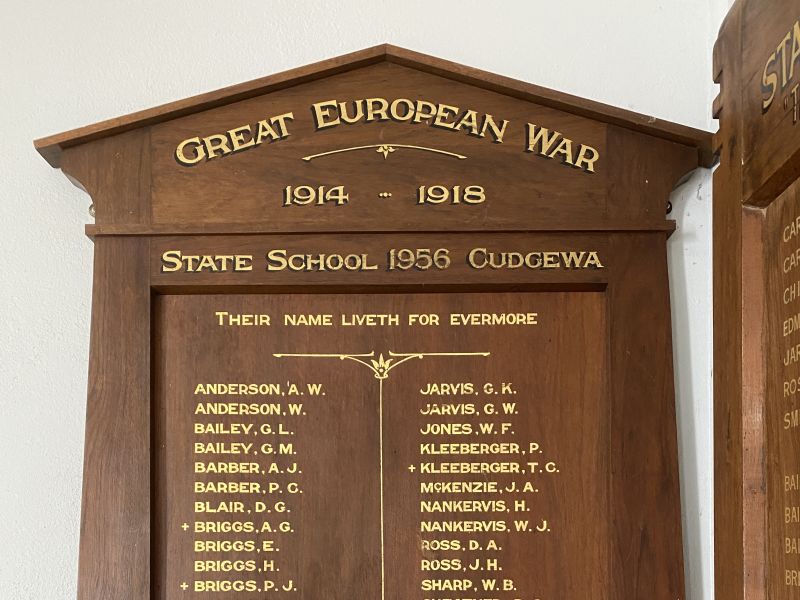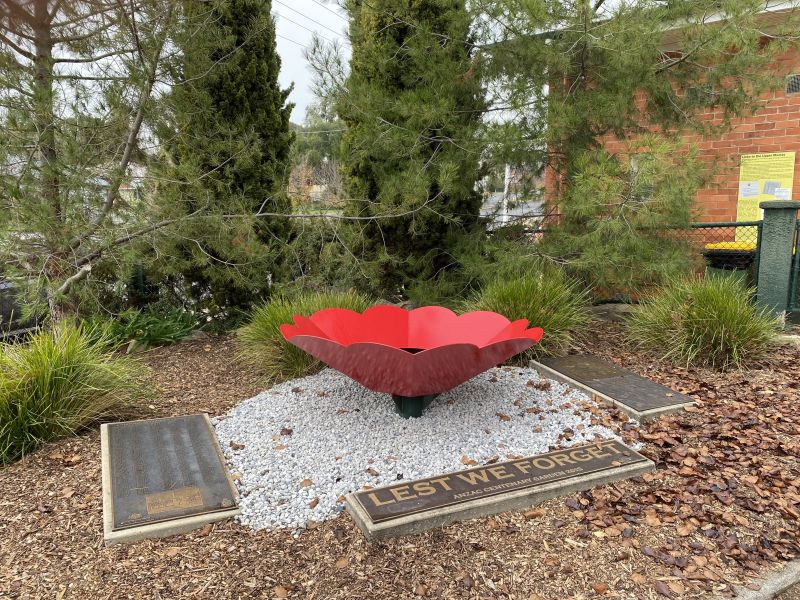
Paul (Jock) Kleeberger
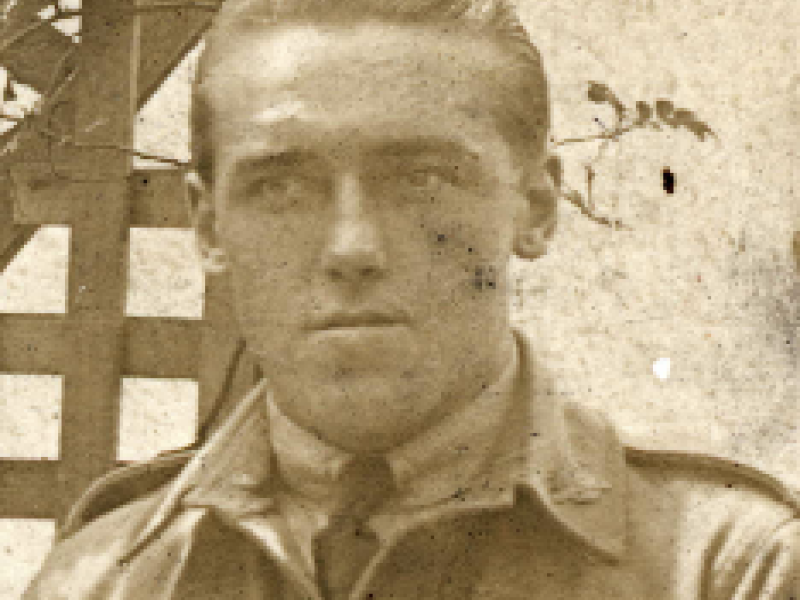
 Stephen Learmonth
Jock was born in 1897 in Corryong, Victoria. He was one of six children of Charles Julius Robert and Mary Annie (née Craig) Kleeberger. In 1898, Charles was named Registrar of Births and Deaths at Cudgewa, Victoria. He resigned this position in 1900 and became the head teacher at Cudgewa State School. Unfortunately, when Jock was only seven, Charles died of heart failure while at school. That left Mary to raise six children, aged between seven and seventeen.
In 1905, Mary married Charles' younger brother, Theodore, and the family moved to Melbourne, where they lived at 75 Dryburgh St in West Melbourne.
Jock enlisted on 25 August 1914, putting his age up two years to 19. He claims in his attestation form that he had prior experience with the Senior Cadets and the 64th Infantry Battalion. This may have been true, but given his lie about his age, it could have been included to strengthen his chances of success. Even at 19, Jock would have required his mother’s permission to enlist; however, such a note is not to be found in his Service Records. Jock was allocated Service Number 365 and placed in C Company of the 6th Infantry Battalion.
The battalion embarked on HMAT A20 Hororata at Melbourne on 19 October 1914. After a brief stop in Albany to join other troopships and escorts, the Hororata arrived in Egypt on 2 December. The 6th Battalion took part in the second wave of landings at Gallipoli on 25 April. Ten days after the landing, the battalion, as part of the 2nd Brigade, was transferred from ANZAC to Cape Helles to assist in the attack on Krithia. Fortunately, Jock was not among them.
Jock was wounded twice while on Gallipoli. The first occasion was on 25 April, when he received gunshot wounds to both legs. He was eventually evacuated to No. 1 General Hospital in Cairo, then transferred to No. 2 General Hospital at Mena, Egypt, where he remained for six weeks before returning to the peninsula. The second occasion was 10 August, when he was wounded in the right knee. He was taken to the 24th Casualty Clearing Station at Mudros on the island of Lemnos for eight days before rejoining his battalion on Gallipoli. Jock would leave Gallipoli during the December evacuation and return to Alexandria on 7 January 1916.
After further training in Egypt, the battalion embarked aboard HMAT A70 Ballarat and arrived in Marseilles, France, one week later. In late July, it would see its first action at the Battle of Pozieres.
On 4 September 1916, in the latter stages of Pozieres, Jock was wounded for the third time. He was admitted to No. 3 Canadian Casualty Clearing Station with a gunshot wound to the right arm. He travelled to Boulogne on No. 4 Ambulance Train and embarked on the HS (Hospital Ship) Jan Breydall. The following day, Jock was admitted to the Ontario Hospital in Kent. Six weeks later, he was discharged from hospital and given a two-week furlough. In early December, he was charged with going absent without leave for one day (a common charge handed to many Australian troops) and forfeited two days’ pay as a consequence.
On 20 May 1917, Jock was transferred from the 6th Battalion to the Australian Provost Corps (Military Police). In early August, he was charged with neglect of duty and required to forfeit four days' pay. There is no mention of what he neglected to do. Jock would remain part of the United Kingdom Detachment of the Corps until September 1918. During this time, his duties would include escorting visiting dignitaries, running prisoner escorts, apprehending Australian troops absent without leave, and helping maintain discipline. In late September 1918, Jock was placed on Escort duty to France. One month later, he embarked on HMAT A30 Borda to carry out submarine guard duty on the voyage back to Australia. Jock received his discharge from the A.I.F. on 16 February 1919.
For his service during the war, Jock was awarded the 1914/15 Star, the British War Medal and the Victory Medal.
Mary passed away in 1919. After the war, Jock and his sister Ida lived at 16 Darling Street, Moonee Ponds, with their stepfather, Theodore. Jock was a trainee engineer. By 1924, Ida had married and moved to New South Wales. In 1930, Jock married Annie Ethel Dolan. Later that year, their first child, Patricia, was born, and they moved to 17 Unley Grove in Ascot Vale. In 1936, the family had moved to 53 North Street, and Jock had gained employment as a fitter.
A photograph in Ancestry shows Jock working at Newport Railway Workshops, possibly from the late 1930s or early 1940s. It is most likely here where Jock did his traineeship as a fitter. He would have worked on the construction of locomotives and other rolling stock. During the Second World War, he would have been part of the wartime production of materials ranging from Bren gun carriers to Beaufighter aircraft.
Jock passed away in 1962 in Sunshine, Victoria. In 1967, Annie wrote to the Central Army Records Office to claim Jock’s Galipoli medallion. She would pass away in 1987.