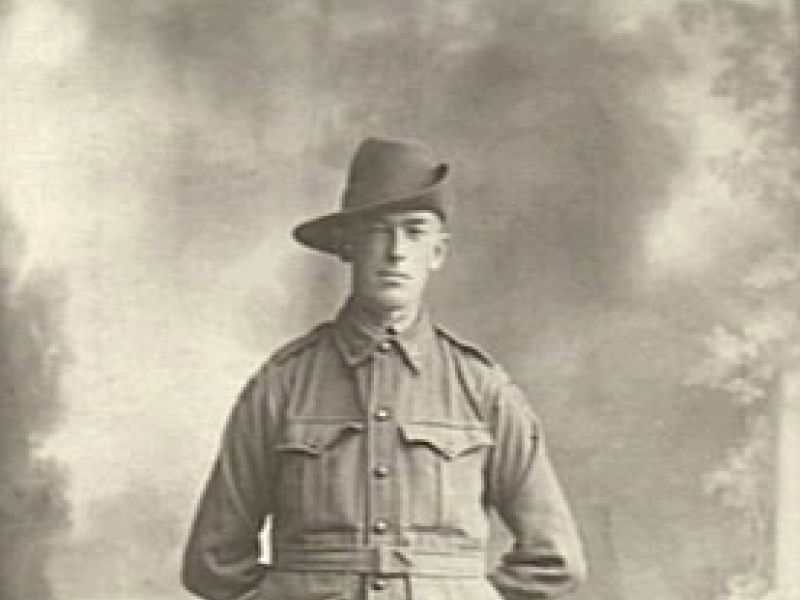
John George Molesworth Crowe
 Stephen Learmonth
John George Molesworth Crowe was born in Tintaldra, Victoria, in 1884 to George and Jane Cathcart, nee Hanna.
At the time he enlisted on 7 October 1915 at Liverpool, New South Wales, John was a single, 31-year-old station manager, with an address of 37 St Edmonds Rd, Prahran, Victoria. His medical examination describes a man who is 6 feet tall (183 cm) and weighs 156 lbs (71 kg). His complexion was given as fair, his eyes grey, and his hair fair. He gave Presbyterian as his religious denomination, and he had no distinctive marks. He was taken on strength with the 11th Reinforcements for the 7th Light Horse Regiment and allocated the service number 1386.
His unit embarked from Sydney, New South Wales, on 23 October, 1915, aboard the SS Hawkes Bay. Upon arriving at Maadi in Egypt, he was taken on strength with the MEF (Mediterranean Expeditionary Force) on 28 December, 1915. On the first day of the new year, John was admitted to the 4th Auxiliary Hospital in Cairo, suffering from mumps. He would remain here until 25 January, when he rejoined his unit stationed at Maadi.
On 25 February 1916, he marched out with the 7th Light Horse Regiment to Serapeum. In April of that year, the Regiment joined the forces defending the Suez Canal from a Turkish advance across the Sinai. It fought at the battle of Romani on 4 August, at Katia the following day and was involved in the advance that pushed the Turks back across the Sinai and Palestine.
Late 1916 and early 1917 saw the Regiment engaged on patrol work until the British advance was stopped at Gaza. It was involved in the two abortive battles to try to capture Gaza on 27 March and 19 April. On 25 June 1917, John was detached for water duty at Khan Yunus, near Tel-el-marakeb.
He was remustered as a temporary driver on 1 August 1917 to replace other drivers who had become ill. This lasted about one month, after which he was reverted to Trooper and returned to duty. This remuster occurred again before the end of October.
In late October of 1917, he was admitted to the 2nd Light Horse Field Ambulance before being transferred to several other medical facilities, including the 76th Casualty Clearing Station, the 43rd Stationary Hospital at Kantara, and the 14th Australian General Hospital at Abbassia, suffering from influenza. As a result of his illness, he was kept at a convalescent hospital due to his having pyrexia (sore muscles). It would be late November 1917 before John was back with the 7th Light Horse Regiment at Moascar.
The 7th Light Horse was involved in the pursuit of the Turks across Palestine and was present at the capture of Jerusalem in December. With the focus of operations shifting to the Jordan Valley, John would have been involved in the raids on Amman from 24 to 27 February and on Es Salt from 30 April to 4 May. On 10 June 1918, he was remustered as a driver once again.
The structure of a Light Horse Regiment consisted of three Squadrons and a Headquarters section. Each Squadron consisted of four troops, with each troop generally being allocated two drivers. John’s job as a driver would have been to take charge of the general service wagons used to transport larger, heavier items.
In early October, John was admitted to hospital once again. This time suffering from septic sores. He would still be in hospital at the 14th Australian General Hospital at Port Said when the Armistice was signed with Germany. The Turks had signed the Armistice of Mudros on 30 October 1918, nearly two weeks before Germany had capitulated.
John was given 14 days' leave in Cairo on 25 November, after his stint in hospital. However, on 12 December, he found himself back in hospital with an old injury to his right hand. John had injured his right thumb by falling off a horse on 1 October, 1918. He had been treated for this at the 14th Australian General Hospital for six weeks, while he was also suffering from malaria. An operation was performed on him at the time, with the surgeons opening the dislocated thumb and forcibly replacing the metacarpal bone. He was classified as having ⅓ incapacity of his right hand, and it was suggested that he be discharged as permanently unfit for duty.
On 15 January 1919, John embarked on HMAT A35 Berrima at Suez and returned to Australia some weeks later. He was formally discharged from service on 3 April, 1919. For his service during the war, he was awarded the 1914/15 Star, the British War Medal and the Victory Medal.
According to the 1919 Electoral Roll, upon returning from overseas, he settled in the Prahan area, living at 37 St Edmunds Rd, Prahan, and claiming his profession as ‘grazier’.
He married Gladys Bella Stennent Elcoate at the Scots Church, Melbourne, in August, 1920. Tragedy struck the newly married couple when, two years later, on 16 January 1922, Gladys passed away. He married Eleanor Mary Alicia (Nellie) Miller. The couple would have two children, Mary and Gordon. John died on 14 October 1937, in Rochester, Victoria, at the age of 53. Nellie would live until 1969 and would be buried alongside John at Boroondara General Cemetery, Kew, Victoria.