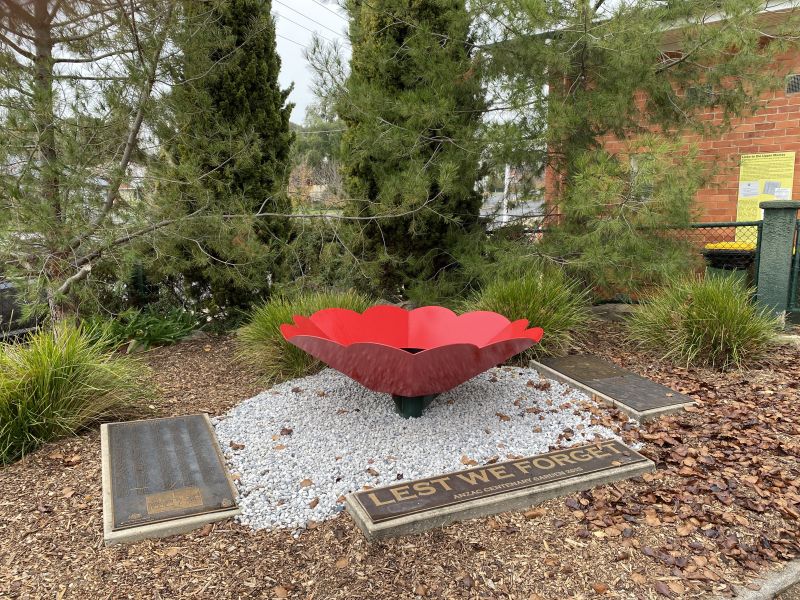
Leslie William Bell
 Stephen Learmonth
Leslie was born on 4 January 1892 in Jingellic, New South Wales. He was the third of five children of John Cameron and Catherine (nee Webster) Bell.
He enlisted at Wangaratta, Victoria, on 15 March 1915. At the time, he was a single 22-year-old grocer, living in Wangaratta. Leslie was allocated the Service Number 838 and placed in D Company of the 24th Battalion. Leslie’s younger brother, George, enlisted a few months later and also served overseas. Leslie embarked on HMAT A14 Euripides at Melbourne on 10 May 1915.
Fred Jacobs, a fellow signaller and also of Wangaratta, wrote to a friend about life aboard the troopship Leslie was also on. This letter was published in the 26 May 1915 edition of the Wangaratta Chronicle.
“LIFE ON BOARD A TROOPSHIP
Sergt. Fred H. Jacobs, a native of Wangaratta, who is a Headquarters Signaller with the 23rd Battalion, 6th Inf, Bde. (Abroad) writes to a Wangaratta friend as follows: Though we have not been on board very long, it is marvellous the way in which the boys have taken to the altered conditions. The troop ship, which we are on is a line vessel fitted out in every detail for the convenience of troops, of which there are a considerable number on board, consisting almost entirely of Infantrymen. For sleeping purposes the troops have each been issued a hammock, which is suspended from hooks screwed into the ceilings, so that when the boat rocks our beds swing also. For the first couple of nights it was quite a conundrum how to keep in the hammocks, but now the lads seem to manage it very well. We have only now made a beginning at doing a little work on board. For a few days nothing could be done owing to the fact that so many of the troops were down to it with seasickness, but now that everyone is better things are going along fine. The Infantrymen do short “gallops” up and down the decks, while the Army Medical Corps are busy bandaging up supposed injuries, and if one happens to glance up to the bridge of the vessel he will see semaphore arms, swinging, to all positions, being skilfully manned by qualified Signallers of the Army; then at the side of them are other signallers communicating by Morse Flags signalling with a vessel at our side, so you see that though we are on the water we are not regarding it as pleasure time, The daily routine is:--Reveille 6 a.m,, 6.15 a.m. Blankets and hammocks folded away; 7 a,m,, breakfast; 9 to 12, drill; 12 noon, dinner; 2 to 5, drill; 5 pm, tea; 9,15 pm., bed; 10 pm, lights out, Though it seems a long day to us, we "spring up" again quite fresh when at 6 a.m, each morning we hear the bugles calling "Get out of bed," They are a fine lot of chaps aboard, and it is good to he amongst them, and to think we are all fighting for the one great cause. From the Wangaratta High School there are four of us aboard, viz., Norman Rothery, whose people reside at Myrtleford; Austin Mahoney, who comes from Hansonville; George Ferguson, who hails from Bobbinawarra, and myself. While from Wangaratta there is Fred Briggs, Ted Lee and Leslie Bell, so Wangaratta is well represented on this troopship. Amusement is very scarce, and reading material hard to get. In the evenings the main amusement among the troops is euchre. On board we have a piano, but it is hard to get a piano player, so it is nearly always vacant. All the Wangaratta and district boys are quite well and are taking a deep interest in their duties.”
After spending time in Egypt, the 24th Battalion landed at Gallipoli on 4 September 1915. It spent the next 16 weeks in the trenches at Lone Pine, rotating with the 23rd Battalion regularly because of the intense, exhausting conditions in that part of the fighting. During October and September, Leslie was sent to hospital on several occasions, suffering from dysentery. At one stage it was severe enough for him to be sent back to Alexandria.
The 10 Nov 1915 issue of the Wangaratta Chronicle published a letter Leslie had written to his mother.
“Signaller Les Bell writes to his mother, Mrs J. C. Bell, of Parfitt Road, under date of 8th September. He says that at last they have landed at Gallipoli, and have been in the firing line for a few days. They arrived at the Dardanelles at 12.30 on Sunday morning, disembarked at Anzac at 5 o'clock a.m., rested in Shrapnel Gully all day, and left on Monday for the trenches, which they entered the same night. The signallers started duty at 9 o'clock on Tuesday on the bussers and telephones at Battalion Headquarters. He has had two hours on and six off so far. He went into the trenches and had a chat with F. Briggs, E. Boyett and E. Lee, who are helping to keep old Wang's good name going. In looking over the splendid trenches he did not think the Australians and New Zealanders who made the first landing got half the praise due to them; the work they have done is wonderful. When the first shell buzzed over his head, his knees seemed to buckle up all ways, and he ducked down mighty quickly. All the new chums duck when the shells go buzzing over head. The shell landed on the hill but did not explode. He made his first stew on Monday out of bully beef and oat meal biscuits, and it turned out O.K.”
After the evacuation from Gallipoli, Australian troops were sent back to Egypt to refresh and regroup. The AIF went through a reorganisation. Original battalions were split to form “pup” battalions. These became a mixture of veterans and recruits. Leslie was taken on strength in the new 57th Battalion. The battalion embarked on the HT Transylvania on 17 June and arrived at the Port of Marseilles a week later.
The battalion took part in Australia’s major engagement in France, the Battle of Fromelles, on 19 July 1916. They played a supporting role, helping repel counter-attacks, but suffered over 200 casualties.
Leslie’s service record for 1917 shows leave to England, a period at the Army Signallers School and a stint at the 12th General Hospital in Rouen, suffering from arthritis in a knee joint.
On the first day of 1918, Leslie transferred to the Australian Army Medical Corps and reported for duty at the 1st Australian Auxiliary Hospital at Harefield. He remained with this unit, apart from a spell in hospital and some leave, until his demobilisation. In mid-September 1919, he applied to be demobilised in England rather than return to Australia. His reasons were recorded in his application.
“I am engaged to be married in England. My fiancée is not desirous of being married and leaving her parents for at least 12 months. I have guarantee of employment which is being forwarded direct, and have a sufficient sum in the New South Wales Saving Bank, which I have cabled for. (About £200). If I return to Australia now it will mean great inconvenience and expense in that I will have to return almost immediately.”
His guarantee of employment was from O.B. Chamber, Watch Maker and Jeweller of 37 Market Place, Warminster. His fiancée, May Meacham of 49 Ebury Rd, Rickmansworth, Hertfordshire, was also required to explain to the Department of Repatriation and Demobilisation why she did not wish to sail to Australia.
“Dear Sir,
My reason for wishing to remain in England for a time is because of my aged mother. She is subject to Chronic Rheumatism and Asthma and I think it is my duty to stay with her as long as possible.
Yours faithfully
M Meacham”
For his service during the War, Leslie was awarded the 1914/14 Star, the British War Medal and the Victory Medal. His name is recorded on the Upper Murray Great War Participants Roll, the Wangaratta District Roll of Honour and the Wangaratta and District Victory Roll.
May’s father, George, had died in July 1908, and as all of her siblings except a younger sister had possibly left home, she felt responsible to care for her widowed mother. In the margins of Leslie’s response, he typed that he intended to return to Australia within eight months. Leslie and May were married in October 1919 at Watford in Hertfordshire. Leslie was discharged in London on 23 February 1920. He never did move back to Australia. May’s mother, Elizabeth, lived for 18 more years.
Little is known about Leslie and May after 1920. Ancestry records indicate they had two sons, the eldest named Roy, and that Leslie died in Watford, England, in December 1972. May’s death date is unknown.
May’s youngest sister, Ethel, clearly had no compunction about leaving her “aging mother”. She married Leslie youngest brother, George, in February 1920, and sailed with him to Australia, to his hometown of Wangaratta.