Percy Clement Barber
 Stephen Learmonth
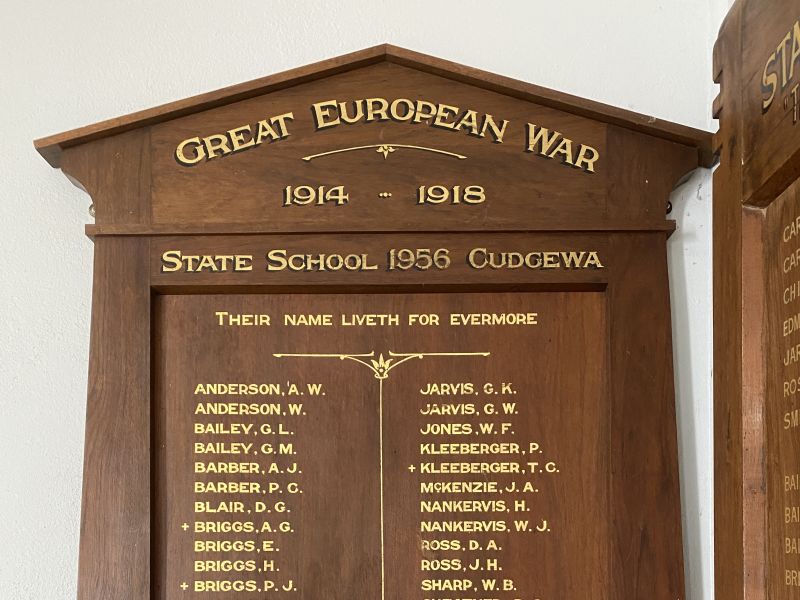
Percy Clement Barber was born on 16 August 1888 at Cudgewa to John Thomas and Ellen Ann Pearce. Percy would have 6 brothers and 1 sister.
On 14 September 1915, Percy enlisted in the A.I.F. at Melbourne, Victoria. He was assigned Regimental Number 1992 and placed on strength with the 14th Reinforcements of the 4th Light Horse Regiment.
Upon enlistment, Percy was 5 feet 9 inches (175 cm) and weighed 174 lbs (79 kg). His complexion was described as fair, his eyes as blue, and his hair as brown. Percy’s records show that he had distinctive marks, including a vaccination mark on his left arm, a mole on his neck and three scars on his right knee. His religious denomination was given as Presbyterian. At the time, Percy was a single, 27-year-old gripman living in Nicholson Street in Fitzroy, a Melbourne suburb. His trade, a gripman, was another name for a person who drove a tram.
Percy embarked on HMAT A32 Themistocles on 28 January 1916, sailing from Sydney. Percy had not long been in Egypt when he was transferred to the 2nd Division Ammunition Column, based at Zeitoun, north-east of Cairo. His stay in Egypt was not to be long when he found himself, along with his unit, embarking on a troopship at Alexandria bound for Marseilles in the south of France and the Western Front.
Upon arriving in France, he was remustered as a driver, but then on 19 September 1916, he asked to be remustered as a gunner with the 2nd Division Trench Mortar Brigade.
It was well known that Australian troops were not well known for their spit and polish and their adherence to military doctrine. Clearly, Percy agreed with this, as on 13 December 1916, he was arrested for “conduct to prejudice good order and military discipline” for failing to salute an officer. For this, he was awarded 2 days of Field Punishment Number 2.
On 3 May 1917, Percy was wounded in action, suffering from gunshot wounds to his right shoulder. Over the next month, he would be transferred to a number of different medical facilities, including the 3rd Casualty Clearing Station, the 5th Australian Field Ambulance, the 9th General Hospital and the 2nd Convalescent Depot in Rouen, France.
A week’s leave in England from the 22 to the 29 of September 1917 allowed Percy to get away from the horrors of the Western Front and enjoy some time seeing the sights of London and sleeping in a real bed. Percy would also experience a week's leave in Paris in 1918. After returning from leave in England, he was promoted to Corporal.
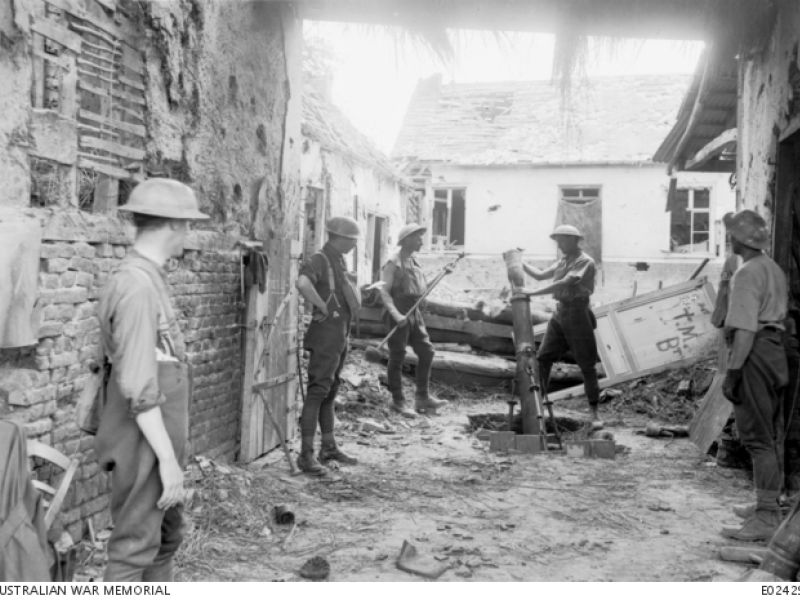
The image shows a medium trench mortar crew in action at a farmhouse 400 metres from the German front line on 29 May 1918. The man loading the mortar is Percy.
On 27 July 1918, Percy was awarded the Military Medal. The actions by which Percy received this medal are noted in C.E.W. Bean’s Official History of the A.I.F. in France, Volume VII.
“It was noted that part of this battery (4th Medium Trench Mortar Battery) brought up rations by daylight. Despite the shelling the battery fired 170 rounds during the operation. The 3rd M.T.M. Bty., on the left flank, had bombarded the wire of the second German line north of the Bray-Corbie road during the afternoon with 112 rounds - at zero hour it fired 37 more. In the 4th Bty. Bdr C.F. Clark and Cpl. G.T. McLennan, and in the 3rd Cpls. S.A. Price and P.C. Barber were conspicious for their work both in carrying and in action.”
On 29 May 1919, Percy embarked on the HT Rio Nigre at Davenport, disembarking at Melbourne on 22 July 1919. He was finally discharged from the A.I.F. on 13 September 1919. For his service during the war, he was awarded the Military Medal, the British War Medal, and the Victory Medal.
Records indicate that Percy married Charlotte Agnes Wyatt in 1919. They would have six children during their marriage, four girls and two sons. The family would live in the Jingellic area, where Percy ran a dairy farm. In 1940, Percy and Charlotte took over the Cudgewa Coffee Palace.
Percy passed away on 20 June 1954 and was buried at Corryong, Victoria.