Richard Henry Jarvis
 Stephen Learmonth
Richard Henry Jarvis was born on April 25, 1890, at Benambra, Victoria, to William (‘Worragee Bill) and Caroline Jane, nee Hadley, Jarvis. He would be the youngest of nine children.
On 4 September 1915, Richard, a single, 25-year-old labourer from Towong, Victoria, enlisted in the AIF at Melbourne, Victoria. He was given the Regimental Number 1582 and was put on strength with the 12th Reinforcements of the 8th Light Horse.
Upon enlistment, Richard was 5 feet 10 ⅜ inches (178 cm) and weighed 12 stone 10 pounds (81 kg). His complexion was described as tanned, his eyes greyish-brown, and his hair dark brown. Richard’s records show that he had the distinctive marks of two vaccinations on his left arm, and scars on his left upper leg and right shin. Richard’s religious denomination was given as Church of England. Once again, as with many boys from Corryong, Dr Greenham conducted his medical examination and signed him off as fit and healthy.
On his last leave before being posted overseas, the Towong community gave a farewell to Richard, his brother Ivan and a few other local lads. It was described in the 4 November 1915 edition of the Corryong Courier.
“TOWONG LADS FOR THE FRONT
On Monday night at the school a farewell social was tendered by the residents to the local soldier boys, James and Jack Anderson, Richard and Ivan Jarvis, and Ernest McInnes, who were on final leave from camp. That the boys are held in high esteem was testified by the large gathering, and by the fact that, though the matter was hastily arranged, the respectable sum of £14 was collected during the day, and was equally divided among them as a cash presentation. Dancing, songs and recitations helped to pass the night pleasantly, but, through it all, an element of sadness was evident, and this fully manifested itself at the final leave taking, when at three a.m. Mr J. Hayes drove his car to the door to take the boys over the first stage of their journey.”
Richard embarked on HMAT A11 Ascanius on 10 November, 1915, sailing from Melbourne, Victoria. Upon arriving in Egypt, the 8th was sent to training camps at Heliopolis and spent some time preparing themselves for the type of warfare they would encounter in the desert conditions of Palestine.
It wasn’t long before Richard was admitted to the No. 1 Australian Stationery Hospital at Somalis, suffering from appendicitis. He would remain in hospital for over a month before he was transferred to the 3rd Light Horse Regiment at Tel-el-Kebir. Recurring bouts of appendicitis would see Richard admitted to hospital two more times before finally being returned to duty with the 8th Light Horse on 7 September, 1916. Richard’s admission to hospitals would not stop there, as, during the time he was in Egypt and Palestine, he would be admitted for tonsillitis and eye problems (amblyopia).
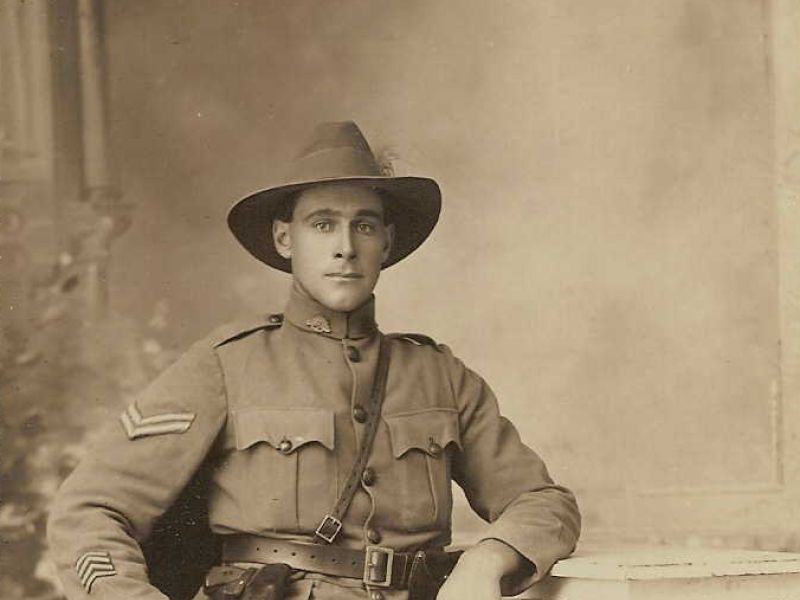
On 20 June 1917, Richard was attached for duty with the Anzac Provost (or Military Police) Corps at Moascar. While with this unit, he would be promoted initially to Corporal on Christmas Day 1917 and then acting Sergeant three months later.
The second half of 1918 would find Richard on duty with the Egyptian Expeditionary Forces in and around Jerusalem, especially with the 1st and then the 2nd Light Horse Brigade Headquarters. The War Diary of the Assistant Provost Marshal, ANZAC Mounted Division, provides examples of the types of duties Richard would have performed during this period. The movement and direction of traffic and the control of prisoners as the Allied forces pursued the Turks were seen as a top priority, but we also read of problems with the native hawkers in and around the EEF camps.
On 27 June 1919, Richard embarked on HMAT Madras at Kantara, returning to Australia some weeks later. He was finally discharged from the AIF on 22 September 1919. For his service during the war, he was awarded the 1914/15 Star, the British War Medal and the Victory Medal.
In November 1921, Richard applied for a block of land under the Soldiers' Settlement Scheme. He was successful in obtaining one of the fourteen blocks available.
Records indicate that Richard married Irene Edith Mee in 1922 at Albury, New South Wales. They had four children. By 1967, the couple were living at 108 Tarakan St, Albury. Richard passed away in 1971, at Woodend, Victoria, at the age of 81. Edith died a year later in Wodonga. Both were laid to rest in the Wodonga Cemetery.