Royal (Roy) Briggs
 Stephen Learmonth
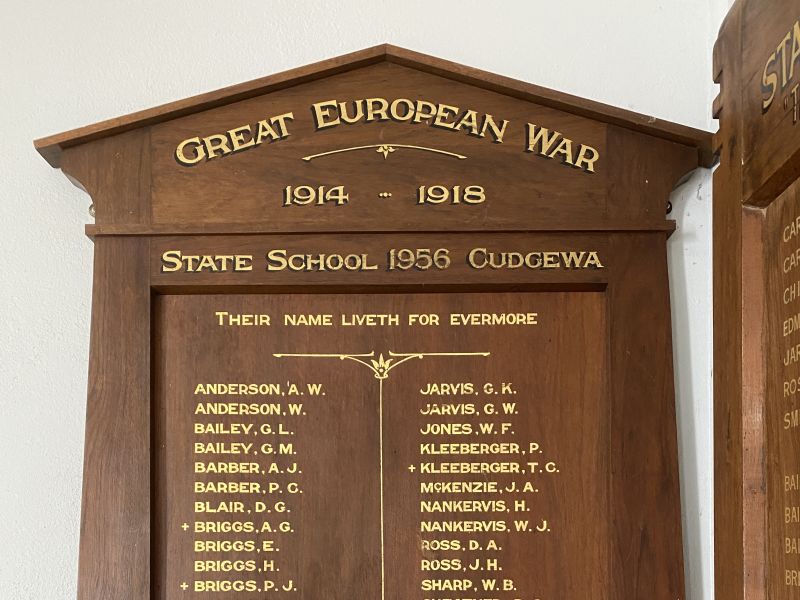
Royal (Roy) Briggs was born in 1897 at Cudgewa, Victoria. He was the third of nine children to Thomas Ewing and Frances Ann (nee Bennetts) Briggs of Corryong. By 1930, four of Roy’s siblings had died; Bessie in 1899, Thomas in 1901, Allan in 1925 and Ivy in 1929. His brother Walter would die as a Prisoner of War of the Japanese on the Burma -Thailand Railway during the Second World War. Strangely enough, Roy would also become a POW but of the Germans in the First World War.
Roy was working as a station hand near Cootamundra when he enlisted on February 23 1916. He gave his next of kin as his father, who was at the time living in Corowa, NSW. Being under the age of 21, he needed his parents' written consent to enlist, which they duly gave. He was allocated the Regimental Number 5980 and placed in the reinforcements for 4th Infantry Battalion.
He embarked on HMAT A18 Wiltshire at Sydney on August 22 1916, and arrived at Plymouth, England, in early October. He was assigned to the 1st Training Battalion and underwent further training in trench warfare. On December 13, he embarked on the SS Arundel at Folkstone and made the short trip across the English Channel to France. Five days before his first Christmas away from Australia, he was taken on strength with the 4th Battalion.
In the Spring of 1917, the Germans executed a strategic withdrawal to the Hindenburg Line. On April 9 1917, the 4th Battalion was involved in an offensive that pursued the German troops. They successfully captured the villages of Boursies, Demicourt and Hermies. At the end of this action, Roy and a number of other Australian troops were missing. In July, a witness, G.M. Hogg (6016) of D Company, 4th Battalion, gave a statement to the Red Cross Missing Persons unit.
“Re these eight men. On 16th April 1917, I saw them cut off and surrounded by the enemy to the right of Bapaume at a village called Hermies. From the attack of April 15th 1917 I saw them taken prisoners and marched off on the date at the place referred to. I saw them clearly and recognised them all. There were 13 in all but the other five are not on the list. As far as I could judge none of these eight men had been wounded when taken away. Our Artillery set up a heavy bombardment all the time they were marching off. I was wounded the same day and sent to Hospital.”
It wasn’t until January 1918 that Roy’s sister Ruby received official confirmation that he was now reported as being a Prisoner of War, captured on April 15 1917, at Demicourt and that he was interned at Gefangenenlager, Dulmen, Germany. The late notification may have been due to the first notice being sent to his father in late September 1917 at John Street, Corowa, but it had been returned unclaimed.
Reports from POW’s indicate that Dulmen POW Camp was one of the better camps, being relatively organised and airy.
A copy of a letter written by Stephen Strong to his father appeared in the April 4 1918, edition of the Argus. Stephen was captured alongside Ernest Briggs (unclear whether a relation of Roy) on November 14 1917 and sent to Dulmen
“PRISONERS IN GERMANY
Mr Henry Strong of 131 Mark street, Moonee Ponds, has received a long letter from his son, Stephen Strong, of the Salvage Corps, who has been a prisoner of War at Dulmen, in Germany, since November last. Amongst other things he says:- “We are permitted one post-card a week and one letter a fortnight. This is the third letter and the fifth post-card I have written. The Red Cross people look after us very well. Each man receives a parcel every 10 days, containing 2lb. of biscuits, three tins of meat, two of cheese. 1/4lb. Of tea, one tin of cocoa, three tins of milk, and half a pound of dripping. When we arrived here word was sent on to the Red Cross of the size of boots and clothing, new uniform, safety razor, &c. The uniform is heavy blue serge tunic, long trousers and blue military cap, and chaps who have recieved them look very smart. After this, instead of one parcel in ten days, each man gets three a fortnight, and three loaves of bread a week. These parcels contain all sorts of things imaginable, cake, pudding, tobacco, and cigarettes. Every week we have a variety show, admission 10 pfenning (one penny), and we have a splendid theatre, a full orchestra, and plenty of first-class artists, including a large number of professionals. I do believe there is a picture show, but I have not been to it.”
Roy was repatriated in early December 1918, and arrived back in England on December 7. He was granted leave in mid-January 1919. On February 15 1919, he married Ann Collis O’Brien. Ann lived with her parents, William and Catherine O’Brien, at 21 Fisher’s Alley at Point Pleasant, Wandsworth, with her three other siblings. It’s not known how the couple met or what William and Catherine thought of their 20-year-old daughter marrying an Australian and moving back to Australia with him. In March and April 1919, he was charged with four counts of being absent without leave, resulting in him forfeiting a total of 20 days' pay and undergoing 14 days of Field Punishment No. 2.
Roy and Ann embarked on HMAT A64Demosthenes on July 26 1919. For his service during the war, he was awarded the British War Medal and the Victory Medal. Roy was discharged on October 29 1919.
In the April 28 issue of the Victorian Police Gazette, a warrant for Roy’s arrest was issued.
“MALVERN - 26.4.21 - Briggs, Royal, is charged, on warrant, with deserting his wife, Ann Collis Briggs, 182 Glenferrie road, Malvern, at Malvern. Description:- A returned soldier, late 5980, 4th Battalion, A.I.F., 23 years, 5ft, 6½ in., dark complexion and hair, brown eyes, slim build, tattooed on both forearms, flag on left, and a woman on right arm; dressed in a dark-grey suit, and a grey cap, or brown hat, black boots. May be at 24 Park-street, Malvern. Previously followed the occupation of an electric tram conductor. - O.6151. 26th April, 1921.”
Ann had been in Australia for less than two years. By the end of 1921, both of her parents had died. It is not known what became of Ann.
Correspondence in Roy’s Service Records indicates that in 1923 he was living and working at Warwillah Station, Booroorban, 70 kilometres south of Hay, NSW. By 1941, he had moved to 394 Cardigan Street in Carlton, Victoria. Other records indicate that Roy married Elizabeth Mary Thorogood in Victoria in 1962. Between 1963 and 1969 the couple lived in Armadale. Roy died suddenly at his home in Prahran, Victoria on August 17 1969 and was buried in the Springvale Botanical Cemetery. Mary passed away in 1979.