Thomas Ward
 Stephen Learmonth
Thomas and his twin brother William Robert were born in 1893 in Benalla, Victoria, to William Ward and Esther, nee Hurst. Thomas and his twin, Robert, had two sisters and a brother.
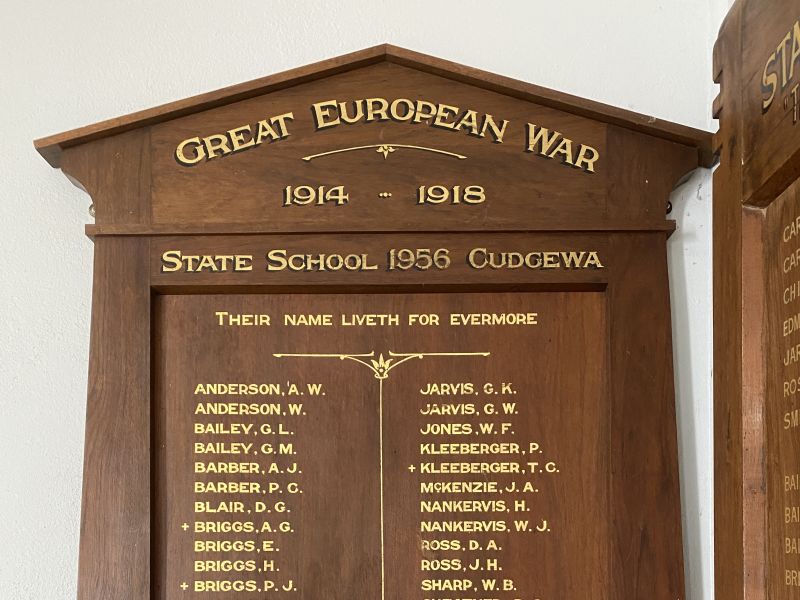
When Thomas enlisted in the 16th Reinforcements of the 4th Light Horse on 3 February 1916, at Melbourne, Victoria, he was a single, 24-year-old labourer, living in Cudgewa, Victoria. His next of kin was his mother, and her address was also Cudgewa, Victoria. Like many men of Thomas’ age, he had experience with weapons through his six-year membership in the Upper Murray Rifle Club.
His height at enlistment was 5 feet 6 inches (164 cm), while his weight was 120 lbs (54.4 kg). His chest measurement was given as 31 inches (79 cm) to 33 inches (84 cm). Thomas’ complexion was fresh, his eyes brown, and his hair brown. His religious denomination was the Church of England. His records note two distinctive marks: his vaccination mark and a mole on his back. He was allocated the Regimental Number 2393.
Thomas embarked from Australia on board HMAT A53 Itria on 18 April 1916, at Port Melbourne, Victoria.
On 29 May 1916, he was taken on strength with the 4th Light Horse at Telekiber, Egypt. A month later, due to the oversupply of men in the Light Horse Regiments, Thomas was taken on strength by the 1st Double Squadron of the 1st Light Horse Brigade. The role of this Double Squadron was to guard the Suez Canal from Turkish Forces. Thomas would remain in this unit until 22 November, 1916, where, after his first hospital stay, he was taken on by the 1st Light Horse Training Regiment. He would remain here until late December when he transferred to the Australian Camel Training Unit at Abbassia, Cairo. Clearly, camels were not to his liking, as in late February 1918, he was transferred back to his unit, the 4th Light Horse, based at Ferry Post on the Suez Canal.
During his three years away in Egypt, he was admitted to hospital a number of times for various ailments. An extreme case of diarrhoea would have him admitted to the No. 3 Australian General Hospital for a period of six weeks in September of 1916, while typhoid fever would put him in a critical condition in the 47th Stationary Hospital for approximately a month in August of 1918.
On 15 June 1919, Thomas embarked on the SS Essex at Kantara bound for Australia. He was finally discharged from the AIF on 2 October 1919. For his service during the war, he was awarded the British War Medal and the Victory Medal.
Not much is known of Thomas’ life upon returning to Australia. He passed away on 9 September, 1975, at Sunbury, Victoria and was buried there.