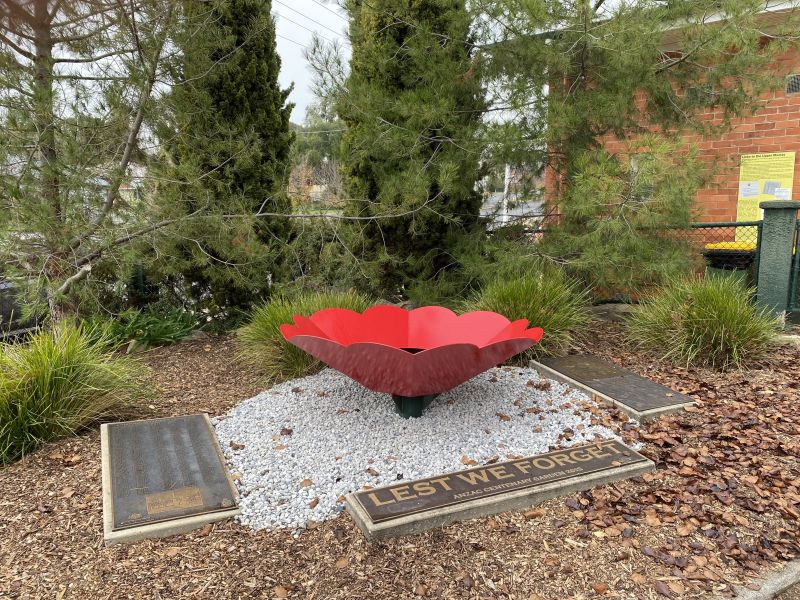
Vernon Clifford Drummond
 Stephen Learmonth
Vernon Clifford Drummond was born in 1890 in Albury, New South Wales, to Robert and Isabella, nee Waite. When Vernon was ten years old, his brother, Frank Edwin (1900 to 1962), was born in Albury.
When Vernon enlisted at Cootamundra, New South Wales, on 16 October 1915, he was a single, 25-year-old farmer living in Walwa, Victoria. His medical examination shows that he was 5 feet 8 inches tall (173 cm) and weighed 138 lbs (63 kg). His complexion was given as dark, eyes brown and hair black. He had no distinctive marks, and he gave his religious denomination as Presbyterian.
Vernon embarked on HMAT A25 Anglo Egyptian at Sydney, New South Wales, on the 12 May, 1916. The sea voyage to Egypt would take about one month, and on 16 June 1916, he disembarked at Suez. Upon arriving, he was taken on strength with the 1st Light Horse Regiment based at Tel-el-Kebir.
Unfortunately, four days after this, he was admitted to the 2nd Australian Stationary Hospital suffering from a venereal disease. He would only be in hospital for two days before being returned to duty with the 1st Light Horse Training Regiment.
On 6 August, 1916, he joined the 1st Light Horse at Romani. The Regiment had just been through a tough time fighting the Turks and, at the time, was resting at camp as well as burying their dead from their previous engagement. On the 8 August, the Regiment left Romani for Quatia, taking their turn as advanced guard for the Desert Column. The task before them was to cut off the Turks at a place called Bir el Abd. This would be the first battle that Vernon would experience, and is described in the Regiment’s War Diary.
The force moved along the caravan route to Hod el Khibba, in a night march, reaching a point north-east of Bir el Abd. On reaching the edge of the sand dunes north-east of Bir el Abd, the unit came under heavy fire, and was forced to deploy on a line running eastward into the dunes from the edge of a marsh, el Huag, lying north-east of Hod el Hisha. At 11 a.m. an attempt was made to straighten out the line - the Wellington Mounted Rifles, attached to the 2nd Light Horse Brigade, moved forward and occupied a hill south-west of Hod el Asal. The 1st Light Horse Regiment moved forward supporting this attack, one troop reaching the hill. As the enemy appeared to be making some advance across the flat to the east, two troops of the regiment were moved up to Hod el Hisha, and were heavily fired on, at which time the Wellingtons were being heavily shelled on the hill occupied by them south-west of Hod el Asal. The enemy made a general advance, and orders were received at 3.30 p.m. to withdraw to the north-west towards Hod Hamada, thence via Hod el Khibba to Oghratina, where the regiment bivouacked for the night. Lieutenant R. A. L. McDonald and two men had been killed, and Major D. W. A. Smith and 13 men wounded.
In mid September, Vernon was admitted to the 31st General Hospital at Port Said, suffering from bronchitis. Ten days later, he was transferred to Cairo and admitted to the 14th Australian General Hospital with a recurrence of a venereal disease. One week before Christmas Day, 1916, he was transferred to the hospital's Dermatological Section and declared cured of the disease. Unfortunately, he was still suffering from asthenia following his bout of gonorrhea. This had left him lethargic, and he was placed on the list to be discharged back to Australia.
In early 1917, Vernon embarked on HMAT A14 Euripides for the return home. He was finally discharged from the AIF on 4 April 1917. As a result of his overseas service, he was awarded the British War Medal and the Victory Medal.
In 1919, his father remarried, Vernon’s mother having passed away in 1914. His stepmother was Eliza Hoare (1966 to 1945).
He married Vera Jean McLachlan in 1922. They had no known children. The couple initially lived in Walwa, but by the early 1940’s they were living in Tawonga, where Vernon worked as a butcher. He died in 1956 in Yackandandah, Victoria, at the age of 66. Vera had passed away four years previously, in 1952, at Tarcutta, New South Wales.