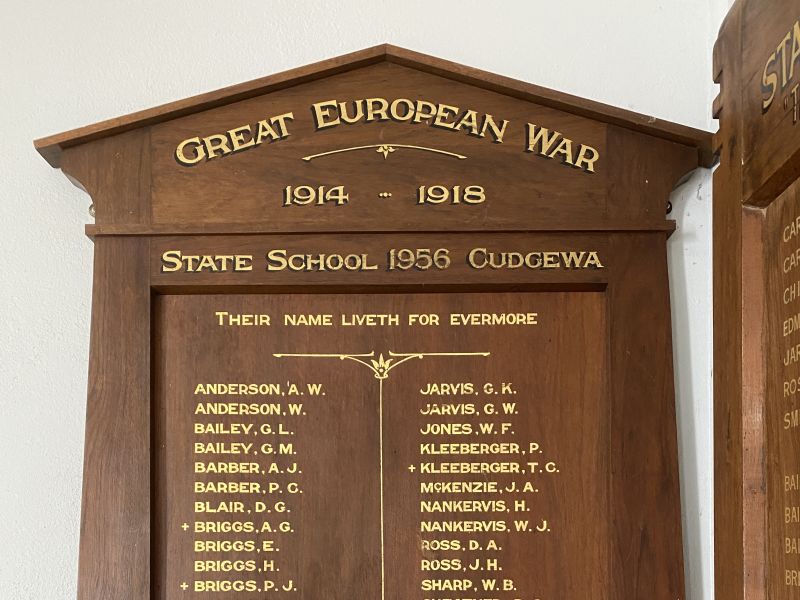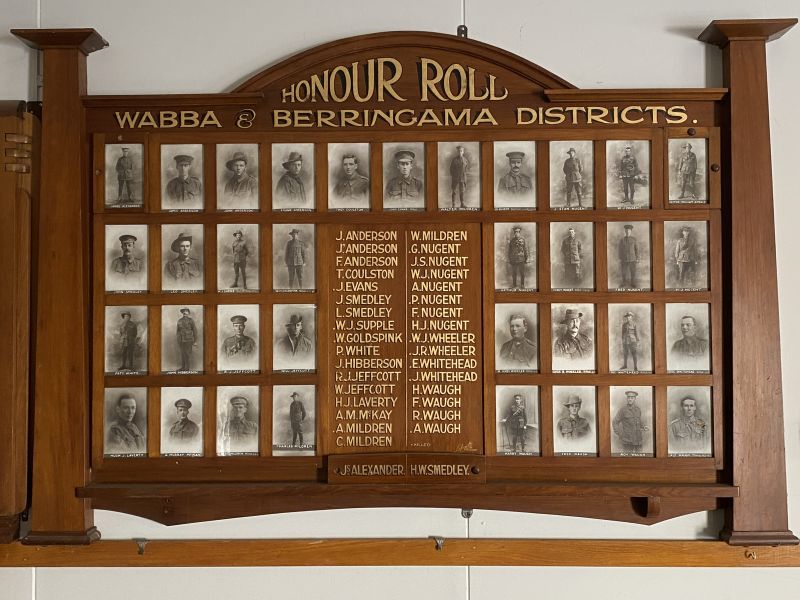
William John Anderson
 Stephen Learmonth
William John Anderson was born in 1893 in the town of Corryong, to Martha, nee Doran and William George Anderson. He would be the eldest of five children. All of his siblings attended the schools of either Cudgewa or Corryong. William attended the schools at Cudgewa, Towong and Berringama.
William enlisted on 3 September 1915 in Melbourne, Victoria. On enlistment, he was only 21 years and 10 months old and living at Towong, Victoria. He was given the Regimental Number 1532 and was put on strength with the 12th Reinforcements for the 8th Light Horse Regiment.
Upon enlistment, William had black hair and brown eyes. He weighed 11 stone 2 pounds (70.7 kg) and was 5 feet 8.5 inches (174cm) tall. His chest diameter was 36.39 inches (92.4 cm), and his distinctive marks were recorded as a mole on his back and right buttock, 4 vaccination scars and one normal scar on his left arm that he had acquired at sometime in his life. William’s religious denomination was Roman Catholic, as was that of all of his siblings and his parents.
William was placed in the 12th Reinforcements of the 8th Light Horse Regiment. He embarked on 10 November 1915 on HMAT A11 Ascanius, sailing from Sydney. The trip took him across the Great Australian Bight to Fremantle, on to Colombo, in Ceylon, before finally disembarking at Suez, at the southern end of the Suez Canal, in Egypt. The trip took about six long, hot weeks.
William wasn’t long in Egypt before he was admitted to the No 4 Auxiliary Hospital at Cairo, suffering from mumps. This condition would keep him in hospital for about a month, after which he was taken on strength with the 45th Battery of the 4th Division Artillery and remustered as a Gunner. Two months later, he embarked on a troopship at Alexandria, disembarking at Marseilles on 10 June and joining the BEF in France.
After a period of illness (bronchitis) and injury (sprained right ankle), William transferred to the 4th Australian Division Ammunition Column as a driver. On 27 October 1917, he received a shell wound to the right hand and right knee. He was initially transferred to the 3rd Australian Field Ambulance and then evacuated to England, where he was admitted to the Royal Herbert Hospital at Woolwich. With recovering from his wound and being ill due to other causes, William would not rejoin his unit until mid-May of 1918.
On 4 March 1919, he returned to Australia, embarking on the HMHS China and arriving back on 6 June. He was discharged 18 days later. William received the 1914-15 Star, the British War Medal, and the Victory Medal.
After the war, William married Mary Mann. They had four children during his marriage. He passed away on May 25, 1968, in Sydney, NSW, at the age of 75. He was buried in Randwick General Cemetery, Randwick, NSW.