William Robert Ward
 Stephen Learmonth
William Robert Ward was born in Albury in 1893 to William and Esther (Ethel) (Nee Hurst) Ward. His father, William senior, passed away, the result of blood poisoning, on May 20 1907. This left Esther with a young family, William junior being the eldest at 14. The year after her husband's death, Ethel applied for a residence area on a water reserve at Cudgewa. The April 2 1908 issue of the Corryong Courier reported on her plight.
“Mrs Ward stated that she was a widow with five young children, the eldest 16 years of age. Three were dependent on her. Had been living on the two acres applied for about six years ago under a miners right. Had a three-roomed house on it. Had never selected and owned no land. Her husband had owned no land, as far as she knew. All the improvements on the block belonged to her. [On behalf of this application Mr A.C. Weber, secretary of the Ward Relief Committee, stated that Ward died in May last and left Mrs Ward and children in poor circumstances. A fund of £40 had been subscribed for her assistance, and the intention was to utilise it in making a permanent home for Mrs Ward. Application had been made for the land, and the Shire Council had recommended the alienation of two acres at the north end of the reserve. Mrs Ward was now living at the south end, but the house could easily be shifted, and the committee would be satisfied with the northern end if it would save friction.]” Ethel was successful in her application.
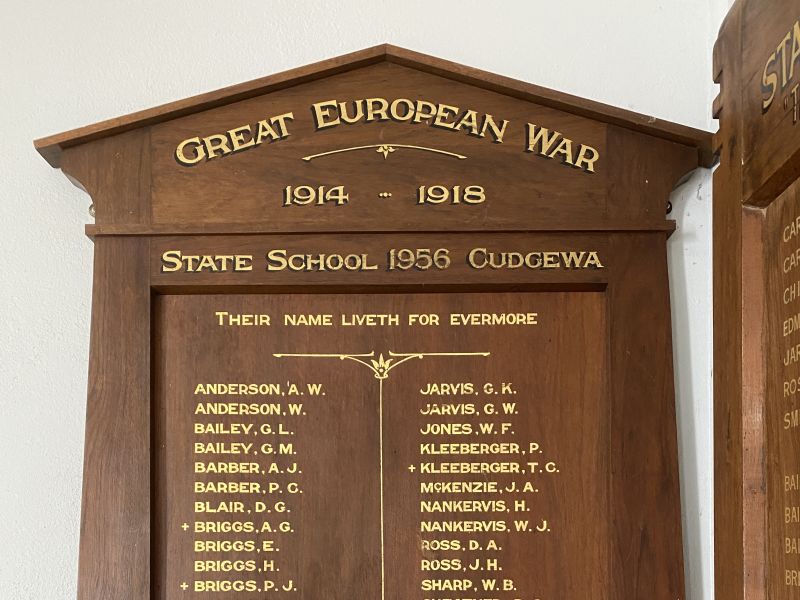
He enlisted on September 1 1915, in Melbourne, Victoria. At the time, he was a single 23-year-old labourer living and working in Cudgewa, Victoria. He was allocated the Service Number 1444 and placed in the 1st Reinforcements for the 29th Battalion as a Private. Like many young men around Australia, he had joined the local rifle club, where he had practised musketery skills. William spent one month training with the 22nd Depot Battalion at Royal Park before being transferred to the 4th Depot Battalion at Seymour.
In early November 1915, he embarked on HMAT A11 Ascanius at Melbourne and arrived at Suez on December 7. He was taken on strength with the 29th Battalion at Tel-el-Kebir on March 3 1916. William spent a few days with the 15th Field Ambulance at Ferry Post, although the reason is not declared on his Service Records. In mid-June 1916, He embarked on the SS Tunisian and headed for the Western Front. After one week on the ship, he disembarked at Marseilles.
On January 5 1917, he was charged with appearing on parade with a dirty rifle. He was docked two days' pay. William was wth the battalion when it played a major role at Polygon Wood in 1917 and participated in the attack at Morlancourt in late July 1918. Finally, he would take part in the battalion’s last major action of the war in September when the 3rd and 5th Australian Divisions, and two American divisions attacked the Hindenberg Line across the top of the 6 kilometre St Quentin Canal.
In October 1918, just prior to the battalion being disbanded, William found himself spending time in a variety of medical institutions suffering from gastritis. It was severe enough to warrant his evacuation to hospital in England. While posted at the Overseas Training Battalion, William was transferred to the reinforcements of the 58th Battalion before being sent back to France. On October 14 1918, he was sent to the Machine Gun Training Depot at Parkhouse Camp in Wiltshire.
William boarded the HT Orga on February 19 1919, and sailed home to Australia. He was discharged on May 30 1919, and was awarded the 1914/15 Star, the British War Medal and the Victory Medal for his service during the war.
Upon returning to Australia, newspaper records indicate that William and his family operated a bakery in Cudgewa. The September 18 1919 issue of the Corryong Courier includes the statement “William R. Ward, Cudgewa, made a similar application [for a registration of a business] in regard to their bakery premises. - Recommended.” There were also advertisements in the Courier for “William Ward (Late AIF) Baker, Cudgewa, Delivers Bread to Corryong three days per week.”
Electoral rolls indicate that William lived in Albury between 1931 and 1933. He married Grace Parish in 1942. From 1942 to at least 1980 they lived at 42 Tennyson Street, Malvern East, Victoria, and William had gained employment as a stableman. Grace passed away on September 27 1977, while William lived to age 100 and died on December 17 1993. Both Grace and William were cremated, and their ashes collected by family.