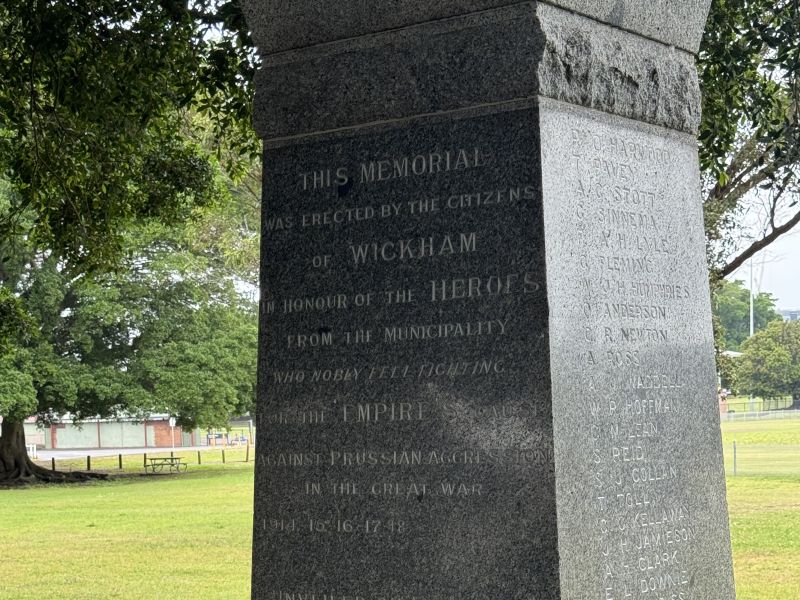
Private Thorold Toll, 4th Australian Machine Gun Company
 Australian War Memorial
Thorold Toll was born in the Newcastle suburb of Wickham, New South Wales on 24 April 1894. He was the eldest of seven children born to Albert and Hannah Toll, though only five survived beyond early childhood.
The family remained in Wickham throughout Thorold’s childhood. He attended Wickham Superior Public School and later a local technical college, before beginning to work as a manager at his father’s carrying firm. The company would later become Toll Carrying Company.
As a child, Toll suffered an ancient that left his right hand permanently injured. Although he only had use of his thumb and one finger on his right hand, he was an accomplished sportsman. As well as excelling as a cyclist and runner, he was an active member of the Newcastle Surf Club and Live Saving Brigade.
Toll attempted to enlist in the Australian Imperial Force in Newcastle in early 1915, but was rejected due to his injured hand. Undeterred, he travelled by train to Sydney, where he enlisted on 21 June 1915. He managed to hide the injury to his hand from the examining medical officer, and his application was accepted without comment.
Toll was allotted to the 8th reinforcements of the 13th Battalion, and began training at Liverpool Camp. Less than two months later, on 9 August 1915, Private Thorold Toll departed Sydney in the troopship Runic, bound for Egypt.
From Egypt, Thorold travelled to the Greek Island of Mudros, where he joined the rest of the battalion in late October. By November, the battalion had returned to Gallipoli, where it was involved in defending Durrant’s Post.
As the Australian forces prepared to leave the Gallipoli peninsula in mid-December, Thorold was evacuated early due to illness. He was admitted to hospital on Mudros with influenza on 14 December, and spent the next week recovering.
Thorold rejoined his unit on Lemnos on Christmas Eve 1915, and by January was back in camp in Egypt. On 17 January 1916, he was promoted to driver within the battalion’s machine-gun section, and was allocated transport duties.
With the reorganisation of the Australian Imperial Force in early 1916, the battalions’ machine-gun sections were consolidated into companies to support each brigade. A company had 16 Vickers .303 calibre, water-cooled heavy machine guns, each with a crew of three men. Thorold was appointed to the 4th Australian Machine Gun Company on 9 March 1916, and began preparing to move the company’s guns to the Western Front.
The company left Egypt on 1 June 1916, and arrived in France nine days later. Machine-guns were central to the trench warfare of the Western Front, and throughout the rest of 1916 the company was involved in the 4th Brigade’s fighting on the front line around Armentieres and into the Somme Valley.
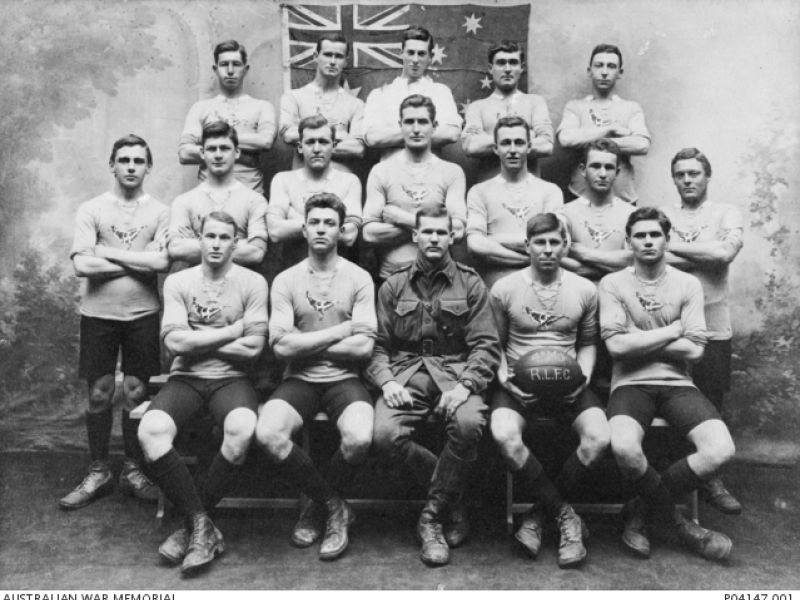
Soon after arriving in France, Thorold reverted to the rank of private at his own request, and joined one of the machine-gun teams in the company. At some stage in 1916, Thorold shot down a German aeroplane with his machine-gun, an act that won him respect amongst the men of the company. He was also a proud member of the company’s rugby league team, the Mudlarks, which played whenever the men were away from the front line.
Writing home in the autumn of 1916, Thorold confided: “I have gone through several of the most horrible days of my life … Our company had … 20 per cent casualties. … The shell fire is awful, and the saps very shallow and filled with dead. People at home have not the faintest idea of what war is.”
After a relatively quiet winter, the German retreat to the Hindenburg Line in the spring of 1917 saw the machine-gun company and the rest of the 4th Brigade once again involved in heavy fighting. On 11 April 1917, it was involved in the disastrous First Battle of Bullecourt. The company’s unit diary reported, “Out of 5 officers, 110 men and 16 guns … only 1 officer, 15 men and 2 guns returned to our lines.”
Thorold was one of the men declared missing in action. He was captured at Bullecourt, and transferred to work behind the German lines.
On 1 May, Thorold and seven other prisoners were working on an ammunition dump at Corbieham when the area was shelled by the allies. All eight of the men, including Private Thorold Toll, were killed during the bombardment.
Thorold Toll was 23 years old.
All eight men were buried in a communal grave at the Corbieham Communal Cemetery. No cross was erected over their graves, and none of the other prisoners of war were allowed to attend the funeral.
After the war, the Imperial War Graves Commission erected eight headstones over the final resting place of the eight men. Thorold’s headstone bears the inscription selected by his grieving family back in Australia:
“He was ever loving, faithful and true”.
Image caption - Thorold Toll Middle row 4th from left.
AWM collection P04147.001 Studio portrait of the rugby league team known as the 'Mudlarks'. The Mudlarks was made up of members of the 4th Machine Gun Company.
- AWM Roll of Honour https://www.awm.gov.au/collection/R1671246
- AWM collection image https://www.awm.gov.au/collection/C1021065