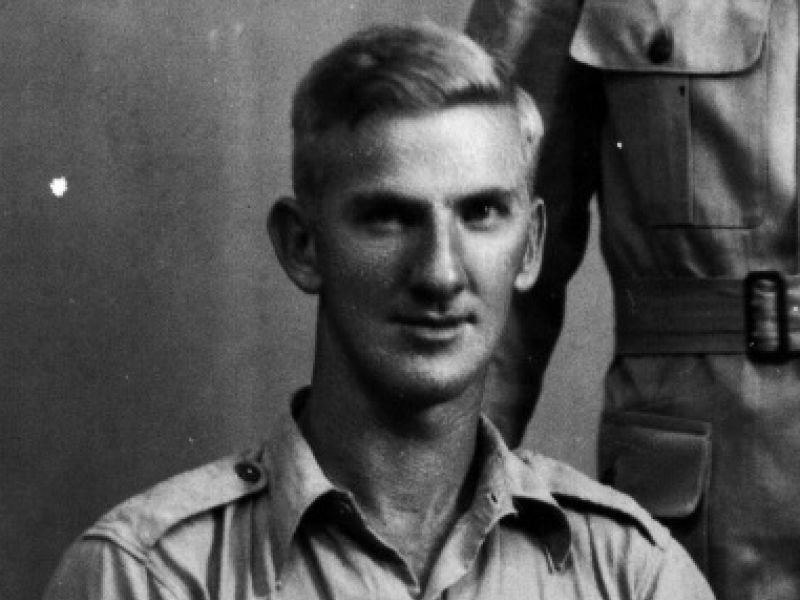
Sergeant John Cumberbach Norbury, 2/10th Field Regiment
 Australian War Memorial
John Norbury and his twin, Ralph, were born on 22 December 1914 in Atherton, Queensland, to Frederick and Grace Norbury.
They grew up in a family of four brothers and three daughters. John went on to work as a clerk for the Brisbane City Electric Light Company while his twin, Ralph, was a midshipman at the Australian Naval College for four years. Having learnt to fly and obtained a civil aviation licence, Ralph enlisted in the Royal Australian Air Force, but was killed in an air accident at Point Cook on 6 December 1939.
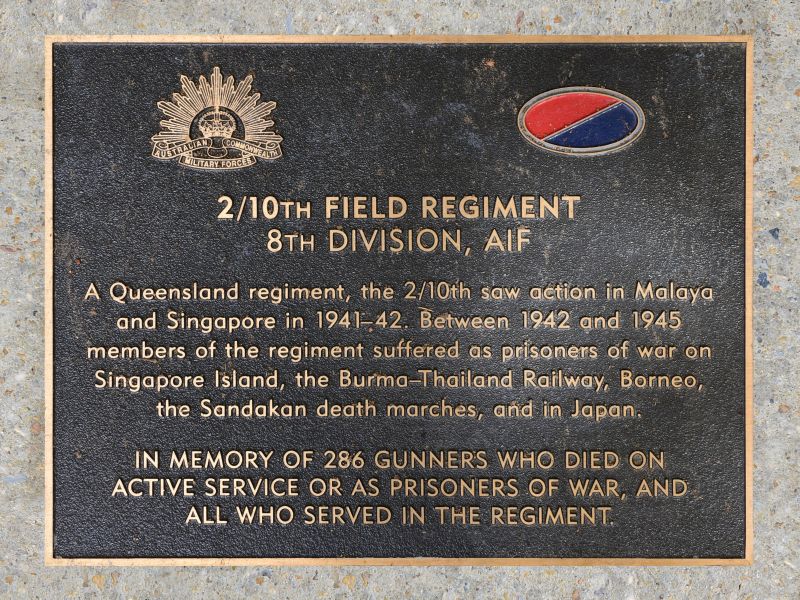
After grieving the loss of his twin brother, John Norbury enlisted in the Second Australian Imperial Force on 24 July 1940. He was allotted to the newly formed 2/10th Field Regiment, one of the 8th Division's three artillery regiments.
From October to December they conducted field manoeuvres and trained with 18-pounder guns from the First World War. A high point of their training was a nine-day field manoeuvre through the Brisbane Valley, with live firing from Caloundra range. The 2/10th was given leave in January 1941, and on the second of February they arrived at Circular Quay in Sydney to board Queen Mary, which had been converted from a passenger ship to a troopship.
Queen Mary was a part of a convoy taking troops of the 8th Division to Malaya and Singapore. The convoy reached Malaya on 19 February, disembarking the 2/10th at Malacca, in Johore. The regiment took up residence in the Malacca High School and the school at Tranquerah. While in Malacca the regiment was attached to the 8th Division's 22nd Brigade. The men trained and carried out manoeuvres at Mersing, where they were located when Japan entered the Second World War, beginning with the invasion of Malaya.
By this time, Norbury had already demonstrated his talent for leadership, having been promoted to sergeant on 27 August 1941.
In early January 1942, while still at Mersing, the regiment was re-equipped with 25-pounders, replacing the old 18-pounders. Four days later, its position was bombed and strafed for the first time by Japanese aircraft. Japanese troops advanced through Malaya quickly, and by January they had entered Johore. Norbury and his regiment first went into action on 21 January, when they fired on Japanese troops along the Mersing–Endau Road, north of Lalang Hill. The Japanese force had cut off a platoon from the 2/20th Battalion but the 2/10th regiment’s fire allowed the platoon to escape.
The gunners of the 2/10th were in action from then on, firing on targets in the Mayang Estate and Lalang Hill. During the night of 26 January it provided artillery support for the 22nd Brigade's successful ambush in the Nithsdale Estate. After the Nithsdale battle, the brigade withdrew to Singapore Island, which took several days, moving one gun at a time under enemy air attack. The last of the regiment's troops crossed the causeway to Singapore just after 9 pm on 30 January. The causeway was demolished the next morning.
For the coming battle, the 2/10th Field Regiment was located in the north-west of the island.
The main Japanese assault on Singapore began on 8 February. Crossing the Johore Strait in barges, the Japanese had broken through by midday the next day. There had been continual heavy fighting and although the regiment had been shelled and bombarded with air attack, it fired up to 800 shells, and sank 30 sampans carrying Japanese troops. With the Japanese advancing, on 10 February the men were withdrawn to Singapore Harbour.
Commonwealth troops withdrew to the city, around which they formed a defensive perimeter. Troops were withdrawn from Changi and the eastern beaches. What was left of the 8th Division was concentrated around Tanglin Barracks. The 2/10th gunners remained in action, firing 2,100 rounds on Bukit Timah village. The next day they moved to the Tanglin golf course, where they came under enemy artillery fire and air strikes. The regiment ceased firing at 10.30 pm on 14 February, and the next day the garrison surrendered.
Initially imprisoned in the sprawling Changi prisoner of war camp, before long members of the 2/10th Field Regiment were allocated to external work parties.
Norbury was one of the 3,000 prisoners who were part of A Force, the first Australian group to leave Singapore for Burma. After sailing in the Celebes Maru on 15 May, a third of A Force disembarked at Victoria Point in the far south of Burma. Another third were sent to Mergui and the remainder to Tavoy, all tasked with building air fields.
At first the conditions for prisoners were adequate, if basic. Japanese control was fairly lax and the men established a relatively good working relationship with the Japanese.
With the airfields completed, A Force went by ship to Thanbyuzayat to work on the Burma–Thailand Railway in September. Now known for enduring the cruel treatment of prisoners of war held by the Japanese, those working on the railway found themselves at the bottom of a social system that was harsh, punitive, fanatical, and often deadly; maltreatment, sickness, and starvation were rife.
John Norbury, however, would be spared the sufferings of his comrades. He died on 9 June 1942, before A Force moved to work on the railway. Initially buried near where he fell, his remains were later reburied in Thanbyuzayat War Cemetery, where they lie today, among more than 3,000 Commonwealth burials of the Second World War.
The Norbury family suffered more than most during the war, having already lost John’s twin brother, Ralph, to an aircraft accident. Another brother, Frederick, joined the AIF and served in England, the Middle East and Australia before dying of heart attack on 1 March 1945.
- AWM Roll of Honour https://www.awm.gov.au/collection/R1682460
- Find a grave https://www.findagrave.com/memorial/56175744/john-cumberbach-norbury